Recent Issues I Newsletters I Petfood Forum I Subscribe to Magazine
  Sign In I  Sign Up
PetfoodIndustry.com

  • HOME
  • MARKET INFORMATION
  • NUTRITION
  • SAFETY
  • PRODUCTION
  • PACKAGING
  • TOP PETFOOD COMPANIES
  • News
  • Products
  • Petfood and Treats
  • Petfood-Connection.com
  • Industry Calendar
  • Buyer's Guide

  • Article
      • Email this to a friend Email
      • Print Printer
        Friendly
      • Font size: Decrease Font Increase Font
      • Share:Share
      • Share:Share Close
        • FacebookFacebook
        • MySpaceMySpace
        • stumbleuponstumbleupon
        • deliciousdelicious
        • diggdigg
        • newsvinenewsvine
        • linkedinlinkedin

      Textured vegetable protein: all about appearance

      It makes for a great visual effect in canned foods

      BY Greg Aldrich, PhD Release Date: Comments(0)
      0809PETingred3_opt.jpg

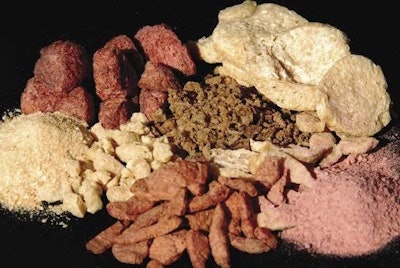
      A TVP "meat piece" does a better job of distinguishing itself as a "meat chunk" than an actual chunk of chopped or reformed meat.

      Textured vegetable protein (TVP), the meat extender we loved to ridicule in our school lunches, may be more prevalent in petfood than many realize. It isn't being used to stretch the meat budget or even to supplement meat protein. Instead, the most common application for TVP in petfoods is cosmetic. It makes for a great visual effect in canned foods, making them look more like real meat.


      It's not a cost-cutting matter. As it turns out, in a wet petfood application, a TVP "meat piece" does a better job of distinguishing itself as a "meat chunk" than an actual chunk of chopped or reformed meat. The reason for this is because TVP retains its shape, coloration and distinct outline during retort. So, one can discern with just a glance that there is a real difference between this virtual meat chunk and its surroundings. It is especially true for the chunk in loaf product formats in which a meat piece is embedded in a meatloaf or paté.

      Appearance matters 

      So, it appears that petfood isn't solely about nutrition. It does have its shallower side in which appearance matters. While this might give purists indigestion, the application of TVP chicken-analog pieces in a loaf product or beef-analog pieces in a lighter colored chicken based meatloaf is pretty popular in the canned dog food market. The technology is also deployed in numerous overseas markets without shame.

      While it may be assumed that wet petfoods are predominantly meat based and this infiltration of vegetable proteins into these products might seem like heresy, their popularity would indicate that it is an effective method to deliver the visual experience desired by the pet owner. So, if TVP is so common, then what is it and how well does it perform with our pets?

      What it is 

      According to the AAFCO Official Publication (2008): "Textured Soy Protein Product is made from defatted soy flour mixed with water and/or steam, extruded and then dried."

      While the products on the market are predominantly soy flour, depending on the application, cost, availability and desired appearance of the piece, other proteins might also be included. Examples include small quantities of wheat gluten or more commonly flour from other edible beans (e.g., lima, pinto or navy). Thus, it is most often known and marketed as the broader "vegetable" protein, rather than exclusively as soy protein.

      TVP came about during the 1960s as research to develop meat analogs met up with the expanding application of extrusion technology. In general, defatted soybean flour (soybean meal that has been ground really fine) is combined with processing aids (calcium chloride, sodium carbonate, sulfur) and colors (caramel color, FD&C red #3, etc.) in the preconditioning cylinder prior to extrusion.

      TVP retains its shape, coloration and distinct outline during retort.

      Extrusion and drying 

      For the production of TVP, extruders are commonly high-temperature, short-time single screw machines very similar to those used in the production of extruded petfoods. The actual development of texture occurs at the end of the extruder screw and during exit from the die as cellular proteins reorient or realign themselves into strands or fibers (Harper, 1978). These newly formed fibers are created when denatured protein molecules rupture and form new intermolecular peptide bonds that then aggregate into fibrous subunits.

      After conveyance away from the extruder, the pieces are dried to a moisture level of 6% to 8%. In the dried form, TVP is stable, with most suppliers claiming a shelf life of one to two years. The dry product is easy to handle and in canned formulas may be added at 1% to 15% depending upon the visual appearance desired.

      The dry pieces rehydrate readily and will absorb two to three parts water per unit weight. After rehydration, the TVP piece is perishable and should be handled in a manner similar to that of meat. Thus, rehydrated pieces should be processed immediately or stored under refrigeration.

      Performance with our pets 

      Since the starting material for TVP is soy flour (also known as finely ground soybean meal), the nutrient composition should not be expected to differ substantially. TVP is sold at a crude protein of 50% or more. It contains approximately 1% fat, 3 to 6% ash and 3.5 to 5% crude fiber (about 15% total dietary fiber).

      In a recent scan through the literature, no data reporting intake or palatability issues were found related to TVP. It is generally assumed the flavor and aroma of TVP is bland, and it will take on the sensory attributes of surrounding ingredients.

      As for dietary effects in pets, several research studies have been published. Each study utilized the same experimental diets in which dogs were fed canned foods that replaced beef with TVP at levels of 14, 29 and 57%. No health or nutritional anomalies were noted from these studies. However, relative to beef, dogs fed the TVP-containing diets had slightly lower nutrient digestibility, their stool volume increased and the stools were softer and more fluid (Hill et al ., 2000; Hill et al ., 2001).

      It was also noted that insulin secretion in the first few hours following a meal was decreased for dogs fed the TVP diets (Hill et al ., 2006). This is most likely due to the oligosaccharide content of TVP and, if managed properly, could be a dietary tool in treating diabetes.

      Proving itself 

      TVP is a convenient, stable and effective means for achieving the appearance of meat pieces in wet dog and cat foods. At inclusion levels well beyond those commonly used in petfood, TVP has been shown to be safe, though a negative for stool consistency. Palatability or animal acceptability has not been identified as an issue, and at typical dietary levels TVP has minimal impact on digestion or stool consistency. So, while TVP may have an image issue with its name, it has proven itself in the categories of appearance and utility.


      Dr. Greg Aldrich is president of Pet Food & Ingredient Technology, Inc.
      Updated: Nov 08, 2010 This article appeared in Petfood Industry, September 2008. ©Copyright 2013, All Rights Reserved.


      1
      1
      1

      Related Content

      Previous
      Next
      • cat nutrition

      • dog nutrition

      • functional pet food

      • pet food ingredients

      • pet nutrition

      Peas in petfood

      The lowly pea appears to be an effective ingredient for the next generation of dog and cat diets

      Carrageenan: for appearance's sake only?

      What is this quiet, unassuming ingredient, and should it be there?

      Pulses: new ingredients for petfoods?

      With the availability of quality ingredients declining, perhaps we need to explore this category

      More content about cat nutrition

      Functional fiber with color

      Tomato pomace has the potential to provide additional nutrition and health benefits

      Call to action 2010

      5 small steps would streamline information on petfood ingredients to help communicate with pet owners

      Peas in petfood

      The lowly pea appears to be an effective ingredient for the next generation of dog and cat diets

      More content about dog nutrition

      Carrageenan: for appearance's sake only?

      What is this quiet, unassuming ingredient, and should it be there?

      Call to action 2010

      5 small steps would streamline information on petfood ingredients to help communicate with pet owners

      Functional fiber with color

      Tomato pomace has the potential to provide additional nutrition and health benefits

      More content about functional pet food

      Broth: connecting food with feelings

      It's the finishing touch that can meet both owner and pet needs.

      Carrageenan: for appearance's sake only?

      What is this quiet, unassuming ingredient, and should it be there?

      Are chelated minerals worth it?

      The question is whether they provide additional benefit to the dog or cat

      More content about pet food ingredients

      Are chelated minerals worth it?

      The question is whether they provide additional benefit to the dog or cat

      Carrageenan: for appearance's sake only?

      What is this quiet, unassuming ingredient, and should it be there?

      Broth: connecting food with feelings

      It's the finishing touch that can meet both owner and pet needs.

      More content about pet nutrition
       

      Comments

      0 Comments

      Add Comment

      Text Only 2000 character limit
  •  
  • Create or Maintain an account

    • Sign Up
    • Edit Your Profile
    • Subscribe to Newsletters
    • RSS feeds
    • Why Register

    Custom Publications

    • Empyreal 75 Update
    • The Extru-Technician

    Digital Editions

    • Petfood Industry
  • Events

    • Petfood Forum
    • Petfood Workshop
    • Petfood Forum China
    • Petfood Forum Asia
    • Petfood Forum Europe
    • Webinars
  • Help and Information Center

    • Support
    • Petfood Industry Editorial Staff
    • Advertising Contacts
    • Media Guide
    • Article Reprints

    Newsletters

    • Petfood Industry e-News
    • Petfood Industry Nutrition News

    Digital Directories

    • Petfood Industry Reference and Buyer's Guide
  • Social Media

    • Petfood-Connection
    • Petfood-Connection Smart Phone App
    • Twitter
    • Facebook
    • YouTube

    Nutrition Courses

    • WATT eLearning
    • Customized Training

    WATT Corporate

    • About WATT
    • Corporate Contacts
  • © Watt Publishing Co., 2013 All Rights Reserved
  • |Sitemap

--- Thank you for your patience ----

If you have any issues logging in or any other need feel free to contact us.

loading