Recent Issues I Newsletters I Petfood Forum I Subscribe to Magazine
  Sign In I  Sign Up
PetfoodIndustry.com

  • HOME
  • MARKET INFORMATION
  • NUTRITION
  • SAFETY
  • PRODUCTION
  • PACKAGING
  • TOP PETFOOD COMPANIES
  • News
  • Products
  • Petfood and Treats
  • Petfood-Connection.com
  • Industry Calendar
  • Buyer's Guide

  • Article
      • Email this to a friend Email
      • Print Printer
        Friendly
      • Font size: Decrease Font Increase Font
      • Share:Share
      • Share:Share Close
        • FacebookFacebook
        • MySpaceMySpace
        • stumbleuponstumbleupon
        • deliciousdelicious
        • diggdigg
        • newsvinenewsvine
        • linkedinlinkedin

      FDA to communicate more clearly?

      Under the Plain Writing Act of 2010, US agencies such as the Food and Drug Administration will have to use plain English in their communications

      By David A. Dzanis, DVM, PhD, DACVN Release Date: Comments(0)
      1111PETinsight1

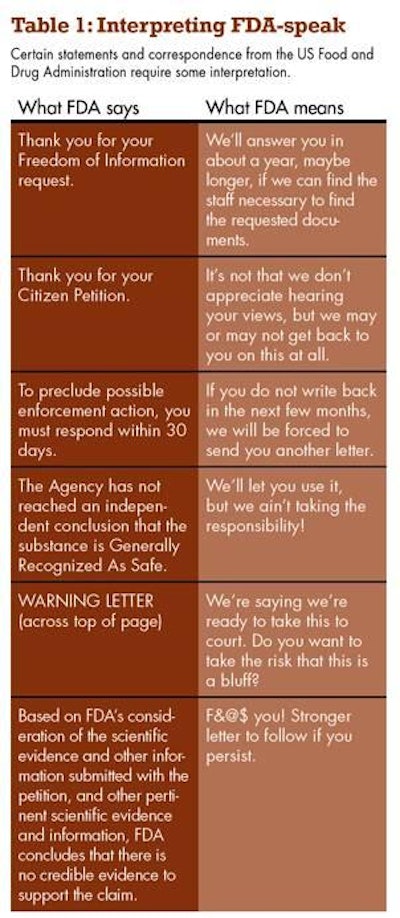
      Certain statements and correspondence from the US Food and Drug Administration require some interpretation.

      While many petfood companies have been preoccupied with concern about the ramifications of the Food and Drug Administration Amendments Act and the Food Safety Modernization Act on their businesses, another piece of legislation appears to have gone largely unnoticed.

      Briefly put, the new law says that whereas the lexicon utilized in extra-office correspondence and other communications as authored by employees (be they civil servants or contractors) and others affiliated with the Executive Branch are perceived as not fully effective in transmittal of intended information to the non-governmental populace, pursuant to HR 946 all letters, publications, documents and other mailings (but not regulations per se), irrespective of medium or format, shall heretofore be constructed so as to use verbiage most likely to convey the full and appropriate message to a recipient of assumed average education and intellect, to be implemented and in force no later than the 13th day of October, in the year 2011.

      In other words, the US federal government is now required to write in plain English!

      The stated purpose of the Plain Writing Act of 2010 is “to improve the effectiveness and accountability of federal agencies to the public” (see “Useful links”). I’m not sure, but I think I’ve seen similar verbiage in the texts of legislation such as the Paperwork Reduction Act of 1980, the Deficit Reduction Act of 1984 and the Internal Revenue Service Restructuring and Reform Act of 1998.

      Writing plainly does not appear to be an intuitive process.

      As of the time of this writing, I do not see any indication of impending change to the Food and Drug Administration website. However, the Department of Health and Human Services (of which the FDA is a part) appears to be gearing up to comply with the new requirements.

      As evidenced by the guidance provided to agencies in implementing the act, writing plainly does not appear to be an intuitive process. Employees are being instructed to “write as you talk,” which includes writing short sentences, omitting unnecessary words, using the simplest form of the verb, minimizing abbreviations and using contractions where appropriate. The government is now “we” or “us,” the recipient “you."

      The guidance also advises writers to avoid jargon, which it sees as “unnecessarily complicated, technical language used to impress, rather than to inform, your audience.”  I’m not sure if I wholly agree. In dealing with regulatory issues, as with other specific fields, use of some jargon is much more efficient, if not necessary.

      For example, “enforcement discretion” succinctly iterates a specific concept. Alternatively, instead of “we will use enforcement discretion,” the FDA would have to say, “While the use of this substance technically does not wholly meet the provisions of the Federal Food, Drug and Cosmetic Act, based on our internal review of pertinent safety data we have concluded that it poses a minimal risk to animal/human health when used as intended, and as such we do not anticipate that we will initiate or recommend enforcement action at this time, on the conditions that labeling conforms to our requirements to provide for safe use, use of the substance does not extend beyond the agreed upon purpose or level of inclusion and no other information is received that would have us question our original determination of safety.” Which is easier to say?

      On the other hand, I have seen at least one non-governmental website interpret the term “enforcement discretion” as meaning, “Petfood companies have a license to lie!”  Thus, maybe some clarification might not be a bad idea.

      The government is now "we" or "us," the recipient "you."

      Much of my business consists of explaining to clients what a regulator means by certain statements in correspondence (see Table 1).  I laud any effort to make communications with the FDA more understandable, though I do not fear this new legislation will render my “interpretation” services wholly obsolete. The act does not apply to the writing of regulations, so do not expect much change in style from that respect. Plus, the act only affects the FDA, not state feed control official offices, so I still should have lots of work!  


      Useful links 

      Plain Writing Act of 2010 text:

      http://frwebgate.access.gpo.gov/cgi-bin/getdoc.cgi?dbname=111_cong_bills&docid=f:h946enr.txt.pdf 

      HHS implementation plan:

      www.hhs.gov/open/recordsandreports/plainwritingact/plain_writing_act_report.pdf 

      “How to” plain language writing guide for government agencies:

      www.plainlanguage.gov/howto/guidelines/FederalPLGuidelines/TOC.cfm 


      Get more 

      Find more columns by Dr. Dzanis at

      www.petfoodindustry.com/petfoodinsights.aspx.


      Dr. Dzanis is CEO of Regulatory Discretion Inc. and a writer and consultant on nutrition, labeling and regulation.
      Updated: Oct 12, 2011 This article appeared in Petfood Industry, November 2011. ©Copyright 2013, All Rights Reserved.


      1
      1
      1

      Related Content

      Previous
      Next
      • pet food labeling

      • pet food regulation

      GoodGuide: Science Diet number one in petfood brands

      1,500 products, 50 brands rated in survey

      AAFCO committee passes calorie proposal

      During the annual meeting, the Pet Food Committee approved recommendations to require calorie content statements on all dog and cat food labels

      Pet Food Industry Association of South Africa vows to eliminate petfood fraud

      Association committed to protecting South African pet owners from 'rogue petfood manufacturers'

      More content about pet food labeling

      FDA discusses petfood labeling and safety

      Public meetings invited comments and provided updates

      AAFCO holds petfood workshop

      The intent was to educate regulators and industry about the Model Pet Food Regulations

      AAFCO news, part 2

      Committees discussed key proposals such as a possible shift in the oversight of animal feeds

      More content about pet food regulation
       

      Comments

      0 Comments

      Add Comment

      Text Only 2000 character limit
  •  
  • Create or Maintain an account

    • Sign Up
    • Edit Your Profile
    • Subscribe to Newsletters
    • RSS feeds
    • Why Register

    Custom Publications

    • Empyreal 75 Update
    • The Extru-Technician

    Digital Editions

    • Petfood Industry
  • Events

    • Petfood Forum
    • Petfood Workshop
    • Petfood Forum China
    • Petfood Forum Asia
    • Petfood Forum Europe
    • Webinars
  • Help and Information Center

    • Support
    • Petfood Industry Editorial Staff
    • Advertising Contacts
    • Media Guide
    • Article Reprints

    Newsletters

    • Petfood Industry e-News
    • Petfood Industry Nutrition News

    Digital Directories

    • Petfood Industry Reference and Buyer's Guide
  • Social Media

    • Petfood-Connection
    • Petfood-Connection Smart Phone App
    • Twitter
    • Facebook
    • YouTube

    Nutrition Courses

    • WATT eLearning
    • Customized Training

    WATT Corporate

    • About WATT
    • Corporate Contacts
  • © Watt Publishing Co., 2013 All Rights Reserved
  • |Sitemap

--- Thank you for your patience ----

If you have any issues logging in or any other need feel free to contact us.

loading