Recent Issues I Newsletters I Petfood Forum I Subscribe to Magazine
Login   Sign In I  Sign Up
PetfoodIndustry.com

  • HOME
  • MARKET INFORMATION
  • NUTRITION
  • SAFETY
  • PRODUCTION
  • PACKAGING
  • News
  • Products
  • Petfood and Treats
  • Petfood-Connection.com
  • Industry Calendar
  • Buyer's Guide

  • Article
      • Email this to a friend Email
      • Print Printer
        Friendly
      • Font size: Decrease Font Increase Font
      • Share:Share
      • Share:Share Close
        • FacebookFacebook
        • MySpaceMySpace
        • stumbleuponstumbleupon
        • deliciousdelicious
        • diggdigg
        • newsvinenewsvine
        • linkedinlinkedin
        • mixxmixx

      Petfood innovation: marketing vs. regulatory

      In a competitive marketplace, products need innovative ingredients that are marketed to consumers—but in a way that complies with regulations.

      By David A. Dzanis, DVM, PhD, DACVN Release Date: Comments(0)
      1202PETformulation1

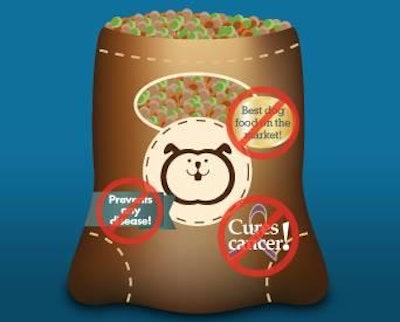
      To stand out and appeal to consumers, petfood products need to be formulated with innovative ingredients and those innovations communicated on the packaging, while still complying with accepted regulatory precepts.

      While the marketing, R&D and regulatory departments within a petfood company share a common goal—to contribute to the success of the company—the respective functions of the first two departments compared to the last often appear diametrically opposed.

      In a competitive marketplace, the need to distinguish your products from others is a major key to success. Distinctiveness often is accomplished through the development of formulations using innovative ingredients and/or novel functions for ingredients. Marketing then strives to use words and graphics to convey the benefits of those innovations in a manner that maximizes consumer appeal of the product.

      The purpose of regulatory affairs, on the other hand, is to ensure that product formulations, as well as those words and graphics that accompany the products, comply with acceptable regulatory precepts. This function is often viewed by marketing people as needless hindrance of the message they deem essential to sell more product. Semi-joking disparagements such as referring to regulatory affairs as the “Department of Sales Prevention” are not uncommon.

      Referring to regulatory affairs as the “Department of Sales Prevention” is not uncommon.

      From the regulatory perspective, even the best new ingredient or claim is worthless if it results in a denial of state registration or another enforcement action. Just because a rule seems unnecessarily restrictive—if not downright silly—that does not mean it can be ignored.

      What regulatory people often do not fully grasp is the need for marketing to have some creative license to keep ahead of (or at least keep up with) the competition. If left to regulatory personnel alone, the product likely would be sold in a boring, graphic-free bag with just the mandatory label information (carefully reviewed for compliance, of course) and absolutely zero romance copy. Frankly, that doesn’t sell product. There needs to be some means of capturing the consumer’s attention and providing him or her with ample persuasion to purchase—otherwise, you might as well sew a feed tag on a burlap sack and be done with it.

      So, the formulation and labeling do need to “push the envelope” if the product is to be successful in the marketplace. How far that envelope is pushed all boils down to risk management.

      Any new ingredient or claim constitutes a potential regulatory risk. In this case, the role of regulatory cannot be to totally eliminate all risk but rather to assess the relative risks of various scenarios. Each company has its own degree of risk aversion, but the goal is to balance that risk versus the perceived market benefit.

      Just because a rule seems unnecessarily restrictive—if not downright silly—does not mean it can be ignored.

      The organization of the company—particularly in how marketing, R&D and regulatory relate—directly impacts how well the departments interact. In some companies, the typically smaller regulatory department reports directly to marketing. So, while regulatory concerns may be considered, there are no assurances that these concerns will always be heeded. In at least one petfood firm, the head of marketing and the head of regulatory affairs are the same person! This makes it extremely difficult for that person to consider both sides of an issue equally.

      Ideally, the marketing and regulatory departments should be separate and distinct so one cannot overrule the other. Both should ultimately report up to a common senior executive who makes the final decisions. It is the responsibility of that executive to weigh the potential risks versus the perceived benefits and act accordingly.

      If a product doesn’t sell as well as anticipated, well, it may be hard to say whether a more overt claim or inclusion of a riskier ingredient would have made the difference. More obviously, a pile of objection letters from state feed control officials means you went too far.

      Most importantly, whether dealing with a new ingredient or a new claim, regulatory needs to be involved early in the process. Too many times, potential regulatory issues are not considered until a draft label is provided for review, and by then the project’s momentum may take precedence over any issues raised.

      How far the envelope is pushed all boils down to risk management.

      The sidebar lists some of the regulatory considerations for both new ingredients and new claims. Of course, some matters may need to be addressed by those outside the regulatory department, such as the costs of incorporating a new ingredient, whether it is feasible to incorporate the ingredient in a particular petfood matrix and how to assess and document benefits.

      Admittedly, early participation of regulatory personnel in the marketing and R&D processes may kill some very good concepts. However, that may save the company a lot of time and money that otherwise would have been wasted. Also, regulatory may offer guidance or alternatives that would help R&D focus on attainable marketing goals, also allowing marketing to convey a meaningful message that both appeals to purchasers and is acceptable to regulatory officials.


      Assessing new ingredients and claims 

      In developing a new product, regulatory considerations concern mainly two areas.

      New ingredients:

      • Is safety and utility documented? If not, what would be required?
      • Is the ingredient sanctioned—e.g., generally recognized as safe (GRAS), a food additive or defined by the Association of American Feed Control Officials—for use in petfoods?
      • Is it sanctioned for its intended use (species, level of inclusion, function)?
      • If not sanctioned for intended use, is it possible to get sanctioned?
      • What would be the process to sanction?
      • What would be the costs required to sanction?
      • What would be the timeframe required to sanction?
      • What are the risks of using an unsanctioned ingredient?
      • Are there alternative ingredients that are already sanctioned for that intended use?

      New claims:

      • What is the documentation to support the claim as truthful and not misleading?
      • Is it a drug claim (that can never be used on a petfood label)?
      • Is it a food claim that requires pre-market substantiation? If so, what data are required?
      • Is it a comparative claim? How is the comparison measured?
      • What are the time and costs required to generate supportive data?
      • What are the risks of using a drug claim or unsupported food claim?
      • Would alternative verbiage avoid drug claims?
      • Would alternative verbiage avoid need for data for substantiation?

      More resources online 

      Read more about balancing competing needs and activities in “Bringing a new petfood product to market” at www.petfoodindustry.com/7587.html.


      Learn about new product development 

      To learn more, register for Petfood Workshop: New Product Development, April 4-5, at the Renaissance Schaumburg:

      www.petfoodindustry.com/Workshop2012.aspx.


      Dr. Dzanis is CEO of Regulatory Discretion Inc. and a writer and consultant on nutrition, labeling and regluation.
      Updated: Jan 12, 2012 This article appeared in Petfood Industry, February 2012. ©Copyright 2012, All Rights Reserved.


      1
      1
      1

      Related Content

      Previous
      Next
      • functional pet food

      • pet food ingredients

      • pet food labeling

      • pet food packaging

      • pet food regulation

      Pedigree set to launch Dental Care Month for dogs in June

      Petfood maker aims to raise awareness of oral health for dogs

      Effect of camel milk on diabetic dogs

      The dogs treated with camel milk showed a statistically significant decrease in blood glucose and total protein concentrations

      FAO recognized primary pulses

      These pulse crops are recognized by the Food and Agricultural Organization of the United Nations (FAO)

      More content about functional pet food

      Amino acid profile of scarlet macaw chicks

      The lower crude protein and amino acid densities could result from a combination of differences in the essential AA composition of the body tissues and other factors

      How fatty acids affect adipokines in cats

      EPA may ameliorate the decrease in adiponectin and the increase in insulin and triglyceride concentrations in obese cats

      Businesses look to turn Great Lakes Asian carp invasion into profit through petfood, oil

      Business plan in the works for area food processing plants

      More content about pet food ingredients

      Clean labels provide transparency for pet owners

      Help consumers understand what is in your products with the clearest communication possible

      GoodGuide: Science Diet number one in petfood brands

      1,500 products, 50 brands rated in survey

      Petfood companies, pet owners to blame for pet obesity, vet says

      Vet says pet obesity problem due to high calorie content in petfood, overfeeding of pets

      More content about pet food labeling

      Mocon Inc. announces 2011 free webinar schedule

      Monthly series includes speakers on topics like food safety, product shelf-life and packaging

      Petfood takes a vacation

      Now is the time for packagers, producers, marketers and manufacturers to capitalize on the traveling with pets trend

      Eagle Packaging Machinery LLC Boxxer AutoLock Case Erector

      The Boxxer AutoLock Case Erector from Eagle Packaging Machinery LLC uses no tape or glue when erecting RSC/HSC style boxes with auto-locking bottom.

      More content about pet food packaging

      Virtual Petfood Forum 2011

      Thank you for tuning in to Virtual Petfood Forum! Remember, as long as you registered (for free), you can access an archive of the event through January 26, 2012. Visit www.wattevents.com for more information.

      Why you should read 'Feed Your Pet Right'

      This book takes a decidedly different turn from the usual consumer-oriented petfood fodder

      Video: 'Business Day with Terry Bradshaw’ includes segment on petfood safety

      Petfood safety segment covers steps being taken by manufacturers to ensure safe production, why further safety regulations are needed

      More content about pet food regulation
       

      Comments

      0 Comments

      Add Comment

      Text Only 2000 character limit
  •  
  • Create or Maintain an account

    • Sign Up
    • Edit Your Profile
    • Subscribe to Newsletters
    • RSS feeds
    • Why Register

    Custom Publications

    • Empyreal 75 Update
    • Essentially Pet
    • The Extru-Technician

    Digital Editions

    • Petfood Industry
  • Events

    • Petfood Forum
    • Petfood Workshop
    • Petfood Forum Asia
    • Petfood Forum China
    • Webinars

    Help and Information Center

    • Support
    • Petfood Industry Editorial Staff
    • Advertising Contacts
    • Media Guide
    • Article Reprints
  • Newsletters

    • Petfood Industry e-News
    • Petfood Industry Nutrition News

    Digital Directories

    • Petfood Industry Reference and Buyer's Guide

    Social Media

    • Petfood-Connection
    • Petfood-Connection Smart Phone App
    • Twitter
    • Facebook
    • YouTube
  • WATT Corporate

    • About WATT
    • Corporate Contacts
  • © Watt Publishing Co., 2012 All Rights Reserved
  • |Sitemap