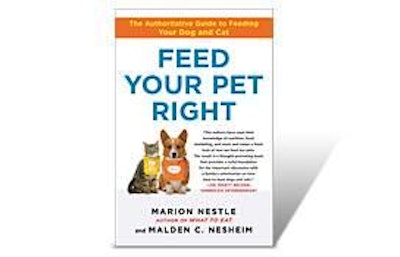
Nestle is also a Paulette Goddard professor of human nutrition at New York University. Nesheim is an expert in animal nutrition whose background includes many years as a professor at Cornell University, where he also served as director of the Division of Nutritional Sciences, provost and vice president for budget and planning. His many writing credits include books and articles in professional journals on various facets of human and animal nutrition.
These are smart people, in other words. Brave, too. Because when they got in front of that room full of petfood industry professionals, they were well aware that some of the conclusions they were about to present might not be popular, such as:
- The pet food marketplace is just as complicated, misleading and confusing as the human food marketplace;
- The industry that makes petfood is unusually closed and secretive; and
- Pets can flourish eating just about any foods. As long as the diet includes sufficient amounts of a variety of minimally processed foods—meat, dairy, fruit, vegetables, grains (or their substitutes)—the needs for essential nutrients and energy will be met.
If you’re a pet food manufacturer, marketer or retailer whose business depends on the sale of commercial food, this may not be the kind of news you care to hear. But it likely is the kind of news many pet owners will welcome.
Why? Because it’s coming from a reputable outside source, for one; and two, because science-based conclusions like the third point above open the door to a great deal more flexibility in feeding a pet. As the authors state, until recently, pretty much every instruction pertaining to feeding one’s dog or cat has fervently recommended a single kind of diet, whether it be only commercial foods, only raw foods, only home-cooked foods and so on.
In the age of blogs like Itchmo and Pet Connection, not to mention Facebook and Twitter, pet owners are increasingly “doing it for themselves.” As a result, even with their enormous media budgets, the combined forces of the largest pet food manufacturers are no longer controlling the information flow.
What’s more, with the pets-as-family trend stronger than ever, pet owners are becoming more and more proactive when it comes to seeking pet health information from outside the usual bounds, information like that to be had in Feed Your Pet Right.
If this is starting to sound like a plug for the book, it absolutely is if you’re interested in the future of the pet food market. Because in this column’s estimation, several of the book’s suggestions for today may constitute a significant portion of the pet food market of tomorrow.
Certainly, the market is already looking quite a bit different. Only a few years ago, for example, refrigerated pet food was practically nonexistent in the US. Now, an upstart called Freshpet has teamed with Tyson to go national with refrigerated pet foods for dogs and cats. During the 52 weeks ending April 18, 2010, sales of Freshpet dog food and treats in tracked mass-market channels rose 54% to US$14.5 million, according to SymphonyIRI. Although the organic pet food segment’s growth rate fell to “only” 10% in 2009 because of the recession, sales have increased six-fold since 2003, to US$85 million in 2009, and raw/frozen pet food and pet food mixes are also coming on strong.
What all this adds up to is a greater focus on “fresh” in the pet food market, as feeding preferences continue to align with trends on the human side. But what these trends also underscore is that pet food marketers are increasingly facing a choice: to specialize in a certain area, thereby forgoing the many other viable slices of the overall petfood pie; or to diversify, as Nature’s Variety has done by offering both raw and traditional diets.
Regardless of which path today’s pet food makers choose, they will be dealing with a much better informed consumer market whose days of being a captive audience are indeed a thing of the past.
Information is provided by Packaged Facts based on reports including Natural, Organic and Eco-Friendly Pet Products in the U.S., 3rd Edition (June 2010).