
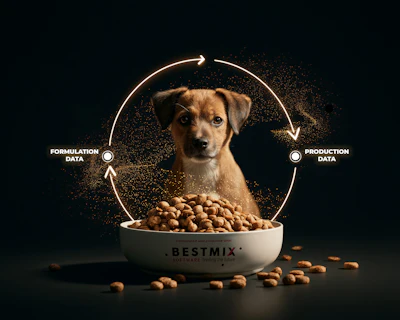
Discover how AI can help pet food manufacturers move beyond predicting production outcomes to optimizing formulations with real-time data. Learn how smarter formulation decisions can reduce variability, improve quality and make every production run better than the last.
Brand insights from BESTMIX Software
AI is changing the conversation in manufacturing. Pet food producers are hearing the same message everywhere: AI can predict, optimize and improve production performance. Most of these discussions focus on smarter analytics, better forecasts and more accurate predictions. But prediction alone doesn't improve manufacturing. The assumption is simple: if manufacturers can predict what will happen, they will naturally make better decisions.
A dashboard can identify production trends. An AI model can predict finished moisture or flag a potential quality deviation. Yet if that prediction never changes tomorrow's formulation, nothing has really changed. The production run is complete, the insight is recorded, and the business moves on exactly as before.
This explains why so many AI projects struggle to deliver measurable business value. McKinsey reports that while nearly every company is investing in AI, only a small minority believe they have reached AI maturity and are consistently capturing value from those investments.
The real opportunity isn't better prediction. It's making every production run improve the next one.
When formulation, production and quality become part of a continuous learning process, production data stops being a historical record and becomes an input to the next decision. Instead of simply explaining yesterday's performance, it helps optimize tomorrow's formulation.
That is the difference between analyzing manufacturing and continuously improving it.
When production data never becomes formulation knowledge
Every production run teaches a pet food manufacturer something. It shows how every ingredient batch behaved under real production conditions. It indicates whether drying achieved the expected moisture, how operators adjusted the process, which batches performed better than expected and where quality began to drift. By the end of the shift, the factory knows more than it did that morning.
Yet much of that knowledge never reaches the people creating tomorrow's formulation.
Production data remains in historians. Laboratory results stay in quality systems. Process information sits in MES reports. Every department gains valuable insight, but those insights rarely come together where they create the most value: the next formulation.
The result isn't a lack of data. It's decisions that continue to rely on yesterday's assumptions instead of today's production reality. The industry doesn't suffer from a lack of data. It suffers from disconnected decisions.
Why are we still formulating for the worst batch?
Every scientist knows why safety margins exist. Nobody wants to risk failing a nutritional guarantee because finished moisture happened to be slightly higher than expected. Building additional nutrients into the recipe has always been the responsible way to protect product quality and regulatory compliance.
The question is whether manufacturers are still protecting against uncertainty they've already reduced.
Every formulation begins with assumptions. How variable will the ingredients be? How stable will the process be? How much moisture will remain after production?
Those assumptions become nutrient safety margins.
For decades, this was the only practical approach because production experience rarely found its way back into formulation.
Today, production generates more data than ever before. Yet many formulations are still built on the same assumptions. As a result, pet food manufacturers continue paying for uncertainty that may no longer exist.
Every stable production run still carries the cost of protecting against the unstable one. Those costs rarely appear as waste or rework. Instead, they are quietly built into every formulation, every single day.
AI won't improve a poor manufacturing process
One misconception deserves attention. AI does not automatically improve manufacturing. If production processes are inconsistent, ingredient data is unreliable or operational discipline is weak, AI will simply learn from that reality.
In other words, AI doesn't fix poor manufacturing. It scales whatever manufacturing already exists. The more stable and controlled the production process, the more value AI can create.
That is why AI should never be viewed as a replacement for operational excellence. It is an accelerator of it.
Prediction only matters if it changes the next formulation
This is where many AI initiatives fall short. In most cases, they detect, explain and visualize. They help manufacturers understand what happened and even predict what is likely to happen next. But prediction alone doesn't reduce formulation costs. It doesn't improve margins and doesn't optimize tomorrow's recipe.
AI in formulation shouldn't be just another analytics tool. It should be a predictive model that continuously learns from a producer's own production data.
Every production run generates new knowledge about ingredient behavior, process conditions and quality outcomes. That knowledge strengthens the model, making future predictions more accurate. But accuracy alone isn't enough. If the prediction ends on a dashboard, it remains an insight rather than an improvement.
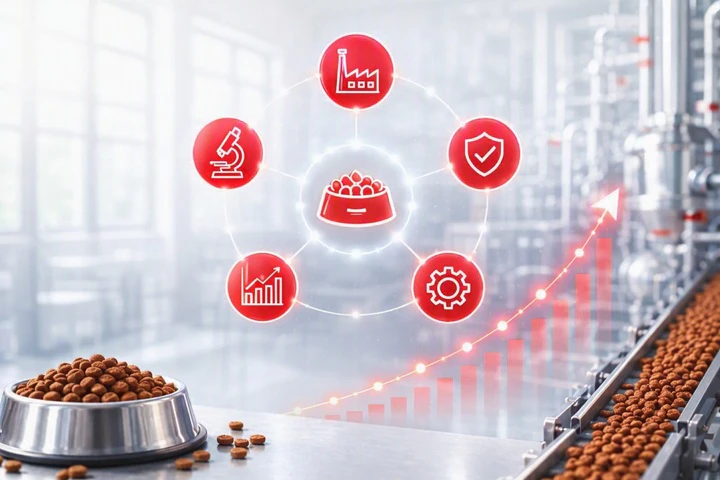
Image courtesy of BESTMIX Software
The real value comes when prediction feeds back into formulation.
Every production run teaches the next one. Every new prediction helps optimize the next formulation. In turn, that formulation generates new production data, creating a continuous learning loop between formulation, production and quality.
In the end, manufacturers don't invest in AI for the technology itself. They invest in better business outcomes. AI is simply the means to achieve them.
This is where AI moves beyond reporting and starts improving manufacturing. Assumptions are gradually replaced with evidence. Safety margins can be based on actual production performance rather than worst-case scenarios. Manufacturers make better use of raw materials, improve formulation accuracy and production consistency, reduce quality deviations and unnecessary giveaway, and ultimately achieve lower formulation costs and higher margins.
Yesterday's production improves tomorrow's formulation. Tomorrow's formulation generates new production data. The model learns again. And the cycle continues.
AI creates value when assumptions become evidence
Recent Deloitte research found that manufacturers implementing smart manufacturing technologies typically report 10–20% improvements in production output, 7–20% improvements in workforce productivity and 10–15% additional production capacity. The greatest benefits come not from visibility alone, but from using operational data to improve decisions across the production process.
The same principle applies to formulation in pet food manufacturing. When production continuously improves formulation, assumptions gradually give way to evidence.
Safety margins become based on actual production performance rather than worst-case scenarios.
Manufacturers make better use of raw materials, improve formulation accuracy and production consistency, reduce unnecessary giveaway and quality deviations and ultimately lower formulation costs while protecting product quality.
That's when manufacturers stop formulating for their worst batch and start formulating for the one they're actually producing.
For more information visit Close the gap between your formula and your line
All images courtesy of BESTMIX Software