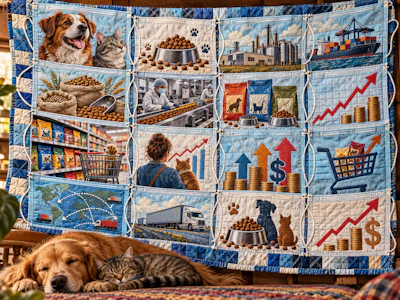
COVID-19 appears to have permanently raised U.S. pet food producer prices by 32.1% between January 2020 and August 2026, with most of the increase occurring between 2021 and 2023. Unlike typical inflationary cycles, prices have plateaued at the higher level rather than returning to pre-pandemic trends.
- Pet food producer prices increased 32.1% from January 2020 to August 2026, from 230.3 to 304.254 on the BLS Producer Price Index.
- The steepest price climb occurred between June 2021 and March 2023, when the index jumped approximately 27.5% in less than two years.
- Prices have remained relatively stable since spring 2023, increasing only 2.6% from March 2023 through August 2026, suggesting inflation has subsided but the higher price level persists.
- This 32.1% increase in six and a half years exceeds the 24.5% growth experienced during the entire preceding decade (2010-2020).
- The pandemic-era price surge has shown no signs of reversal through deflation, creating a permanently higher operating cost base for pet food manufacturers.
The COVID-19 pandemic may have permanently altered the cost of U.S. dog and cat food manufacturing (see infographic below), according to nearly four decades of Producer Price Index data from the U.S. Bureau of Labor Statistics (BLS).
Rather than experiencing a temporary inflationary spike followed by falling prices, the pet food industry appears to have undergone a substantial upward growth in producer prices during 2021 and 2022. Price increases have slowed dramatically since then, but the higher price level has persisted.
The BLS Producer Price Index (PPI) for dog and cat food manufacturing stood at 304.254 in August 2026, compared with 230.3 in January 2020, before the pandemic significantly disrupted U.S. supply chains. That represents a 32.1% increase.
The index measures changes in the selling prices received by domestic producers rather than prices consumers pay at retail. BLS defines the PPI as measuring the average change over time in prices received by producers for their output.
Pet food prices followed a much slower path before COVID-19
The difference becomes clearer when compared with the decade preceding the pandemic.
In January 2010, the dog and cat food manufacturing PPI stood at 185.0. By January 2020, it had reached 230.3, an increase of approximately 24.5% over 10 years, equivalent to compound growth of about 2.2% per year.
Pet food prices therefore increased more between January 2020 and August 2026, 32.1%, than during the entire preceding decade, despite the later period being only about two-thirds as long.
Had producer prices simply continued increasing at the 2010–2020 compound rate, the index would have reached approximately 266 in August 2026. Instead, it stood at 304.254, about 14% above that extrapolated pre-pandemic trajectory.
That calculation does not prove that COVID-19 itself caused the difference. However, the timing of the divergence clearly coincides with the pandemic-era inflation cycle.
Most of the change occurred from 2021 to 2023
The price shift did not occur immediately when COVID-19 reached the United States.
From January 2020 through June 2021, the pet food manufacturing PPI rose only about 1%, from 230.3 to 232.5.
The sharp increase came afterward.
Between June 2021 and March 2023, the index jumped from 232.5 to 296.427, an increase of approximately 27.5% in less than two years.
That period encompassed the supply-chain disruptions, commodity price increases, labor constraints, transportation challenges and broader inflation that affected manufacturers throughout the U.S. economy.
By contrast, producer prices have changed relatively little since the spring of 2023.
From March 2023 through August 2026, the index increased only 2.6%, from 296.427 to 304.254.
The pattern suggests that the inflationary shock itself has largely subsided while the resulting price increases have remained embedded in pet food manufacturers' selling prices.
Inflation slowed, but prices did not return to their old trend
The distinction between the rate of inflation and the price level may be particularly important for understanding today's pet food market.
By 2024 and 2025, month-to-month movements in the pet food PPI had become small again. The index stood at 296.774 in January 2024, 299.614 in January 2025 and 304.096 in January 2026.
In other words, the rapid inflation of 2021–2023 ended without a corresponding period of deflation that would have returned producer prices to their pre-pandemic trajectory.
That creates a different operating environment for pet food companies than existed before 2020. Manufacturers may no longer be facing the same pace of price increases experienced during the inflation surge, but they are operating from a substantially higher cost and pricing base.
The result is a pet food producer-price curve with a visible step upward: relatively gradual increases before COVID-19, a steep climb beginning in 2021 and a new plateau beginning around 2023.
Whether that plateau remains permanent will depend on future input costs and market conditions. Through August 2026, however, BLS data show little evidence that the pandemic-era increase in pet food producer prices has been reversed.
Data: U.S. Bureau of Labor Statistics, Producer Price Index by Industry: Dog and Cat Food Manufacturing, series PCU311111311111, monthly, not seasonally adjusted, December 1985=100.
BLS Producer Price Index program
Full BLS pet food PPI series via FRED
 Tim Wall | ChatGPT