Create a free PetfoodIndustry account to continue reading
Meeting the challenge of Indonesia’s growing demand for poultry
Indonesia is the largest country in South East Asia with a relatively young, fast-growing and increasingly urban population of almost 250 million. The economy is prospering, and growth over the past decade has averaged in excess of 6 percent per year.
Indonesia’s demand for poultry meat is expected to continue growing, primarily driven by the growing purchasing power of the country’s expanding middle class.
Indonesia is the largest country in South East
Asia with a relatively young, fast growing and increasingly urban population of
almost 250 million. The economy is prospering, and growth over the past decade has
averaged in excess of 6 percent per annum. As a result, the middle class has
tripled to 150 million over the last five years alone.
This prospering middle class is driving demand
for poultry products as they are one of the most affordable protein sources
available to Indonesian consumers.
Demand for poultry meat is expected to double within five years and,
because of this, the Indonesian government is keen to support the development
of the poultry sector in a sustainable way.
In 2013, a public-private initiative of Dutch companies active in the
poultry value chain was established to work in close cooperation with their
Indonesian counterparts to improve and strengthen Indonesia’s poultry sector.
Following a thorough examination of the market, FoodTechIndonesia has
identified the challenges currently facing the sector and suggested how to
improve the operations of medium-sized poultry companies, in particular.
Rapidly increasing
demand
In 2012, the Indonesian poultry market was
valued at EUR 4.76 billion (US$6.46 billion), with broilers representing 73
percent and layers 27 percent of the market.
Current consumption of poultry meat
(7.36 kg/head/year) and eggs (74 pieces/head/year) are relatively low compared to
other countries in South East Asia (Thailand: 20kg/160 pieces; Malaysia:
32kg/240 pieces).
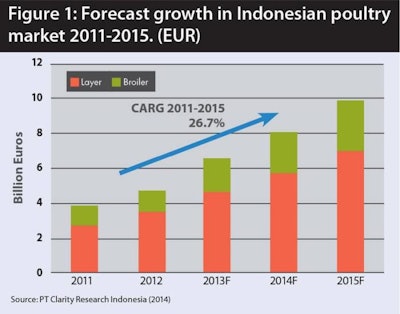
Between 2011 and 2015 the poultry market is expected to grow by 26.7% (CARG) per annum to reach EUR
10 billion (see figure 1). To satisfy this growing local demand, investments in
additional capacity are required and productivity, especially among small and
medium sized enterprises, will have to increase significantly, mainly by
introducing improved (knowledge-intensive) production systems.
Additionally, improved food safety procedures need
to be implemented to ensure that healthy and hygienic chicken products reach
the consumer.
Market structure
Indonesia’s poultry industry is geographically
highly concentrated, largely in Western Java where more than 50 percent of
primary production is located.
The market is dominated by a few vertically integrated
players which, together represent about 70 percent of professional poultry production.
These include Charoen Pokphand
Indonesia, JAPFA, Malindo, Sierad and Wonokoyo.
Poultry farms
Only 2 percent of Indonesia’s broiler farms are
fully closed houses, equipped with automated food and water systems and climate
control. Typically, these farms host 100,000 –400,000 birds.
However, the majority – 95 percent - of
Indonesia’s birds are farmed in small open houses, often built from bamboo, employing
manual feeding and watering systems, and housing 3,000-20,000 birds. These
farms are characterised by high mortality rates
- up to 8 percent - as a result
of disease and high temperatures.
Independent broiler producers are usually
dependent on integrators for purchasing day old chicks, as the cost of
investing in hatchery equipment is high. One solution to this would be the
establishment of a hatchery through the co-operation of 4-6 independent farmers,
who could share the capital investment, risk and then DOCs, suggests FoodTechIndonesia.
However, Indonesia currently lacks sufficient
knowledge in embryology and hatchery management, meaning that its farmers need
to be trained in storage and incubation conditions, data analysis, and hatching
egg transport, for example. There also needs to be training on managing
fertility and uniformity, the optimal use of hatching machinery and equipment
as well as on post hatch performance.
At farm level, the high mortality rates that
typify the sector, and low feed conversion rates can be partly attributed to
open water systems and poor knowledge of disease control. Establishing
demonstration projects showing the added value of closed water systems and
extensive onsite staff training for example, would help to remedy these
problems, the consortium believes.
Alongside this lack of understanding of avian
health there is high use of antibiotics. Broiler farms are using high
quantities of antibiotics for prevention and this is leading to bacterial
resistance. The sector needs to develop alternative treatments, and invest in
biological solutions, as well as introducing the market to antibiotic free
products.
Chicken processing
Indonesia’s poultry slaughter and processing
mostly takes place in backyard facilities. In Jakarta alone, over 2,500
backyard facilities have been identified.
Only 24 percent of the country’s chickens are slaughtered
in abattoirs and only 34 poultry abattoirs hold a veterinary certificate
allowing them to sell to modern supermarkets, fast food restaurants and hotels.
In 2007, the Jakarta government passed a local
regulation banning slaughter within the city, however, to date, it has not been
implemented. The current Jakarta governor has said that he supports implementation
of the slaughter ban. Should it be finally implemented it will be a game
changer as some 1 million chickens are consumed in Greater Jakarta every day and
all will have to pass through recognised abattoirs.
Clearly, there needs to be significant
investment in Indonesia’s poultry processing sector to address the lack of
capacity. Yet capacity is not the only problem, and investment needs to be made
in more efficient, sustainable and Halal-certified slaughter
and processing systems. This would also raise the sector’s efficiency, while
reducing the amount of product that leaves the processing plant damaged and
improve shelf-life.
Many of Indonesia’s abattoirs have only basic
waste water treatment plants, or no treatment facilities at all. This means
that waste water enters the surrounding water system. Furthermore,
useful animal by-products, such as feathers, fat and blood, are rarely
processed into value-added applications such as blood meal, proteins and
minerals which are used as ingredients for the pet food and animal feed industries
amongst others.
There is a strong need for processors to invest
in treatment projects. Demonstration projects, it is hoped, will show not only
the effectiveness of treatment options, but also the economic value that such
systems can bring.
Poultry feed
Indonesia is highly reliant on imported raw
materials for animal feed, as local production is insufficient and typically
occurs in remote areas located far from feed mills. Consequently, 50-80 percent
of raw feed materials are imported. With
such a high dependence on imports, locally produced animal feed is highly
influenced by world commodity prices and exchange rates.
In 2013, for example, animal feed prices
increased by 10 percent, however the Indonesian Rupiah depreciated by 26
percent against the US$. Price increases led to a slowdown of demand for
chicken products while feed producers, unable to pass on the price increases,
saw their profit margins decline.
Another difficulty is that the country’s feed
mills often rely on outdated and inefficient equipment, often 15-20 years old,
and many work in less than optimal ways. These facilities could be better
utilised, and a first step would be through the use of audits and process
improvements, FoodTechIndonesia says. In
particular, operators need to look at feed formulation and composition, raw
materials, energy use, water and other inputs, production processes and
storage.