Electronic nose technology equipped with 18 sensors can accurately detect and predict cat food preferences by analyzing aroma profiles, potentially helping pet food manufacturers screen products more efficiently before conducting animal preference trials.
- Electronic nose technology distinguished cat food products with 99.2% to 100% accuracy when classifying by brand within individual flavors
- Brand differences in cat food aroma profiles were greater than flavor differences, indicating each brand has a unique aroma signature
- The system analyzed 270 measurements across nine commercial cat foods representing three brands and three flavors over 10 days
- Seven cats in preference testing showed Brand A had the highest consumption at 42.31%, while the electronic nose produced similar patterns of differences
- Researchers noted the technology could serve as a rapid, objective quality control tool once properly calibrated and validated with additional products
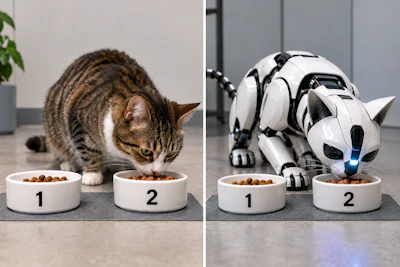
Real cats in feeding trials aren’t likely to lose their jobs to AI and robots. However. electronic nose technology may provide pet food formulators with a rapid method for screening cat food aroma profiles before conducting more resource-intensive animal preference trials, according to research results published in the journal Chemosensors.
Researchers evaluated nine commercial dry cat foods representing three brands and three flavors, chicken, lamb and tuna. They compared feline consumption data with physicochemical measurements, texture analysis and digital aroma fingerprints generated by an electronic nose equipped with 18 metal oxide semiconductor sensors.
The researchers found that the electronic nose distinguished products by both brand and flavor. However, differences among brands were greater than differences among flavors within individual brands.
“This indicates that each brand possesses a unique aroma signature regardless of flavor type,” the researchers wrote.
The authors attributed the stronger brand differentiation to differences in formulations and manufacturing practices rather than labeled flavor alone.
Electronic nose detects differences among cat foods
For the electronic nose analysis, researchers collected approximately 1 gram of each cat food and analyzed volatile compounds in the sample headspace. Each of the nine products was measured three times per day over 10 consecutive days, resulting in 30 aroma fingerprints per product and 270 measurements overall.
In both the feline preference testing and electronic nose analysis, differences among brands within individual flavors were greater than differences among flavors within a single brand.
When products were classified by brand within each flavor, cross-validation accuracy ranged from 99.2% to 100%. When researchers instead attempted to distinguish flavors within individual brands, cross-validation accuracy reached 98.4% for Brand A, 91.3% for Brand C and 81% for Brand B.
Those classification rates do not mean the system has been demonstrated to predict the palatability of unknown cat foods. The researchers emphasized that their analysis characterized the nine products included in the experiment rather than testing a predictive model on independent commercial batches.
The researchers said additional studies incorporating separate manufacturing lots would be needed before the approach could be developed into a prospective predictive quality control application.
Aroma patterns reflect preference test results
Seven castrated domestic shorthair cats participated in the preference testing. The experiment consisted of 12 subunits. During each eight-day subunit, three of the nine foods were offered to each cat. A 10-day washout period using a standard beef cat diet separated the subunits.
Brand A had an average consumption ratio of 42.31%, compared with 34.63% for Brand C and 23.05% for Brand B. A-chicken had the highest individual consumption ratio at 69.93%, while B-chicken had the lowest at 20.61%. The researchers had classified Brand A as premium quality and Brands B and C as medium quality based on price.
Electronic nose (EN) measurements produced similar patterns of differences among the foods. In both the feline preference testing and electronic nose analysis, differences among brands within individual flavors were greater than differences among flavors within a single brand.
“The strong qualitative and numerical alignment between the structural distances in the EN data and the animal preference metrics underlines the potential of the EN system,” the researchers wrote.
However, the study did not establish that aroma alone caused the observed differences in consumption.
Potential tool for pet food product development
The researchers concluded that electronic nose technology could eventually complement animal preference testing by allowing manufacturers to screen aroma characteristics associated with previously accepted diets. However, establishing that application would require calibration and validation with additional products and independent production batches.
“Once calibrated and validated, the EN system can serve as a rapid, objective, and sustainable quality control tool,” the researchers wrote.