Heavy metals detected in bottled water
Brown rice contains 67% more arsenic than white rice
Popular snacks and vegetables contain toxic cadmium
Arsenic detected in beer
All of those headlines are backed by lab results, but they leave out important context.
The U.S. Food and Drug Administration’s Total Diet Study detected total arsenic in 23 of 27 mineral or spring bottled-water samples, averaging just 0.47 parts per billion, while cadmium averaged only 0.0076 ppb. FDA also estimated mean inorganic arsenic concentrations of 154 ppb in brown rice versus 92 ppb in white rice, approximately 67% higher. The agency has likewise found cadmium, a toxic element, in foods as commonplace as sunflower seeds, spinach, potato chips, leaf lettuce and French fries.
If that data stresses you out, don’t reach for a frosty brew to take the edge off. FDA testing of 65 beers found inorganic arsenic averaging 2.1 micrograms per serving. All I need is the air that I breathe to find contaminants like benzene, formaldehyde, fine particulate matter, nitrogen dioxide, ozone, carbon monoxide, lead, arsenic, cadmium and combustion-related compounds.
Almost everything contains something toxic, but breathing, eating brown rice or drinking bottled water won’t poison you (probably). The levels of heavy metals and other noxious substances are too low in most cases to cause harm. The FDA’s findings illustrate the distinction between detecting a hazardous substance and demonstrating that the amount detected constitutes a meaningful health hazard.
Clean Label Project recently published a cat food study, as Lisa Cleaver reported. However, Petfood Industry wasn’t the only place to get this news.
Within days of its release, Clean Label Project's cat food study was reported across at least 97 news sources. A CNN report was republished by numerous local television websites, while separate NewsNation and USA Today stories were also redistributed.
According to the study, lead was detected in 99% of the 100 cat foods tested, cadmium in 96% and arsenic in 94%.
Clean Label Project (CLP) itself cautioned that detection does not necessarily mean a product is dangerous. Nevertheless, the organization used the testing to compare products, identify those with lower contaminant levels and publish its “Clean Sixteen” lists. The Pet Food Institute challenged the study, arguing that CLP’s proprietary purity standard does not provide the risk-based context necessary to determine whether the detected substances present a meaningful hazard to cats.
The scientific debate is important, but another issue deserves scrutiny. CLP derives most of its revenue from the companies seeking its certifications and consulting services.
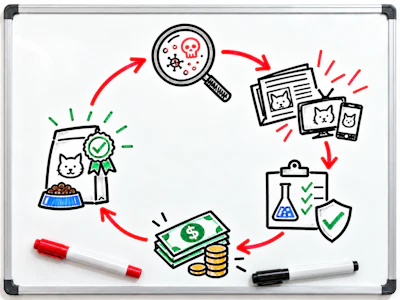
Viewed as a business model, the process can form a self-reinforcing cycle. Identify a potential problem, publicize it, establish a standard to address it, charge companies to demonstrate compliance with that standard and then help certified companies market the resulting seal.
Each stage may have a legitimate purpose. Taken together, however, they create financial incentives worth examining.
The crossroads of ambiguity and fear
CLP begins with a valid scientific premise. Consumer products may contain environmental contaminants that aren't listed on labels.
Its 2026 cat food study used established analytical techniques. Heavy metals were measured using inductively coupled plasma mass spectrometry, while other compounds were tested using liquid chromatography tandem mass spectrometry. CLP says testing is conducted by an ISO 17025-accredited laboratory.
The potential conflict emerges from deciding what those detections mean.
Heavy metals occur naturally in the environment, something CLP itself acknowledges. Detecting lead at parts-per-billion levels does not, by itself, demonstrate a health risk. Toxicological risk depends on dose, exposure and other factors.
Yet CLP states that its guiding principle is that lower contaminant concentrations are preferable. That philosophy allows virtually any detectable difference between products to become a basis for comparison even when both products could be within accepted safety levels.
PFI highlighted that distinction following the cat food report, arguing that detection does not equal harm and questioning why CLP's proprietary methodology differs from established regulatory or risk-assessment approaches.
Make the public aware of the situation
The next stage transforms analytical results into consumer information.
CLP publishes category studies, promotes findings such as the detection of heavy metals in 99% of cat foods and produces Clean Sixteen lists identifying products with the lowest overall contaminant levels.
However, CLP does not publish the individual analytical results underlying those comparisons.
CLP says Ellipse Analytics, its laboratory partner, owns the underlying data and that CLP is not authorized to publish individual product reports. Consumers therefore can see which products CLP considers among the cleanest, but generally cannot examine the numerical results used to produce those distinctions.
That limits independent scrutiny. A consumer cannot determine from the rankings alone whether two products differed dramatically in contaminant concentrations or whether relatively small differences separated them.
This issue arose during CLP’s original pet food ratings in 2017. At the time, CLP similarly declined to release product-level contaminant data, saying its relative ratings offered more useful context.
Establish a proprietary standard
After identifying and publicizing the alleged problem, CLP provides its own standard for addressing it.
CLP says its certification criteria draw from California Proposition 65, European Union regulations, U.S. federal and state requirements and proprietary category-specific data.
Its 2024 Code of Practice went further in describing the commercial function of the program. CLP said category benchmarking establishes superiority thresholds and rewards products performing in the top third of their categories. The document described certification as a “market tool,” intended in part to “create a market opportunity” for manufacturers and provide an on-package marketing solution.
That creates an unusual relationship. CLP helps define the problem. CLP participates in establishing the benchmark used to address the problem. Companies can then pay to have their products evaluated under CLP’s certification system.
While the standard may have scientific merit, CLP also has a financial interest in demand for the standard it created.
Charge companies for the solution
CLP Foundation is a legitimate IRS-recognized 501(c)(3) nonprofit. But “nonprofit” does not mean an organization cannot generate substantial commercial revenue or an annual surplus.
Its latest publicly available Form 990, covering 2023, provides a picture of the organization’s business model.
CLP Foundation reported $720,193 in total revenue. Of that:
- $440,031 came from certification (61.1% of total revenue)
- $228,304 came from consultation services (31.7%)
- $42,664 came from contributions (5.9%)
Altogether, program-service revenue accounted for 92.8% of CLP's revenue, while donations represented less than 6%.
Certification and consulting therefore aren't peripheral fundraising activities. They were the organization's principal sources of income.
CLP reported $562,312 in total expenses and finished 2023 with revenue exceeding expenses by $157,881. That should not be described as corporate profit, nonprofits can retain operating surpluses but cannot distribute them to owners or shareholders, but it demonstrates that CLP's certification-centered activities generated sufficient revenue to support and expand the organization.
On Form 990, CLP reported $440,031 in certification revenue while assigning $67,031 in expenses to that program. Its consulting and educational program generated $228,304 while reporting $264,649 in expenses. Those figures may not represent stand-alone profit margins since other organizational expenses may support the programs. Nevertheless, certification was a significant source of net funding for CLP's broader operations.
CLP openly acknowledges the arrangement. Its current FAQ says the organization is funded through donations, grants and certification fees from brands displaying the CLP mark.
Another detail deserves attention. CLP's 2023 Form 990 answered “No” when asked whether the organization had a written conflict-of-interest policy. The IRS does not require nonprofits to have such a policy, and its absence does not establish that a conflict occurred. But it is notable for an organization whose primary revenue comes from businesses participating in programs it administers.
The same filing also describes CLP's certification program as providing seals for products whose laboratory testing was performed by an “affiliated company.” CLP's current website, meanwhile, describes Ellipse Analytics as an independent third-party laboratory and identifies Ellipse as technical administrator of its certification programs. The filing does not identify the affiliated company by name in that program description, leaving an important question about exactly how CLP defines the relationship among the foundation, its certification operation and Ellipse Analytics.
Certification becomes marketing advantage
After a company pays to participate and its product qualifies, CLP doesn't simply issue a laboratory report. CLP says it works with companies on marketing the award to consumers and retailers. Its certification standards explicitly contemplate use of the mark on packaging as a tool for communicating product purity.
That creates commercial value for certified brands. A CLP seal can differentiate one pet food from another in a market where consumers increasingly scrutinize ingredient quality and food safety.
It can also create competitive pressure. If consumers begin associating the CLP mark with lower contamination, brands without the certification may have an incentive to seek it. Every additional participating product potentially generates additional testing, certification and renewal revenue.
In that sense, publicity surrounding contamination can increase the perceived value of the certification designed to address contamination.
This CLP strategy isn't entirely new.
In 2017, Petfood Industry reported that CLP earned a 4% Amazon affiliate commission when consumers followed links from its website to buy pet foods, including foods that CLP itself had rated poorly. CLP defended the arrangement, saying the links gave consumers access to product information and allowed them to make their own choices. The underlying issue remains remarkably similar.
CLP occupies several roles at once: consumer advocate, researcher, standard setter, certifier, consultant and marketing partner to certified brands. None of those activities individually invalidates its work.
Nor does the business model demonstrate that CLP manipulates laboratory results. Ellipse Analytics uses recognized analytical methods, and ISO 17025 accreditation provides independent verification of laboratory competency. CLP also buys products through retail channels rather than relying on manufacturers to provide samples.
However, being financially dependent on certification, an organization has an incentive for consumers and manufacturers to believe certification provides meaningful value. Publicizing contamination concerns can increase that perceived value. Proprietary standards then establish the criteria for demonstrating superiority, and certification allows brands to advertise that distinction.
Should an organization simultaneously define the problem, publicize the problem, establish the benchmark for solving it, sell the certification demonstrating the solution and help companies market that certification, while deriving most of its revenue from that process?