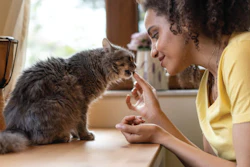
The lag time between human food and pet food trends has been steadily shrinking, and in one area, pets may be leading. “Pet longevity is, in several critical ways, moving faster than human longevity,” wrote food futurist Tony Hunter. “I believe we are testing the future of human health on the other end of the leash right now.”
His inclusion of health is no accident; longevity (for pets and humans) is transforming into a concept called “healthspan.” “Feeding for more good years, not just more years,” as described by Kevin Ryan, Ph.D., founder and CEO of Malachite Strategy and Research, in his Petfood Forum 2026 keynote. “People don’t just want to live longer. They want to delay the point at which living starts to feel like losing.” That desire naturally extends to their family members, including furry ones.
For pet food developers, this reframes life-stage nutrition. “Senior is the wrong frame,” Ryan said. “Consumers who are rejecting the traditional meaning of their own biological age aren’t going to accept that their 7-year-old dog just crossed an arbitrary threshold.”
Arbitrary and not all that accurate, according to Emma Bermingham, Ph.D., founder and head consultant at Ember Pet Nutrition, who also spoke at Petfood Forum and discussed healthspan. “From published nutrient analysis of senior pet diets, it appears current ‘senior pet diets’ are purely marketing driven rather than formulated specially for our senior pets,” she said, emphasizing that the industry should do more with nutrition to ensure cats and dogs age gracefully and healthily.
Unfortunately, we know very little about appropriate nutrition in this area, she added. “There is surprisingly little information about the nutritional requirements of senior pets, and what data is out there is relatively old and not always peer reviewed.”
Aside from this critical research need, advances in pet healthspan are on the horizon. Hunter and Ryan both mentioned Loyal’s LOY-002, an anti-aging drug for dogs 10 years and older, which has received conditional approval from the U.S. Food and Drug Administration. And a study of Genflow Biosciences’ “centarian gene variant” showed superior survival, improved muscle mass and better coat condition in Beagles aged 10+.
Hunter and Bermingham also cited initiatives like the Dog Aging Project, Generation Pup and the Mars Petcare Biobank.
Exciting times, as our pets live longer and stay healthier. “The real longevity breakthrough may not arrive in humans first,” Hunter wrote. “It may arrive through the leash, the food bowl and the veterinary system built for our pets.”