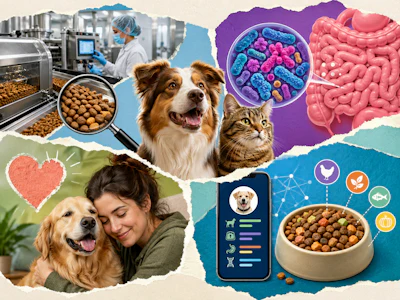
Dog bites human food isn’t news. Human bites dog food is. People are letting pets lead the way in diet trends, Kevin Ryan, PhD, founder and chief executive officer of Malachite Strategy and Research, said during his keynote address at Petfood Forum 2026, in Kansas City, Mo.
“The pet bowl is the uncontested canvas for the owner’s emerging food beliefs,” Ryan said.
Health and wellness trends emerge in pet food first because the barriers to adoption are lower than for children or oneself, he said. Kids are selective and socially influenced, while adults have entrenched habits and personal constraints that make change more difficult. In contrast, pets offer a lower risk environment where owners can project and experiment with their own evolving beliefs. Despite humanization, one’s peers are still less likely to judge an individual for feeding a trendy, but non-traditional or unproven product, to their pet as opposed to their kid.
Ryan outlined five trends influencing pet food development, and in many cases beating human food to market.
Trend One: Clean processing premium
The first trend, clean processing premium, reframes how consumers evaluate processing. Rather than rejecting processing outright, pet owners increasingly expect what Ryan described as “justified processing.”
“Process just enough then stop…for my benefit as a consumer,” he said.
This shift puts pressure on traditional extrusion-based systems, which Ryan described as “vulnerable,” while elevating formats that can communicate gentleness, transparency and time. Strategies include emphasizing slower processing methods, quantifying ingredient integrity and strengthening chain-of-custody narratives.
“The rise of fresh isn’t just that it’s fresh,” Ryan said. “One of the things people like about fresh is the idea is it seems less processed… it seems more gentle.”
Trend Two: Healthspan + metabolic precision
The second trend moves beyond lifespan toward “health-span,” which focuses on delaying decline rather than simply extending life.
“I want to die on the tennis court when I’m 80,” Ryan said. “I don’t want a long, slow decline. That’s what health span is about.”
Emerging tools such as wearables, metabolic data and enhanced ingredient technologies are enabling this shift, although in this the human wearables trend leads pet.
For pet food developers, this reframes life-stage nutrition.
“Senior is the wrong frame,” Ryan said, suggesting a move toward continuous optimization rather than age-based segmentation.
Trend Three: Microbiome 2.0
Ryan’s third trend, Microbiome 2.0, calls for a more integrated approach to gut health. Decades ago pet food was an early adopter of probiotics, but he argued innovation stalled as human food advanced.
“Pet food got here first. Then stopped,” he said.
Three gaps remain: consumer education, translation of research into products, and expansion beyond digestive health. Scientific literature already supports breed-specific microbiome differences, he said, yet those insights have not been widely incorporated into commercial formulations.
Future opportunities include protein–microbiome interactions, prebiotic-focused formulations and postbiotic applications positioned around resilience rather than digestion alone.
Trend Four: The calm economy
The fourth trend reflects growing consumer focus on mental and emotional well-being, extending to pets through what Ryan called “empathy transfer.”
“I deal with anxiety… What about my pet? Why can’t my pet have something like that?” he said .
This is shifting calming products from situational use, such as during a storm or fireworks display, to daily nutrition.
“It’s not about this idea of a moment… it’s about a daily nervous system experience,” Ryan said.
He outlined three formulation strategies: a daily resilience protocol combining functional ingredients, “daypart architecture” aligning nutrients with circadian rhythms, and formats that encourage slower, calming eating behaviors.
Notably, ingredients such as L-theanine, tryptophan and ashwagandha, common in human functional foods, are increasingly being considered for pet applications. However, seeing complex scientific names like L-theanine could trip consumers’ clean label alarms.
As functional ingredients become more complex, formulators face a paradox. Consumers want simple, easily understood ingredient decks. At the same time they also want chemicals with known efficacy, although not called chemicals.
However, many of these functional ingredients come from natural sources or have long histories of human use.
“Look at ashwagandha,” he said. The plant has centuries of recorded human use.
Even an ingredient with a name like L-theanine has a natural source. While it can be extracted from tea leaves, L-theanine more commonly is derived through microbial fermentation.
Nevertheless, Ryan cautioned that novel or more processed ingredients require stronger storytelling and openness. Transparency, even when consumers do not actively seek details, remains critical.
“The idea is that [the ingredient] is not a black box,” he said. “You can look if you want. And just the idea that you could look oftentimes makes people think, well, I guess they don’t have anything to hide.”
He gave the example of a company that put QR codes on their packages leading to sourcing data. Few customers followed the QR codes, but that was a good thing, he said, since it meant they were trusting the authenticity of the sourcing story without feeling the need to check.
Trend 5: The algorithm feeds the dog
The fifth trend centers on data-driven personalization. As pet owners face increasing information overload, technology is emerging as a decision-making layer.
“That responsibility has led us to this idea of maybe I’ll ask AI, maybe I’ll go to technology,” Ryan said.
Subscription models, already normalized in pet food, provide the infrastructure for more advanced systems focused on specific pets. Ryan pointed to future opportunities including digital twins for pets. These digital dogs and cats would be programmed to model a certain real pet’s tastes and nutritional needs. These twins could then do thousands of simulated taste tests to find an ideal formulation.
For the live pets, AI could integrate with pet wearable and other sensors monitoring the animals’ health indicators, including their stool quality.
“A system that learns, adapts and reports,” he said, describing how AI could continuously refine formulations based on pet-specific data.
Pet food is shifting from static product to dynamic nutrition system catering to pet owners’ wants for their pets. Whether through processing transparency, microbiome integration, emotional wellness or algorithm-driven personalization, pet food innovation is leading human trends in many ways.