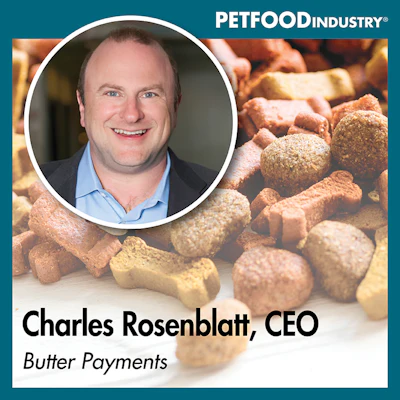
In this episode of Trending: Pet Food, Lindsay Beaton sits down with Charles Rosenblatt, CEO of Butter Payments, to explore the evolution of subscription services in the pet food industry. Rosenblatt breaks down why the pet market is a natural fit for subscription models, citing the alignment of recurring consumer need with predictable business revenue. The conversation covers how back-end subscription management technology has matured, what opportunities exist for companies not yet using a subscription model, and where the category is headed — including AI-driven product recommendations and bundling with pet health services like insurance and veterinary telehealth.
Lindsay Beaton, editor, Petfood Industry magazine and host, Trending: Pet Food podcast: Hello, and welcome to Trending: Pet Food, the industry podcast where we cover all the latest hot topics and trends in pet food. I’m your host and editor of Petfood Industry magazine Lindsay Beaton, and I’m here today with Charles Rosenblatt, CEO of Butter Payments. Hi Charles, and welcome!
Charles Rosenblatt, CEO of Butter Payments: Hi, Lindsay, Thanks for having me.
Beaton: In case you’re unfamiliar with Charles or Butter Payments, here’s what you need to know.
Prior to being CEO, Charles served as Butter’s Chief Commercial Officer, spearheading strategies that leverage machine learning to improve payment authorization rates and reduce involuntary churn — key levers in boosting subscription revenue.
Charles is a recognized leader in global payments with a track record of driving success. Before joining Butter, he held senior roles at Payoneer and Hyperwallet, where he helped lead the company to its IPO. Rosenblatt’s teams also created more than 40% revenue growth for those companies in the year before their exit. During his time at PayQuicker, he served as president and helped them earn a spot on American Banker’s Top 40 Best Fintechs to Work For.
Charles created the first Buy Now, Pay Later product in the United States through Payroll Deduction in 2001 at Capital One. He holds an M.B.A. from UVA's Darden School of Business and a B.A. in Economics and Politics from Pomona College.
Butter Payments is on a mission to end involuntary churn. The company helps the world’s greatest subscription companies retain their hard-earned subscribers and recover millions of dollars in revenue lost to failed payments. Clients include MasterClass, Fabletics, The Athletic, Athena Club, Savage X Fenty, TechStyle, Gopuff, and more.
Charles' extensive subscription knowledge in consumer spaces makes him the perfect person to answer this question: What does the evolution of pet food subscription services look like?
Let's start with a more general question — what brought subscription services to the pet market to begin with? What was it about them that made them applicable to this particular industry?
Rosenblatt: Two things really make subscriptions successful — one on the corporate side, one on the consumer side. On the consumer side, it's a recurring need for a product or service. Pets have that recurring need, whether it's food or, as an example, a subscription box for our bird that provides new mentally stimulating activities each month. That recurring need drives consumers toward subscriptions.
On the business side, it's about creating recurring revenue — what we in the business world call a SaaS revenue stream in a consumer business. If you have a subscription model, you know you're going to have $50 million worth of orders coming in consistently every month. That helps with purchasing, with supply chain management, and with financial forecasting. The convergence of consumer need and corporate desire made the pet food industry a very logical fit for subscriptions.
Beaton: How have subscriptions evolved over the years? Who was first to launch subscription-type services, and how have they gotten to where they are today — not even specifically for pet?
Rosenblatt: I'm not sure exactly who was first. Thinking back, gym memberships were among the earliest — you'd sign up for a 12-month contract with a monthly payment, a recurring charge for a consistent service. Telephone companies followed a similar model, with 24-month contracts and monthly payments. At its core, a subscription is simply a monthly payment for ongoing goods and services.
From there, subscriptions expanded into anything people consistently need. If you need something regularly and don't want to pay a year's worth upfront, the ability to pay as you go at a set cost and set date has now transcended every industry. There are even apps like Rocket Money built around helping people cancel subscriptions because the average person has accumulated so many. Netflix, Hulu, Paramount — that's all subscription now. Inherently, any industry with recurring activity has figured out that building a subscription around it is the best economic model.
Beaton: What did the internet do for subscription services? A lot of the ones I think of right now could exist without the internet, but it would be a lot more difficult — customers would have to come into a store, someone would have to physically keep track of everything. The internet seems like it was a big step forward.
Rosenblatt: The internet made acquisition much easier — click a button and you're in. But I'd also point to Amazon as taking subscriptions to the next level, particularly for consumer goods. Their "Subscribe & Save" model — send your toilet paper every month and get 5% off — created a common behavior that other retailers have benefited from. If Amazon can ship something on the third of every month, others can too.
What's really evolved, though, is the back end. In the last five to eight years, a number of subscription management companies have emerged — not household names for the most part, outside of Stripe — that have made it very easy to manage subscriptions end to end. They handle turning subscriptions on and off, managing communication timing, and automating the entire flow. They integrate with Shopify and other platforms, making it easy for companies to offer multiple plans.
Think about Blue Apron — customers don't just subscribe to "a box." They choose the type of food, how many dinners, and so on. That complexity is enabled by these back-end subscription management companies, which allow businesses to offload the operational work to a third party that handles it automatically.
Beaton: What does the typical subscription user look like? Is there an overall pattern for the type of person drawn to these, or is pretty much everyone using them now?
Rosenblatt: Pretty much everyone is, but you do tend to find more engagement among people who are internet-savvy. One barrier that has largely faded is the reluctance to share credit card or bank account information online — though certain age demographics still have concerns about that.
Through the billions of transactions we process, we don't see individual PII, but from conversations with clients across industries, there does appear to be a particularly heavy concentration of subscription users in the 25-to-35 age demographic, though it varies by industry.
Beaton: What are some of the consumer-facing challenges for companies offering subscription services? Some pet food companies are almost exclusively subscription-based — mostly online companies that let you customize your pet's food and then ship it monthly. How do you connect with customers when your model is essentially set-it-and-forget-it? What are the challenges inherent in that, and how are companies working through them?
Rosenblatt: The set-it-and-forget-it model is definitely easier to operate and probably makes up 85% to 90% of subscriptions. The more custom models — think Blue Apron, where you'd be eating the same meal every week if you set it and forget it — require more active customer engagement. The same is true in pet food; maybe you want to rotate what toys or food formulas your pet receives each month.
Fresh Pet, which is a client of ours, is a good example. Their customers understand going in that engagement is part of the experience — that different formulas require choices. There are people who won't opt for that level of involvement and prefer a steady, curated recurring product. But there's also a demographic that's very comfortable with it. Most people know what they're signing up for.
Beaton: What are the biggest opportunities for companies that might be considering a subscription service but haven't launched one yet — or who sell on Amazon and haven't made that move?
Rosenblatt: It comes back to revenue certainty. If someone is paying you $19 a month, charged on the first of every month, you can project your revenue in a reliable way. Take a straightforward monthly pet food subscription — not a customized fresh food product, just a standard bag of kibble. You know that dog or cat needs food once a month. With a subscription, you know you're guaranteed that purchase.
Without one, a customer might order from you one month, then run out of food the next, realize it's too late to ship in time and head to the grocery store instead. You've lost that sale. We see this in the hair care space as well — someone runs out of shampoo, the subscription hasn't shipped yet and they're going to the drugstore. A subscription locks in that revenue.
The second piece of advice for anyone starting out: have someone manage it for you. Whether that's Stripe Billing or one of the more customized platforms — which tend to make more sense at $20 million to $100 million-plus in revenue — outsourcing the subscription management is worth it. There are easy, reasonably priced plug-ins available, probably cheaper than the cut Amazon takes for sales on its platform. They'll allow you to capture that recurring revenue stream without the operational burden.
Beaton: As we look to the future, I don't see subscription services going away anytime soon. But is there a next evolution on the horizon, particularly for consumer goods? Are there new technologies that will make subscriptions more intuitive?
Rosenblatt: The next evolution will need to be more holistic. Even as a pet food provider, you're only one piece of a pet's ecosystem. Having one subscription that covers everything may start to make more sense.
I was recently at a conference speaking with people in the media industry, and we talked about why newspapers across the country don't bundle their offerings together. The Philadelphia Inquirer is doing a good job of this — they recognized that their readers like cooking, and the New York Times has a great cooking section, so they've contracted to include the Times cooking section in their premier subscription package.
The same opportunity exists in the pet industry. A treat or toy subscription like BarkBox could bundle with a necessary recurring product like food and create a single subscription that covers both. It becomes harder to cancel because even if your pet doesn't need a new toy this month, they still need food — and now it's all together. The Disney-ESPN-Hulu bundle in streaming is a good model for this. They each took a small hit on pricing, but customers now have a harder time disaggregating because each piece of the bundle has something they want.
The pet industry is ripe for that kind of change, because a lot of the subscriptions in this space offer disparate products that could logically be combined.
Beaton: Does AI have a role to play in subscription services?
Rosenblatt: Absolutely. Our company is machine learning- and AI-driven — that's how we ensure failed subscription payments are recovered. On the product side, I think AI will play a major role in recommendations. People are already using ChatGPT to plan their gardens, figure out what to plant and when. The same behavior will apply to pet care.
If I were running a Chewy-type operation, I'd build an AI feature that asks for your pet's name, a few details about the animal, and then generates a recommended monthly subscription order. Now it's not the retailer pushing a product — it's an AI recommendation that customers tend to trust. What's the best monthly package for a Cavalier King Charles Spaniel who runs outside four hours a day and prefers wet food? AI can answer that, populate a shopping cart with products you already carry and turn it into a recurring subscription. That's a significant opportunity.
Beaton: Thank you for coming to chat about all of this. It's a growing part of the pet food and pet industry overall, and I think it's a topic people don't always consider in depth — the evolution of it, how it changed when it hit the pet space, how the set-it-and-forget-it model took off during the pandemic when everything went online and new subscription services proliferated. The category will keep growing, so thank you for breaking down where we are, how we got here, and where we might be going.
Rosenblatt: One more thing to add: I was at Pet Connect USA in December in Los Angeles and saw a strong move into pet health — and those are all subscription businesses, too. Veterinary telehealth is a growing trend. Pet insurance is subscription-based. Animal hospital plans are recurring payments. We have clients in both the pet insurance and animal hospital spaces.
If you're a physical goods company in the pet industry, that's worth thinking about. How can you bundle your products into those health-related subscriptions? How could you get your pet medications tied into a Banfield Animal Hospital insurance payment? That's a monthly bill people are already paying — could your product be part of it? That's where bundling becomes especially interesting, and it's part of why what we do at Butter matters so much. Ensuring those payments go through is critical when physical goods — unlike digital products — have to be procured and shipped.
Beaton: The way pet health mirrors the human health space — and mirrors it quickly — is something the industry talks about a lot. Pet owners do something for themselves and immediately ask, "Why not for my dog, too?" So, I'm not surprised by what you saw, and it makes the landscape very interesting.
Rosenblatt: When the language shifted from "pet owner" to "pet parent," it became logical. When you treat an animal as a member of the family rather than a possession, you want more services for them. That drives the whole ecosystem.
Beaton: Before we go, tell us where people can find more information about you and Butter Payments.
Rosenblatt: You can find me on LinkedIn — just search Charles Rosenblatt. For Butter Payments, everything is on our website at butterpayments.com. There are links to reach out by email. We're happy to talk to anyone in the space.
Beaton: That's it for this episode of Trending: Pet Food. You can find us on petfoodindustry.com, SoundCloud or your favorite podcast platform. If you want to chat or have any feedback, feel free to drop me an email at [email protected]. I'm Lindsay Beaton, your host and editor of Petfood Industry magazine. We'll talk to you next time. Thanks for tuning in!