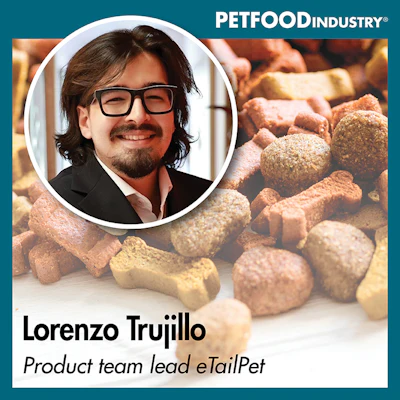
In this episode of Trending: Pet Food, Lindsay Beaton speaks with Lorenzo Trujillo, product team lead at eTailPet, about the current state and future of artificial intelligence in pet retail. Trujillo explains how AI is already being used for inventory management, purchase order generation, customer communication and business analytics, noting that retailers are proactively seeking AI integrations rather than needing education about the technology.
We want to thank Rangen Pet Nutrition for sponsoring this podcast. Rangen Pet Nutrition is your trusted partner in advancing pet health. From antioxidants to custom premixes and pure yeast solutions, they help pet food companies create superior nutrition with innovative science and dependable expertise. Learn more on LinkedIn at Rangen Pet Nutrition.
Lindsay Beaton, editor, Petfood Industry magazine and host, Trending: Pet Food podcast: Hello, and welcome to Trending: Pet Food, the industry podcast where we cover all the latest hot topics and trends in pet food. I'm your host and editor of Petfood Industry magazine Lindsay Beaton, and I'm here today with Lorenzo Trujillo, product team lead at eTailPet. Hi Lorenzo, and welcome back!
Lorenzo Trujillo, product team lead at eTailPet: Hi Lindsay. Hope you're doing well.
Beaton: In case you're unfamiliar with Lorenzo or eTailPet, here's what you need to know.
With a passion for the pet industry and a deep commitment to the success of independent businesses, Lorenzo has dedicated over six years to eTailPet, beginning in web page design where he harnessed his creativity and technical skills to craft captivating online experiences. He has since moved into a leadership role as the Product Team Lead, overseeing the development and optimization of eTailPet's product offerings.
eTailPet is the all-in-one point of sale (POS) solution created by a pet business owner and built specifically for independent pet retailers. This cloud-based technology empowers independent pet businesses with robust software solutions to compete in the growing digital marketplace. eTailPet simplifies inventory management, provides detailed reporting, and boasts online sales and marketing tools that help specialty retailers focus on growing their business.
Lorenzo's extensive, hands-on knowledge of all things technological when it comes to pet retail systems are why I've brought him back today to answer this question: How is AI currently being used in the pet retail space?
Lorenzo, I think we need to start with figuring out just how integrated AI is in pet retail to begin with. Where are we at right now when it comes to AI in retail?
Trujillo: AI is actually pretty prevalent nowadays, especially in regards to plugging into current reporting aspects of certain platforms, ordering, even being able to generate discount codes based off of competition and things of that nature. It's actually something that is an active tool that our users at eTailPet and our sister companies can use now. AI is pretty incredible because it can be used in almost every single facet of your platform, no matter what software we're talking about.
It can do so many things. We have chat GPTs, Claudes of the world that can have very robust workflows and be able to feed into your databases to generate better results, better answers to your prompts, things of that nature. I would say AI is here already, and it's here to stay. I don't imagine it going anywhere.
The thing about AI is it just gets better as more and more folks use it. With that said, we're already seeing pretty amazing results where folks are able to generate purchase orders based off of AI prompts. Things such as, hey, I want to go ahead and order for the next six months based off of my sales, but exclude holiday items because I don't want to stock those until the holiday season comes up. The AI is able to take a look at your database and say, here's an order for the next six months if you want to stock your store, and here's my reasoning why. It's pretty incredible.
I think a big thing in eTailPet, and I think many software companies can say this, is our biggest goal is to make our customers' lives easier. In our space, we want to make them effective business owners, and we want to let them focus on their business. We don't want them to have to spend a lot of time within the software because it takes two hours to build a PO. With AI technology, it's making things much quicker, and I feel it's going to take a lot of stress off of business owners. As they learn to trust the AI, and as the AI gets stronger, it's going to be able to do so much more, but also just work quicker through its prompts, giving you extremely accurate results for things such as ordering inventory for the next couple months, or even looking at year over year metrics and telling you where your areas of growth are, where you can improve, where you should run discounts. It is actually pretty incredible.
To answer your first question, it's here now. In eTailPet we're already utilizing it for things such as inventory management and also for communication from the business to the customer, allowing the AI to look at text communication history and be able to generate responses, so you don't have to spend as much time directly sending text messages yourself. You can essentially have an AI employee that's going to handle the initial responses for you, and then you can do any follow up, or even have it take the entire conversation through to completion as well.
Beaton: You've covered a lot of ground, and I want to dive in more on the word trust, because I think it's one thing for us to understand how ChatGPT works, or people play around with creating an AI to-do list, or they accept Google's AI summaries of the searches they do. I think people are increasingly having a general awareness of that. I don't know that that necessarily translates to people looking at their businesses or their business strategies and going, ah, here's how I can use this in a broader context, outside of just regular, everyday man-type stuff. How comfortable are you finding retailers to be with making use of AI in the pet space? Are you having to do a lot of education, or are people starting to come to you and go, hey, can AI do this for me?
Trujillo: I definitely think it's the latter. I've definitely had quite a few folks reach out, asking for integrations with certain AI platforms because they can do X, Y and Z. I feel AI has really just hit the scene so hard that really, no matter the demographic of retailer, everyone knows about it, and they know what it does in terms of, you can ask it a question, it's going to give you a response, and it's probably going to be accurate. It's not 100% accurate all the time. The technology is pretty early. I mean, we're definitely at least 10 years into that technology now, but as far as the ChatGPTs of the world, that's fairly new to the market.
But I feel, just from anecdotal evidence, from folks that have reached out to me that I know maybe are not super technologically savvy, as far as our retailers go, they even know what the AI does. They're asking, I just saw there's this company that has an AI answering machine, can you guys integrate that for us so we can use it for our customer service line, things like that. It just tells me that AI is everywhere, and it has really touched everybody at this point in terms of them being able to interact with the AI, understand what it does, and then start to get ideas on how to use it.
For us, it's definitely been really no hesitations. People really want to jump into the AI, because I feel it's pretty easy to tell that that's going to be the technology that's going to be extremely commonplace in the future. In the next 10 to 15 years, I would say AI technology within many software platforms is going to be a table stake or an expected item. For us in the pet space, we've definitely seen folks be more willing to jump in and understand what the AI does as well. They have, maybe not an in-depth knowledge, but at a high level, they know enough to want to work with it rather than stray away.
I think in the past, not talking about AI, but when we look to move towards other features for development, we have to do a lot of research and go and talk to our customers, talk to potential prospects, do a lot of market research to understand that if we're going to develop a feature, it's going to hit the mark. People are going to use it. People are going to like it. It's going to solve the problem we're aiming to solve. With AI, we haven't had to do any of that, because everyone has gotten experience with it outside of our system. It's super popular in the media, really easy to find out what AI is doing and the different tools out there that you can use. People are just coming to us already with the knowledge. They know what's going on with the AI. They know what it can do. What can you all do with it? Because I want to work with it.
Beaton: I find that fascinating, because we've known each other for a while, and we've talked about point of sale systems, and they can be pretty antiquated, and people, especially smaller businesses who don't have a lot of money, can hold on to some technology for a while that perhaps is not the most efficient way to be doing business anymore. I'm fascinated by the shift where this type of technology has hit the everyday space so thoroughly that people can make that translation to business and are able to be more proactive about it. Have you seen that in the past? Or does this feel new, an evolution of doing business to you?
Trujillo: Certainly, for me, this is new. Probably the last time we've seen something comparable to this is when folks were moving from on-premises systems or local systems to cloud systems. I think this is even bigger. I have never seen so many people, really, without any convincing, reach out to us to start working with AI and start building on the tools that we already have that use AI. It's almost a table stake item at this point. Folks really want to work with it, and they almost expect it, because we have so many different software companies out there that are implementing AI tools, and we see how well they work. You can look at a lot of different support platforms. They have AI chatbots that help answer your questions. You have a ton of platforms out there that will generate descriptions. At eTailPet, we use AI to generate descriptions, things like that. It's pretty incredible.
I'd say, I think a big part of this too, why we're seeing such a push, and why it's so unprecedented, is because people see the potential. It's very easy to see the potential with AI because of the things that it can already do. It's pretty incredible. You can read a lot of news articles, and if you're on YouTube and you watch any videos about AI, the capabilities of what we can access as the public is already pretty incredible. It's only going to get better as people feed the model and give it more prompts, things of that nature, and the developers start building more onto that stack.
I think people see that it's going to get to the point where the AI can handle almost everything for you. I think business owners see that if they don't jump on and start pushing for AI tools early, that they might get left behind as far as the marketplace goes. I think that's a big part of it too. This technology is probably, within the next 10 years, going to be considered essential so you can compete. It's having the best employee in the world, essentially, that can do anything that you want, almost answer any question that you want at any time. I don't imagine a lot of people passing up on that opportunity, especially as it gets more and more pronounced within the marketplace.
Beaton: You've touched on several things that people are asking AI to solve. What, in general, are some of the top challenges people are coming to you with, and are those challenges different depending on the size of the retailer coming to you? Or is everybody looking for the same solutions?
Trujillo: I would say the size of the retailer, not so much. Everyone's kind of looking for the same things. And I think it's always been a hot topic within retail in general, but especially within pet: inventory. How can we make purchasing, receiving and looking at reporting easier? All of that has to do with dealing with inventory. I would say most of our retailers, just looking at our analytics, besides the register screen, they spend most of their time managing their inventory, and that means editing products and/or making purchase orders, receiving purchase orders, or looking at the reporting around inventory. That's probably the heaviest use areas.
For us, it's always been something on our mind. How can we make that process easier? How can we make it easier to create a purchase order based off of sales? How can we make it easier to handle discrepancies when you have shortages while receiving and damaged products? It's always something on our mind, and I think with AI, that's really the first places that we looked to implement tools. Because ultimately, I think, for me—I 100% want people using our software, but I want them to not have to waste any extra time than needed. They can go and create their PO within a minute or two, move on with their day and go focus on their store.
As a product manager at eTailPet, I want the software to be so good that they can do everything in just a couple minutes and go back to their physical store duties, walk around to interact with customers. A big part of cutting that time out is the inventory management, especially for really any size store. Whoever is dealing with inventory can attest that it generally takes some time. Creating a purchase order might take you an hour if it's a fairly large purchase order with several hundred lines on it. But if you could go and ask an AI chatbot, hey, go ahead and generate me a purchase order based off of the last two months' sales, excluding items with discounts and promo codes, and then it'll generate the order for you within a few seconds—I think that is the bread and butter of AI. That's what people are looking to solve as far as in the pet industry: making inventory easier to manage. AI is going to do that for you, not only just with the ordering, but even reporting as well.
A big thing a lot of folks do, and this is an industry standard for retail, is we gauge our growth based off of year over year, month over month reporting. Imagine you're looking at a year-over-year report, and you ask the AI, hey, where's the areas that we did the best? Where can we improve? Where should we run some discounts on some product because the products are not selling? Or whatever prompt you want to give it so you can know what's the next step for your business? I think is going to be great. Because one thing in pet, we have a lot of folks that are pretty new to the industry, and I think with AI, it's a nice helping hand, and it can guide you through what you're doing. That business owner may not know the next step. They may see, hey, we're doing really well year over year. We're growing, but I have a ton of this inventory that's been sitting here for over a year. I need to know how to get rid of it. I need to know what's going wrong. Let me ask the AI what I should do, and it can go and look at your competitors' pricing and say, hey, you should run a discount based off of the general price of this product in this area. It doesn't sell well, but on a discount, it does. Things of that nature, I think, are going to be what people are looking for us to solve. It's taking away more decisions that they would have to make and just consulting with the AI, reviewing its findings, and then moving forward with whatever they decide.
Beaton: I think it makes sense that a lot of this is centered around business efficiency, but I feel there's another layer to it when it comes to the pet space, because pet retail is so relationship based. It is not simply transactional. Those days have flown. They're long gone. People want to be able to ask pet food store owners for recommendations, and they want to talk about their pets, and they want to have these relationships. It sounds like maybe one of the potential unintended good things about AI, other than the obvious business efficiency stuff, is that it frees up retailers to build relationships with the humans and pets coming into their store. Is that something that you're finding people are excited about when you tell them about all of these efficiencies AI can bring to their business? Is it a need that they're looking to have filled, that they're just spending so much time on inventory, so much time on orders, that they're never on the floor of their own business, especially smaller retailers, because there are a lot of small retailers in the pet industry?
Trujillo: That definitely is, I would say, if not the biggest thing that people are excited about. It's very close. Because I think in general, especially for eTailPet, everything we do as far as development goes, we are trying to make things quicker, make things more efficient. We want them to be out on the floor, interacting with their customers. We want the system to be so efficient that anytime you need to do something with it, it again, just takes a few seconds. You're done, you can go back to the store. AI is going to do a lot of that as well, especially when it comes to ordering, especially for smaller locations where maybe it's just one employee, it's just a store owner. They're going to be able to have time to be able to do their orders, interact with their customers in a fairly quick manner, with AI and all of these other tools available to them and give them the opportunity to walk their sales floor, start thinking about events that can be planned in terms of farmers markets, or maybe working with local rescues, being able to do the extracurriculars around their business. With these new AI tools, I think a lot of folks are really, really excited about, and I am excited about as well.
Anecdotally, with eTailPet, our strongest users who process quite a lot—when you look at each one of these retailers, and a lot of them are single-door stores that do incredibly well, you look at what makes them so unique and what makes their business work, and it's the fact that they're so intertwined with their customers. They have their ear to the ground in their communities. They more than likely work with local rescues, maybe work with fire, LEO, even military. They do farmers markets, maybe even attending city council meetings, things of that nature. Our retailers go really, really far to be ingrained in their communities, and I think that's what makes their business model so strong, because folks believe in that.
Even myself, when I go and shop, I really try not to shop at big box stores anymore. When I find a local store that has the goods that I need and they have a cool story—maybe it's Mom and Pop, maybe it's a historical store. Whatever it is, I want to spend my money at those type of places because they truly believe in the products that they sell, and they're passionate about what they're selling to you. Same thing in the pet community and pet retail. When folks really believe in their message that they want things—providing better holistic products to pets and/or just wanting to offer the best food for pets within the community, or best goods, things of that nature, offering local brands that no one carries—these things are super critical for having a strong business as an independent retailer.
I think the more you ingrain yourself into the community, and you work locally within your community, outside of just your retail and/or grooming-based business, the better you are, because people see that you really believe. You're not just a business owner, you're a part of that community, and you believe in taking care of pets and providing the best options possible for pet parents around your community.
Beaton: This is such an important take, because I feel these days, when we talk about new technologies, we talk about the isolationism of it and how it's tearing people apart or putting people into silos on a human level. To hear that there is a new technology that has the potential to allow people to build relationships again, especially from a business perspective, which is something that's so important in pet—I think it's interesting and important to be able to hear that and acknowledge that there is that potential there, as long as the technology is used to its full potential and to its correct potential. This is what people are asking for, and AI is able to give that to small businesses. Because the industry is made up so very much of small and medium businesses in general, to say nothing of all of the specialty retailers, I love that take on the whole thing.
I want to know what you see coming down the line for AI in pet retail that you are excited about. Is there anything being worked on right now, or anything that you kind of see as AI 2.0 that's coming down the line that has you excited?
Trujillo: I would say specifically for us, I kind of mentioned it before, but the ordering, the AI with the inventory portion, where it can generate POs—I am extremely excited about because I feel for our retailers, it is one thing I consistently hear is, how can I make ordering more efficient? How can I do this quicker, as far as the entire process, starting from creating the purchase order to receiving it? I think AI, with a lot of the predictive modeling that it's able to do, with being able to give you a result based off of a certain data set and be able to articulate why it produced that result, I think is super, super awesome, and we're really, really excited for that. I think that's going to be game changing when we get that into our system. I think that's going to be pretty game changing for anyone else that's in retail using AI models to one, look at your inventory and be able to create orders and things like that and articulate why I created that order. I think it's gonna be really, really game changing.
After a few times of using this new AI model, and they can trust that it works, because not only is it giving you results, it's articulating why those results were given to you, I think we're going to be in a really, really good spot. The same goes for reporting. Looking specifically within the pet space, as you mentioned, Lindsay, a lot of our retailers are small to medium size, maybe one to two-door stores, few employees. One thing that goes with that is having folks that are really savvy at looking at the data that they've collected from their business, with all their transactional reports, their discount reporting. If you could just have AI read that story to you and explain what your data means, I think that's going to be huge for a lot of people.
That's one thing that I've seen can be kind of daunting, especially for newer business owners that don't come from a retail background: understanding their reporting and creating actionable items from that report. It's not very straightforward if you don't have that background. But if you could say, hey, I've been in business for a few months now, AI, can you tell me what I can do better? Where should I run discounts? What inventory should I bring in? And it goes and searches the internet, looks at your competitors, looks at your current discounts and your discount data and tells you, hey, this is what you should do, X, Y and Z. I think it's going to be pretty awesome, because people that are current business owners, I feel, are going to be better off, and they're going to have way higher chances of being successful and to be able to compete with those big box retailers as well.
Big box retailers have entire teams that are dedicated around giving that story and articulating the actionable items for the business. Our small to medium-sized retailers don't have that a lot of the time, and they're just trying to do their best with what they know and what they have. But I think tools like this are going to just take them to that next level and allow them to compete. I really hope with this we're going to see a lot more smaller businesses open up within the next few years because of the AI tools making it so much easier to get into the game, essentially, and understand what do I need to do to be successful here?
Beaton: Well, this has been an incredibly enlightening conversation. I have gone from being lukewarm on AI as an idea in general to being really excited, at least to see what it can possibly do for pet retailers. Because anything that's relationship building and anything that helps streamline what is probably an incredibly tedious but necessary process of doing business, to free them up to do what they really love—nobody opens a store because they love purchase orders. That's not what people are there to do. They're there to make connections and build a brand in their community. Thank you so much Lorenzo for coming on and talking about this next step in technology, because it sounds like it's a really big one, and one that is going to be very interesting to watch over the next few years.
Trujillo: 100%. Just one last thing before we adjourn is, I think it's a double-edged sword. What you said, Lindsay, I was also in the lukewarm group when AI first started really hitting the scene, but I think it's just the same as anything. Don't rely on it completely, but use it for the pros that it does have. I think that's the thing that folks have to be careful of. It's a tool. It shouldn't be your ultimate driver, but I think it's going to get people to a spot where they're not spending as much time within their software, and they could do what they really love. I highly doubt we're going to go down the con side or the double-edged side of AI, but it's always a possibility.
Beaton: I think that is very sound advice. Before we go, let's do a little plug. Where can people find more information about you and eTailPet?
Trujillo: You can find more information about eTailPet at eTailPet.io. If you want to check out what we do, you want to see the features that we have, and possibly book a sales call to see if you want to sign up, all can be done from that website. If you want to find out more about me, you can find me on LinkedIn under Lorenzo Trujillo.
Beaton: Perfect. That's it for this episode of Trending: Pet Food. You can find us on petfoodindustry.com, SoundCloud or your favorite podcast platform. You can also follow us on Instagram @trendingpetfoodpodcast. If you want to chat or have any feedback, I'd love to hear from you. Feel free to drop me an email at [email protected].
Of course, thanks again to our sponsor, Rangen Pet Nutrition, for sponsoring this podcast. Rangen Pet Nutrition is your trusted partner in advancing pet health. From antioxidants to custom premixes and pure yeast solutions, they help pet food companies create superior nutrition with innovative science and dependable expertise.
Once again, I'm Lindsay Beaton, your host and editor of Petfood Industry magazine, and we'll talk to you next time. Thanks for tuning in!