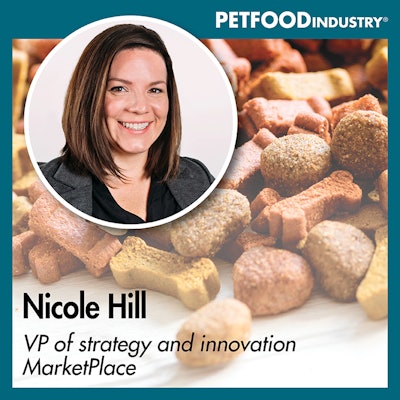
In this episode of Trending: Pet Food, Lindsay Beaton welcomes back Nicole Hill, vice president of strategy and innovation at MarketPlace, to discuss the latest dog food and treats trends shaping 2026. Hill draws on findings from Nextin Research's recently published dog trends report to explore how pet owners are building more customized, multi-format meals for their dogs — balancing a growing appetite for fresh, functional, and natural products against mounting affordability pressures.
We want to thank AFB International for sponsoring this podcast. AFB International is the premier supplier of palatants to pet food companies worldwide, offering off-the-shelf and custom solutions and services that make pet food, treats, and supplements taste great.
Lindsay Beaton, editor, Petfood Industry magazine and host, Trending: Pet Food podcast: Hello, and welcome to Trending: Pet Food, the industry podcast where we cover all the latest hot topics and trends in pet food. I'm your host and editor of Petfood Industry magazine, Lindsay Beaton, and I'm here today with return guest Nicole Hill, vice president of strategy and innovation at MarketPlace. Hi, Nicole, and welcome back!
Nicole Hill, vice president of strategy and innovation at MarketPlace: Hi, Lindsay. Thanks so much for having me back again. Glad to be here.
Beaton: It's very unlikely, but in case you're unfamiliar with Nicole or MarketPlace, here's what you need to know. At MarketPlace, Nicole leads Nextin Research, the source of future-facing consumer intelligence that keeps pet professionals ahead of trends. In her more than 13 years at MarketPlace, Nicole has partnered with brands like BARK, Kerry, TropiClean, and Farmland Traditions to integrate research and strategy, driving product innovation, brand development, and go-to-market success. MarketPlace is a strategic advisory firm that develops and activates pet and human nutrition brands.
Nicole's extensive pet market experience, as well as a recently published Nextin report on dog trends, makes her the perfect person to bring on today to answer this question: What are the latest dog trends in the pet food space? I want to start with a high-level look, and then we will dive into everything that's important. What are some of the top high-level trends you're seeing in the dog food and treats space?
Hill: Some of the top trends we're seeing are, of course, fresh pet momentum — it isn't slowing down, but it is being challenged by the need for affordability. We're seeing that parlay into how pet parents build a bowl, essentially how they make a meal with a combination of food products and formats. It's not a one-stop shop or a one-scoop-and-done situation. In many ways, it's a culinary experience for the pet as much as the pet parent — combining dry, liquid, and in-between products to introduce variety and promote functional nutrition in all aspects of their pet's diet.
Beaton: Are consumers being brand loyal when it comes to mixing? Do they want to get everything from a single brand, or are they equally willing to shop around — food from here, a topper from there? What are they looking for?
Hill: What we're seeing is that while there's certainly a degree of brand loyalty — especially when it comes to the main components of a dog's meal, since pet parents don't want to make transitions — as long as the main ingredients are the same as what they're currently feeding, they are willing to make a move. When it comes to combining a variety of components to make a meal, there is a willingness to reach across a variety of brands and product lines to build that solution for their pet.
Part of that comes from the fact that there's a limited number of brands that merchandise their products as a system. A brand may have kibble offerings, wet food offerings, fresh food offerings, and so on, but many treat those as different sub-brands within their portfolio rather than positioning them as a system the pet parent can customize within that brand.
For that reason — and because of the novel formats and delivery systems that pet parents aren't as accustomed to — they might find a trial-friendly size in a different brand, experiment with it, see if their pet takes to it, and see if it delivers the features and benefits they're looking for. Right now, consumers are gravitating toward what they think their pet needs to complete that meal: from a sensory standpoint, a nutritional standpoint, and on the functional benefit front.
Beaton: Given that pet owners have increasingly wanted a more customized experience over the last several years, and have really started playing around with the economics — trying to give their pets the best while staying within a budget — do you think the opportunity to present various product lines as a system is something brands are leaving on the table?
Hill: I do. It's an opportunity, but also a challenge. There is probably some fear of inefficiency or cannibalization within a portfolio. If a brand says, instead of my customer buying just our premium refrigerated fresh pet food, I'm going to introduce a kibble to complement it — or a more value-oriented product within the line — there's fear of cannibalizing more premium offerings. Especially for brands that have staked their value around a specific delivery system or format, walking that back isn't really an option. If it's not in alignment with their values, that makes sense.
There's also the reality of shelf space. Getting prime real estate in the brick-and-mortar channels where customers are actually shopping isn't easy to come by. When you have the option to get a certain number of SKUs of your main volume drivers in, versus potentially trading some of that out for riskier or more experimental products, that's a significant factor in determining what the assortment looks like.
On the e-commerce side, that aspect is less challenging in terms of what you can present to market. But we still see that so much trial happens in a brick-and-mortar setting before converting to ongoing purchase online, and trial tends to be driven by those in-person, in-store experiences.
Beaton: We know economics is one of the things pet owners are asking about. Dog owners in particular — unless you have a micro breed or small breed — tend to pay more for food than cat owners would. But we're also seeing that they still want the same level of quality; they want more for less, which is really the nature of consumerism. We're all looking for more for less in every industry. What specifically are dog owners asking for when it comes to feeding their animals?
Hill: Dog owners in general are looking for all-natural ingredients. I recognize that from a regulatory and messaging perspective, that means one thing versus what it means from a consumer desire and positioning standpoint. But it is still a factor — more than a third of dog owners consider it a top-three attribute when selecting a dog food. Affordable price comes in right behind it; more than a third also consider affordable price a top-three factor. Then, right behind that, is a specific health benefit — 32% of dog owners say they look for a specific health benefit as one of their top three factors when selecting a dog food.
When we think of those things together, it's that "I want it all" mentality: affordable, made with quality-sourced ingredients — or what consumers tend to associate with quality, which is the concept of all-natural — and then they want to see, experience, or believe in the health benefit that nutrition is positioned to deliver. My dog is a German Shepherd/St. Bernard/Golden Retriever mix, and hip issues have been top of mind since he was a puppy. For another owner, it might be seasonal skin allergies or sensitivities, or just overall skin and coat health.
We're seeing those standard need states continue to drive a lot of that, but also continually emerging need states that are gaining visibility in the pet space, just as they have in the human space — things like gut health and digestive health, which are continuing to gain prominence and importance in all aspects of pet nutrition, especially with the increased conversation around the mainstreaming of gut health as a critical component of overall health and immunity.
Beaton: I want to dive a little deeper into functional, but first I want to talk about how interesting it is that "natural" is still a top priority when the industry never quite got on the same page about what natural even means. When I started covering the industry 15 years ago, there was some discussion and it settled on a definition, but I feel like it hasn't really changed since then. From a marketing perspective, the industry has kind of catered to what people think natural is. Is there any movement on that front in terms of nuance, or does it really just mean "green, holistic, fill-in-the-blank with whatever little seedling-coming-out-of-the-ground stock image we've all used"?
Hill: It has evolved quite a bit, and one of the things I love about consumer research is that it still surprises me. While consumers do generally struggle to define their expectations of natural, one thing that challenges my conventional perception of what consumers believe qualifies as natural is this: when we looked at those motivated to purchase dog foods made with cultivated meat — lab-grown meat — 40% of those consumers said all-natural ingredients were a top-three factor in their dog food decision-making.
To one segment, cultivated meat would be the antithesis of natural. But to another segment, aspects of it can still hit that expectation in their minds — perhaps because it's less about the process by which the protein is produced and more about the quality of the inputs or an overall perception of premium quality. It points to a potential future trajectory where there is motivation for naturalness without a shared definition with the industry.
We probably need to come up with a term — collectively, consumers and industry alike — to describe what people mean and what they're looking for. AAFCO has a definition of natural, but whether cultivated meat can be produced by processes that fall within that definition is an interesting question I'm not positioned to answer. What I can say is that for a meaningful number of consumers, cultivated meat and "natural" are not conflicting concepts.
Beaton: That's striking, because this isn't the first time a major trend has been both popular and in direct opposition to what consumers say they want concurrently. Sustainability is another one — consumers say they want a whole laundry list of things, but also ask for things that directly contradict what would need to happen to be truly sustainable. Pet owners seem to exist comfortably in that dichotomy, but it's an absolute nightmare for an industry trying to figure out what consumers actually want. Is that a challenge the industry will always face, or are there any signs of things coming into alignment?
Hill: I remember a couple of years ago attending a talk at Petfood Forum about Black Soldier Fly Larva and its potential, and one of the themes was that regulatory is never going to be ahead of trends — because it's the trends themselves that create pull demand and the need for regulation. There is always going to be that tension, especially in areas considered very innovative. Even in long-standing principles like the concept of naturalness, one of the biggest challenges is the absence of shared language between the industry and consumers.
That's a huge part of what we try to identify in our Nextin consumer research. If we don't know how people define the concept of general wellness, or what "quality" means to them when selecting a food for their pet, we can't reasonably make business, product development, or brand decisions on a term we don't have a clear, shared definition of. Regulatory is always going to follow trends, and it requires pressure from consumers and the industry both.
Because consumers will seek out solutions regardless of regulatory guidance or barriers, and so much of how regulation is managed is retroactive and punitive — there's not really a way to consistently ensure every product perfectly matches those standards. There are trust signals like certain retail channel standards or organizations like NASC with their quality seal for preferred suppliers, but because of the overall lack of shared definitions and the nature of regulatory having to follow where trends lead, there will always be some of that tension. Our job as members of the industry is to try to keep those as closely aligned as possible as innovation develops.
Beaton: I did say I would get back to functional, and I want to springboard off of what we've been discussing. Functional is very popular right now and very multifaceted, but it seems a little more straightforward — maybe because there are defined conditions that everything is trying to meet. Is that playing into its popularity at all, or is it more a symptom of consumers paying closer attention to their pets and wanting that customizable experience?
Hill: In our experience, benefits lead the path to purchase — whether in supplements or, to a large degree, in food. As we talked about, a specific health benefit was one of those top three factors for dog owners. One of the things we do in our research is define what "functional" means, because what it means to the industry and what it means to consumers are two different things. We don't ask, "Have you fed your dog a functional treat?" We ask, "Have you fed your dog a treat that offers specific health benefits?" — and that allows us to really assess what those motivations are.
Functional benefits lead the path to purchase, but they're not the only consideration. Format plays a role, price plays a role, and brand plays a role. While consumers are certainly putting a mix of products — and in many cases a mix of brands — into their pets' bowls, we also see that about 40% of dog owners have fed their pet the same brand of dog food for the entirety that they've owned that pet, whether from puppyhood or for the dog's full lifespan.
That doesn't mean they've exclusively fed that brand, but there is that element of brand loyalty. If you're looking for a specific benefit, you'll probably start within the brand set you're comfortable with, and see if something there meets your needs — but it's not guaranteed. You might still be pulled toward other brands or other parts of the aisle.
Beaton: Is functional being seen more in treats as a straight supplement, or in a complete and balanced diet right now? And is there room for growth in any of those categories?
Hill: We see it happening across all of them — food, treats, supplements. From a consumer lens, when we look at those purchase-driving benefits, the numbers among those who purchase functional treats, supplements, and dental care for their pets — really all of these proactive health components — are striking. They over-index quite a bit for every single need state. They're purchasing products motivated by multiple need states, even more so than the average dog owner. It's really a motivated mindset, not just a product category behavior.
When we did consumer segmentation analysis for the dog category, we found that while benefit is important, there are premium segments that are not functionally focused — they care about feeding premium foods in multiple formats, but aren't functionally motivated. It's really more of a psychographic factor specific to dog owners who share certain values and priorities, rather than something tied to a specific product category.
Beaton: There is so much going on right now — and every year it feels like there's even more. What are the current barriers the pet industry and the dog segment are facing when it comes to any kinds of products? Where are the pain points right now?
Hill: The pain points are multifaceted, and part of it depends on the positioning and priorities of the brand as well as the consumer segment. Even those we call "invested idealists" — generally not price-sensitive, early adopters, willing to pay more for sustainability — affordability still matters to them. While some in that segment don't put as high a value on price, it affects purchases across the board.
Trying to innovate is always an expensive endeavor for brands, but even from a trial standpoint for consumers, if you're trying a new product and you don't know whether your dog will like it, whether it will do what you need it to do, or whether it will deliver an observable benefit — that's a real barrier. Brands are going to have to make a strong case to drive trial and offer trial-friendly pack sizes that allow for low-stakes barriers to entry when it comes to new product innovation.
I also think brands that have positioned themselves exclusively around fresh refrigerated and fresh frozen options — not freeze-dried or shelf-stable types — are going to be challenged to grow their market if they cannot offer something more price-accessible. That's where toppers come in. There has to be an acceptance that fresh food is sometimes used as a topper, not necessarily as a full meal, even though it's sold as a complete and balanced diet. The question is: how can brands speak to that usage without abandoning their positioning and their belief that fresh is best?
On the other hand, brands that have been around a long time and established credibility are going to have to branch out in ways that invite variety — maybe that means selling a smaller bag of kibble alongside other food types and formats, making the customized bowl possible for dog parents in a way that feels distinct and intentional. All while meeting the nutritional guidelines for a complete and balanced diet, because at the end of the day, that's essential — not just from a regulatory standpoint, but for the wellness of our pets.
Beaton: If a company is trying to figure out how to make all of that happen, do you think they should play the numbers game — explaining that per bowl it costs this much, or that a larger bag is a better value — or appeal more to pet owner emotions around health and wellness? Or do they need to find a balance and do both? Does it depend on the audience?
Hill: It depends on the audience. In our consumer segmentation research, we identified that 34% of dog owners are what we call "budget balancers" — budget-minded dog owners who are also selective in their purchases, meaning they buy three or fewer pet product categories for their dog. That includes toys, beds, food, treats, supplements — three or fewer. They're pretty selective in what they're purchasing, or they choose affordable dog food as a priority. That's about a third of pet parents overall, so the message for a budget balancer is going to be different from what we call "eco-agents."
About 13% of dog owners are eco-agents — eco-conscious dog owners who are willing to pay more for sustainable pet products, but who feed non-premium food formats. Different from those invested idealists who are willing to pay more for sustainability and feed premium food formats. Eco-agents are motivated primarily by the sustainability factor and don't necessarily value food format as a major driver in their decision-making.
For some consumer segments, a math equation can help justify a decision. As brands collect more data on how certain nutrition products impact a dog's overall health and wellness — and the proactive health piece that can minimize veterinary visits and out-of-pocket expenses — that's one facet. Then there's the investment people want to make in sustainability factors like upcycled ingredients. It really is segment specific in terms of how brands communicate their value to different pet owner audiences.
Beaton: As we transition to talking about opportunities, I want to start with something you just said about veterinary visits and nutrition as a component of that. Pet owners more than ever are considering the holistic health of their animals, and nutrition has always played a role in that — but I think it's playing an even larger role as prices continue to rise everywhere, and veterinary visits in particular are getting more expensive.
I'll use myself as an example: I'm very proactive about wellness visits and dental cleanings for my cats and dog, and I can tell you my bills have gone up. If people are having to make trade-offs, and they can find a higher quality — or perceived quality — dog food that they feel good about, is that an opportunity the pet food industry could be taking advantage of in terms of positioning? I know you have to be careful with claims, but just taking the more holistic view and saying, "This is a genuine, legitimate part of your animal's health and wellness — here's why it matters."
Hill: I think so. We've seen a trend in the human nutrition space around proactive health for quite some time, and as we continue to see crossover between human and pet trends, that's one that's certainly translating. It speaks to the elevated focus on need states around things like gut health and immunity. The challenge remains: how do brands prove that value when in many cases you're playing the long game?
My dog is 14 years old, which — especially for a big dog — is remarkable. We used a pet age calculator, and it put him at 103 in human years. When I think about that, I don't know that anyone could have told me when he was a puppy what to expect, and I'm not sure I would have had complete confidence in that kind of positioning anyway. Brands and companies are getting better at validating their claims with clinical research and other evidence, but when it comes to quality of life and longevity, those are hard metrics to mentally wrap our minds around as pet owners. How much do we believe a claim on a package or backed by a veterinarian?
The proactive health piece is motivating, and I think it's a big driver behind increased interest in dental care beyond treats — we're seeing that across product categories. But it still requires quite a bit of legwork from brands to help consumers understand how that translates to out-of-pocket value when it comes to how they budget for their pets.
Pet parents don't budget for their pets based on income bracket — it's really spread across all household income levels. How you make that case, and what validating points you have to back it up, will continue to be something brands have to contend with. At the end of the day, it is an emotional motivator. Why do we want our dogs to live a long, happy, healthy life? Because we think they're better than most humans, and we want them around for as long as possible. Brands will continue to contend with how to communicate that value and back it up with credibility.
Beaton: As we're recording this at the beginning of February 2026, there is a lot going on economically and from an industry perspective, and everyone is trying to dig in and figure out how they're going to get through the year in the black. What other opportunities are out there that companies can focus on at a time when the initial instinct might be to pull back on innovation and new products — even though that's no way to build a business long term? What's out there to keep moving forward?
Hill: A lot of it comes down to need states that are underserved in categories where that need state isn't currently accessible. For instance, eye care and functional treats — especially for some of the smaller breeds that tend to have eye health issues — what does proactive health look like in the context of eye care for dogs? Not in ways that ask someone to wholly overhaul their dog's main diet, but ways to support that proactively.
I think brands will likely be discontinuing products that aren't performing, but that will make room for more value-oriented offerings — and I don't just mean cheaper or lower cost. The question is how things can be combined or bundled in ways that increase the total purchase while giving consumers more value: multiple products, greater variety, or combining need states in product formats and segments that are currently underserved.
Dog owners are purchasing an average of five and a half product categories when you think of everything from food, treats, toys, beds, and waste management. There are opportunities to merchandise differently. When you think about waste management and picking up after your dog, what does that look like alongside a digestive health supplement or food? Those kinds of bundles and trade-ups can motivate a pet parent to try something or make a switch they weren't considering before.
Brands are also going to have to invest in defending their market — especially those with more market share for others to pull from — and really listen to the consumer. You can look backward at purchase data and scan data showing the highest-driving pack sizes, product types, formats, and need states over the past 52 weeks, but ultimately, consumers can only buy what's on shelves.
If you want a real advantage, it's about looking ahead: what are those unmet needs, what is the white space in the category, what pain points are consumers expressing that you are uniquely positioned to address with speed to market that others can't match? That's more of a three-year outlook than a this-year play, but it's always important to be looking ahead. In the short term, bundling opportunities and cross-category combinations can help brands leverage what they already do well in ways that reach consumer segments they hadn't reached before.
Beaton: My audience knows that for these kinds of conversations, I always like to wrap things up looking to the future, and we're already getting a little future-focused. My final question: let's say we're having this conversation again in February 2027. All current things continuing the way they are, no wild surprises — what is the rest of this year likely to look like for the dog industry?
Hill: I think we're going to see some turmoil and fallout in the fresh pet food space. There will be brands that pull ahead because they understand how to ride the wave of shifting market dynamics and economic pressures, and there will be brands that struggle to keep up. There is still a lot of demand and interest in that category, so there's going to be a tug of war over the fresh pet food consumer — the prospect who has expressed interest or done some trial but hasn't entered into full adoption. Brands — not just in fresh, but across premium and conventional formats — are going to be hustling to make the best case to consumers.
That puts consumers in a position of power. It's almost like real estate when things shift between a buyer's market and a seller's market. This year, it's going to be a buyer's market. Pet parents have so many options to choose from, and some may have to scale back. Scaling back might mean: I used to include four different products in my dog's meal, now I'm going to focus on three. The volume of those three goes up, but they drop the fourth. Brands are going to have to make a compelling case to keep showing up in consumer shopping carts and in their dogs' bowls.
Beaton: Nicole, it is always a pleasure to talk trends with you. On the heels of the Nextin dog report coming out, I knew immediately I wanted to have you back on to talk about a segment of the market that's so saturated it can be difficult to carve a path even in a normal year — much less dealing with all the extra factors of the last few years. It's always good to see where things are trending, and it's always good to have you on. Thank you.
Hill: Thank you, Lindsay. It's always a pleasure to chat with you — you always ask such thoughtful and insightful questions. Thank you.
Beaton: Before we go, where can people find more information about you, MarketPlace and Nextin?
Hill: Our dog research is available for licensing right now. It includes a 73-page deep-dive analysis and report — covering so much more than what we touched on today — as well as drag-and-drop PowerPoint charts for all of the major dog trends you'd want to put into your presentations and sales decks. That's all at nextinresearch.com.
Everything on the strategy, branding, and marketing front is at marketplacebranding.com, where we do everything from go-to-market strategies to product packaging design that helps brands bring products to market — or refresh brands that need to rethink their strategies in the face of an ever-changing consumer landscape.
Beaton: Perfect. That's it for this episode of Trending: Pet Food. You can find us on petfoodindustry.com, SoundCloud or your favorite podcast platform. You can also follow us on Instagram @trendingpetfoodpodcast. If you want to chat or have any feedback, I'd love to hear from you — feel free to drop me an email at [email protected].
Thanks again to our sponsor, AFB International, the premier supplier of palatants to pet food companies worldwide, offering off-the-shelf and custom solutions and services that make pet food, treats, and supplements taste great.
Once again, I'm Lindsay Beaton, your host and editor of Petfood Industry magazine, and we'll talk to you next time. Thanks for tuning in!