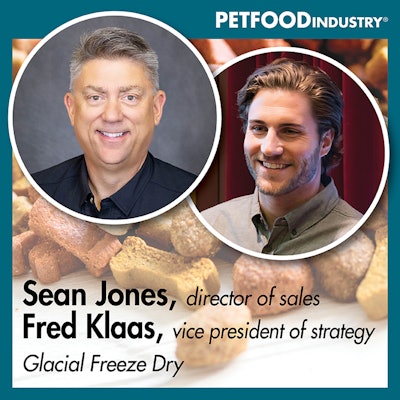
In this episode of Trending: Pet Food, Lindsay Beaton speaks with Sean Jones, director of sales, and Fred Klaas, vice president of strategy, at Glacial Freeze Dry about the complexities of scaling a pet food business. Jones and Klaas share insights from their experience growing Foodynamics from a single tabletop freeze-dryer to processing 30,000 pounds of raw materials monthly before its acquisition by Glacial Freeze Dry in 2025.
Jones and Klaas emphasize that while ideas may come easily, successful execution requires balancing strategic vision with practical implementation, and ultimately understanding the "why" behind scaling decisions.
We want to thank AFB International for sponsoring this podcast. AFB International is the premier supplier of palatants to pet food companies worldwide, offering off-the-shelf and custom solutions and services that make pet food, treats, and supplements taste great.
Lindsay Beaton, editor, Petfood Industry magazine and host, Trending: Pet Food podcast: Hello, and welcome to Trending: Pet Food, the industry podcast where we cover all the latest hot topics and trends in pet food. I'm your host and editor of Petfood Industry magazine Lindsay Beaton, and I'm here today with Sean Jones, director of sales, and Fred Klaas, vice president of strategy, at Glacial Freeze Dry. Hello to you both, and welcome!
Both answer: Thank you for having us.
Beaton: In case you're unfamiliar with my two guests or Glacial Freeze Dry, here's what you need to know.
Sean brings over 30+ years of executive leadership experience, including C-level roles managing multi-billion-dollar P&Ls. His passion for pet nutrition has shaped the last decade of his career in the pet industry. Sean and his wife founded What's In The Bowl Pet Shops, based in Wisconsin. Sean also founded Foodynamics, a freeze-drying company that private-labeled products for more than 150 pet industry brands. In August 2025, Foodynamics was acquired by Glacial Freeze Dry, where Sean now serves as Director of Sales, partnering with brands across the U.S.
Fred Klaas is the VP of strategy for Glacial Freeze Dry, joining the business in 2025 after working with its owners for most of the last decade. He brings his experience in marketing, operations, and business development to support Glacial as it embarks on a new chapter in the freeze-dried industry.
Glacial Freeze Dry is a family-owned, U.S.-based contract manufacturer and co-packer that helps brands take freeze-dried products from pilot to production with clean-label recipes, flexible batch sizes, and audit-ready processes. With their state-of-the-art freeze dry technology, Glacial Freeze Dry gives brands a low-stress path to growing — and eventually insourcing — their fresh ideas into in-demand freeze-dried lines.
Sean and Fred's business knowledge of taking a company to the next level is why I've brought them on today to answer this question: How can a company scale up its business? What kind of experience have both of you had scaling a business?
Jones: I can take that one first. We scaled Foodynamics, which was acquired by Glacial Freeze Dry in 2025, from freeze-drying some stuff in a commercial kitchen in the back room of one of our independent pet stores. We were freeze-drying products, making them for our customers. We scaled that business from having one tabletop freeze-dryer to having commercial freeze-dryer scaling to about 30,000 pounds of raw materials a month. That was quite the journey. One of the things that we've always said is every step of the way, we probably always should have gone bigger. Scaling has been something that's on our mind every minute of every day.
Klaas: I've been fortunate enough to work for a handful of different companies in various stages of their life cycle and have really enjoyed the early side of things and being able to have a large impact, an outsized impact for the number of folks that you have and see the company really grow and transition as it starts to scale. As we look to take Glacial to its next level off the success that Sean started with Foodynamics, we're looking to leverage Sean's experience in Fortune 500 companies to small pet shops and my background in a number of different industries to really see Glacial take that next step.
Beaton: I can't help but use Glacial as our case study for this conversation. To the audience, we're going to go back and forth between talking larger business strategy and then specifically talking about Glacial as a case study in all of the steps that it takes to scale up a business. We're going to start that part of the conversation right now. When scaling up Glacial, what have been some of your considerations and what was the initial conversation like? How do you know when to pull the trigger on something like this?
Jones: That's a really good question, because that's a question that's always been in our minds for the last 10 years. What really drove us was, it seemed every step of the way shortly after every expansion that we made, we probably had five pretty milestone expansions over that 10-year period. We reached capacity way quicker than we anticipated. Some of that had to do with the timing and the industry, but it also had to do with what we could afford to do with each expansion. Pulling the trigger was basically, hey, we have these great business opportunities ahead of us, and how much business are we currently turning down. It's probably a horrible business strategy to have, but we were just trying to meet the demand that our customers put in front of us.
Beaton: Do you think there's some benefit to waiting to meet the demand, or is it more common to project out the demand and then start scaling up before the demand is there?
Jones: In my previous roles, I never liked to be in the position where we were just responding to the demand. I've always wanted to be more strategic, but in our case, funding was really the limiting factor of being able to meet that demand. In my previous roles, I've had experience increasing business over a three-year period by 2,600%, but that was the goal from day one was to reach that level. We were properly positioned in the market to be able to do that. I know Fred can talk about now with the acquisition of Glacial Freeze Dry, we're really in that position where we're going to be able to stay ahead.
Klaas: The unhelpful answer here is that there isn't a right or wrong way to do it. Different companies are approaching it differently. For us, the way that it's been done thus far has been a combination of both Sean trying to respond to and track demand a little bit more closely. That tied a lot to financing and bootstrapping and staying lean as a more startup.
Certainly now through the acquisition of Glacial, we're using that as justification to make some forward-leaning bets and look towards the future of how do we stay ahead on our supply and project what we think reasonable demand looks like and be able to meet that demand as it comes to fruition as opposed to a little bit more on the responsive reactive side.
Beaton: Now the pet food industry in particular has a lot of companies that at one point or another, whether it's now or in the past, identified as startups, whether it's an ingredient company, a brand in particular. A lot of pet food brands started out as startups. You've already mentioned, Sean, that capital is the number one consideration. Everything else can be in place, but if you don't have the money to scale up, it is not happening.
When do you have that conversation and how do you make sure that money is there to scale up your business? What is that process like? Because it sounds like that is probably the biggest stumbling block.
Jones: You're absolutely right. You have to have that strategy in place from day one. I look at a lot of the startups out there. They're already raising capital before they produce a product. Our growth was very organic. We were producing products at a very small scale for the demand that was in front of us at the time. We were self-funded. As we look back, we probably should have said, how seriously are we going to take this rather than just meeting the demand in front of us and being more strategic on where we think it was going to go.
One of the most important things for us was finding the right partners for funding. We were very much challenged with that and certainly we spent more than 12 to 18 months looking for that right partner when we decided to take that strategic leap. One of the other things that most people don't consider is even though you have the capital, being able to be strategic in your growth. Our greatest expansion was during the pandemic and the availability of machines.
We were able to secure some business loans, but the availability of machines, that took nine months to have a custom machine built for us. There's a lot that goes into it. Having the right capital partner that aligns with the original goals and mission of the company. I have to say, I sometimes don't want to admit how many groups we talked to that it was very clear from the early minutes of the conversations that the mission wasn't going to be aligned.
Part of the reason why it took us so long to find the right partner was the combination of finding the right capital partner or finding the right organization that you really feel comfortable selling to. We'll probably talk more about this, but really the depth of the people that you surround yourself with. I've always liked to talk about human capital and finding the right people.
We were very successful and lucky, frankly, that we were able to work with people like ourselves that weren't in this industry but had a lot of experience in other industries and just tremendous aptitude to grow into an industry.
One of the things we just did is we found people that had these phenomenal aptitudes and prior successes in their careers that shared our passion. We started to adopt best practice standards right from the beginning. The combination of finding the right partners, the right machine manufacturers and the right people is really what contributed to our success.
Klaas: One thing that I'd like to add from the perspective of the people side of things, that's one of the things that's been really exciting is coming into the pet industry and seeing that it's a real true passion area. It's not just an interest or a job or some place to work. It's something that a lot of our folks and a lot of the folks that are in the industry are just deeply passionate about that I think it drives a deeper level of commitment and harder work towards success. Sean is a great example of that. I haven't met anyone yet that's more passionate, more interested, more deeply mission-driven, and the people he's surrounded himself with certainly reflect that ethos as well.
Beaton: I feel like that's something that's really important to talk about because the pet food industry in my experience, and I've been in the industry for 15 years now, is that there is a lot of passion and there are a lot of mission-driven companies and people who feel very strongly about why they're in the industry and what they want to accomplish.
I think that it really can't be understated how important it is when you're trying to do any kind of business partnership, anything from buying equipment to finding the right company to work with in a merger or an acquisition, to ensure that everybody is on the same page. What are some of the details that go into that? You said that you had some meetings where you knew in the first few minutes and you walked out of the meeting and were like, okay, not that group of people.
What are some of the things that you have to balance, because you're trying to grow your business? It is a business proposition, but it is also a people proposition. How do you walk that line between doing what's best for the business in terms of growth and meeting your business strategy versus being able to look yourself in the mirror and go, okay, we are sticking true to the mission that means so much to me?
Jones: Wow, that's so profound because I actually remember doing that looking in the mirror, literally looking in the mirror. At least we were in the position where if we didn't find a partner, the outcome was going to be we don't expand. We've always positioned ourselves in that space where we could either stay right where we were, or we could scale down.
Those are discussions I had with my wife and our team. It's so important to have that right partner. When we were talking with Glacial, I could tell the exact moment where I knew that this was going to work. They asked, would you be willing to compromise on how you source some of your products, some of the business practices that you've shared with us? It was one of those challenge questions. They said that would have basically killed the deal because they really wouldn't want us to be willing to compromise.
That was just the moment for me that I realized what's important to us is just as important to them. It's kind of like a dating relationship, right? You're really getting to know each other and being able to not only do the due diligence that you do in business, but that due diligence to determine what that partnership is going to look like and whether you're both headed in the right direction, or the same direction, I should say.
I just felt very good about that, but we were lucky that we always had that fallback of, well, we're going to decide not to expand and we're going to stay right where we're at. Having that due diligence into finding the right partnership or having the capability to do that to not have to expand. I don't feel like even in our current relationship that there's that pressure. I spent 30 years of my career having that pressure of having to reach a quarterly margin. It really changes a lot of your thinking and how you execute on that strategy, whereas we're still, to this day, focused on the mission and letting that guide us. I could tell you after 30 years, that is the most liberating and almost spiritually liberating feeling that you can have in a career.
Beaton: What was it like on your side, Fred? And then just your experience in business in general with doing something like this, walking that line?
Klaas: A lot of companies talk about people as a differentiator, as a core part of their mission. How you bring that to life and whether that actually holds true is something that isn't always the case. It isn't something that everyone always holds true. When we saw what Sean had been building and the direction he'd been heading in, we felt really strongly aligned with what he was doing and how he was doing it and who he had working for him. Our hope and goal is certainly to continue that. Zooming out and how that plays into overall business, for us as an organization, we're very values aligned, very mission-driven.
Understanding from the beginning what some of those boundaries are, as Sean referenced, asking about what's your willingness to be flexible on some of those things like sourcing, like quality, how willing are you to change what you've been doing? In some ways, change is necessary, growth is necessary, but in some of those core foundational things like a values-related area and not being willing to flex on that. Identifying that early on is something that's going to set us up for success and be really important to where we're headed.
Having those conversations regularly where we're talking about opportunities and potential different directions we can go, but really leaning back on, okay, is this who we want to be? Is this how we want to do things? Making sure that everybody is holding each other accountable to this is the direction we want to go is certainly a big part of what we feel will make us successful.
Jones: One of the things that really exemplifies who Glacial Freeze Dry is, if you look at the logo, there's a hexagon around a glacier, and there's a space in that hexagon, and that actually represents transparency. That was just part of why I sometimes say they had me at hello, because we actually knew them pretty well before the acquisition. That just exemplifies what was important to us. Then you actually see that exemplified within a logo and transparency is one of our core values.
They had the much more creative sense than I would, but they actually included that as a graphic representation in their logo. I hope that every company that goes through an acquisition or if they bring on an investor has that same feeling about the relationship they have, because I think that's when you're scaling, one of the keys to success in the future is if you're acquiring a company or if you're investing in a company, what's made you want to invest or acquire that company will continue.
Those core values that are held by both parties is incredibly important. I'm not sure if that synergy is always well recognized in the beginning. I think you have to get to know each other first.
Beaton: I want to talk about potential pitfalls. We've been dancing around them, not the right relationship, the missions don't align. But there are a lot of companies in the pet industry, especially brands, who might be considering scaling up for the very first time. You guys have experience. This wasn't your first rodeo. You had the lessons learned to go behind to make sure this was going to go the way that you wanted it to go.
If you can think back a little bit, what might be a big pitfall for somebody who's scaling up for the very first time? What is it that they really need to have in their heads when they start to try to figure out, do I want to be acquired by somebody so that they can help? Do I just want to continue to try to get investors, continue to try to raise more money to scale up? What are some of the really important points where a company can just completely fail in their scaling up journey? Then how do you navigate something like that to keep from happening?
Klaas: To start, we've made a lot of mistakes. We will continue to make mistakes. We are far from perfect. We have some experience we're pulling from. But every business that you're scaling has new challenges. There's going to be uniqueness to it. We're certainly using our experience and pulling together as a team to try and be as successful and mistake-free as we can.
One of the things that comes to mind immediately is balance. Trying to strike the balance between where can you foresee going in the near future versus where do you need to go in six months, a year, five years, and trying to be realistic about that. I think it's easy to get wrapped up in the idea of how quickly your business can scale or how quickly you can get to that next level.
Not getting too far ahead of yourself, not forecasting out too aggressively is definitely something that we've been really cognizant of. You saw that in the wake of the pandemic across a number of different industries. A lot of folks felt like it's good now, demand is really strong. It's going to be great forever. We're just on this upward trajectory. That obviously hasn't proven true.
Keeping that in mind, it's fortunate for us to have that in recent memory, to be able to look ahead in our business now and try and say, here's where we think we can be. At the same time, why I say balance is because we also don't want to be forecasting too conservatively and not thinking big enough and ending up in a situation where we're effectively turning on new capacity, turning on new demand, scaling to a point that we've all of a sudden already met and exceeded. Now we need to figure out and scramble on taking another step forward. That's one thing that's been helpful for us is Sean is a dreamer and a visionary and someone that absolutely thinks big.
Myself and some of the other team, we've been able to harness that in the right direction and get to a point where we've forecasted demand and forecasted the future in what we feel is a fairly realistic perspective and has some lofty goals, but that feel attainable. Finding that balance and being appropriately conservative and appropriately hopeful are definitely challenges and struggles that a business could have.
Jones: To echo that, I always call myself a student of the pet industry way beyond the decade that I've been working in it. My family was somewhat involved in it. One of the things I've been seeing, especially in the last probably three or five years, is with the acquisition of a lot of different companies or investments made in a lot of different companies. In my previous career, I've been involved in hundreds of those types of acquisitions or investments.
One of the things that I think you have to know with eyes wide open when you're looking for that investment or to be acquired is if that acquiring company or the investment entity has certain expectations, whether they're quarterly or a longer-term strategy, you really have to be aware of, does something need to happen that has never happened before with your company? Do you have to do things so much differently?
For example, if you're selling in just online or if you're selling in small retail locations, do you need to go into a big box store, do you need to engage in an omnichannel presence in order to hit certain returns? Sometimes what happens with that is if you have investors, the founder or the owner, the company continues to get diluted because they're not meeting. You have to really read the fine print when you bring on an investor, because a lot of times if you're not hitting certain benchmarks or expectations, you continue to get diluted.
The other thing, too, is if the expectation is to be in this many channels, you have to realize what your market share is. We're very aligned on realizing that we know who our end consumer is, who the pet parent that's going to buy the types of products that we produce. We know who they are. We have, I think, a very realistic expectation of what that market share looks like today. We have projections on what that market share is going to look like in the coming years.
The danger that happens is acquiring companies or investors look at a company and they compare it to maybe a category that isn't really aligned. It's not the same. You can't compare a baked treat with a freeze-dried treat, for example. It's a very, very different consumer. A lot of times the expectations are you can put a more expensive, more premium, in our opinion, product on the same shelf next to a lot cheaper product and then have to be on a race to the bottom in order to compete with that cheaper product or a product in a completely different category.
One of the big pitfalls is comparing either your category, and for example, we work with a lot of different companies, and they might be in a grocery store, and the products that we're making, they're generally more expensive than most of the other products on the shelf in a grocery store. Then they're experiencing a challenge with sales. They want to continue to lower their MSRP. That's a lot of times a mistake because you're competing with a completely different market segment. If the expectation of a company or a new entity is that you're going to compete with a different category or have the same growth rate or expect the market share to increase, that's a huge pitfall and it's a huge danger and it's not a realistic expectation.
Klaas: Concluding those comments with the word expectation also brings to mind another pitfall I think that we see a lot and that we're certainly trying to avoid is the challenge of going from idea to execution because I think in a lot of ways, ideas are easy.
Execution is really challenging and I think often oversimplified. That could be as simple as how does your product compete on the shelf at what price point? To internally, how do you appropriately scale your team and identify what that needs to be ahead of when it needs to be there so that you're not burning your team out or stretching too thin?
Especially when you're a younger company scaling from startup to a more mature company, you have fewer hands doing a lot of different things. Making sure that they have the support and you're adding team members appropriately. Similarly, food safety, when you have a lot more product moving through your facility, those sort of things and processes that maybe worked at a smaller scale, suddenly don't at a much higher volume.
Making sure that you're focused on some of those things. It's one thing to just say, hey, we're going to start doing X amount more product every day, but to tactically execute that and create the processes, bring in the people and be able to do that, I think is definitely a big challenge to be wary of.
Beaton: I think one of the things you said, ideas are easy, execution is really challenging, is such an important thing for people to hear in business, especially people who are newer to business. I think you should probably put that on a pillow because ...
Klaas: Well, I certainly didn't come up with it on my own. I'm sure it's just a regurgitation of others, but it feels like ideas are hard, right? When the thought is to come up with a great idea or come up with a great company or we're going to do this, that feels hard, but the hard part is actually on the back end, right, and making it come to life and come to fruition. That's something that successful brands, successful companies, they're all really good at.
Jones: Yeah, I agree with that, absolutely. We were at a conference and someone asked us, I was doing a talk with entrepreneurs and they said, well, how do you get all this done? Actually one of our manufacturing partners said, well, they actually execute on the things that most people only think about. In business, execution, in my opinion, is everything. Being able to take an idea and then operationalize it and make it into reality is everything in business. You're absolutely right, Lindsay. It's the most under-realized universal truth in business.
Beaton: As we wrap things up, you've given people a lot to think about and we've covered a lot of ground in terms of scaling up from a case study to overall business strategy, the pitfalls, the opportunities, the conversations you need to have. Let's say somebody is having a conversation with you and they look you dead in the eye and they're like, my business is ready to scale up.
What is the one question you would ask them that they need to be able to answer before they can really start on this journey?
Klaas: Man, that's a great question. More philosophical, but of course, what comes to mind immediately is why. Why are you doing this? Why do you think you're ready to scale? Why do you want to go to the next level? Which leads into what are you trying to achieve, what's driving you, understanding that why. In the pet industry, and certainly for us at Glacial, that's driven by this idea of we want better options, more options.
We want excellent brands to be on the market for pet parents and to create really cool, unique products that are species appropriate. Understanding that why is a huge part of that decision of am I going to take this next step? Because baked into that is also a ton of hard work, a ton of time, a lot of money, and certainly sacrifice. Understanding that and what's driving you is a big part of someone knowing whether or not they're ready for that.
Jones: Absolutely. That's usually the first place I go over to the five whys, why you're going to do this. Probably even bigger one is if you're ever going to get funding for your project, what's your plan? How can you execute on that? Fred's absolutely right. That first question is the why and probably asked repetitively and rhetorically a million times.
Beaton: Well, I want to thank the both of you for coming on the show today. Scaling up, as we've talked about, is a significant conversation in the pet space because so many companies come in either from other industries or they enter as a small brand with a lot of vision. I think the conversation we've had today is important because it's a frank discussion about what happens when you feel like you're ready to move up to the next level with your business.
It is a complicated prospect, and there are a lot of moving parts. I think it's really important to get it out there. Before we go, I always like to do a little plug for my guest. Where can people find more information about the both of you and Glacial Freeze Dry?
Jones: You can find us online at glacialfreezedry.com. You can also follow me on LinkedIn. I'm very active on LinkedIn. I try to post almost every day. My username is Sean B. Jones.
Klaas: To echo Sean, the website's a great place to reach out to us. We'll be pretty active, I think, at a number of events over the next year. Look us up at Global and Superzoo and a handful of other events in the industry. Sean is a great person to connect with on LinkedIn. He's super active. I'm a little less active on socials these days, but also on LinkedIn at Fred Klaas.
Beaton: Perfect. That's it for this episode of Trending: Pet Food. You can find us on petfoodindustry.com, SoundCloud or your favorite podcast platform. You can also follow us on Instagram @trendingpetfoodpodcast. If you want to chat or have any feedback, I'd love to hear from you. Feel free to drop me an email at [email protected].
And of course, thanks again to our sponsor, AFB International, the premier supplier of palatants to pet food companies worldwide, offering off-the-shelf and custom solutions and services that make pet food, treats, and supplements taste great.
Once again, I'm Lindsay Beaton, your host and editor of Petfood Industry magazine, and we'll talk to you next time. Thanks for tuning in!