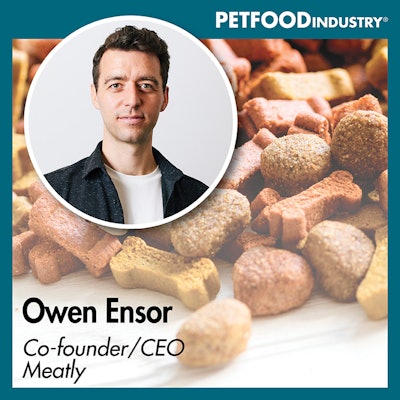
In this episode of Trending: Pet Food, Lindsay Beaton speaks with Owen Ensor, co-founder and CEO of Meatly, about the current status and future of cultivated meat in the pet food industry. Ensor shares insights on consumer education, market acceptance across different regions, and the role cultivated meat can play in creating a more sustainable, ethical pet food system. Ensor also outlines his vision for the next five to 10 years as the industry works to optimize production and expand availability in both pet food and human food markets.
We want to thank AFB International for sponsoring this podcast. AFB International is the premier supplier of palatants to pet food companies worldwide, offering off-the-shelf and custom solutions and services that make pet food, treats, and supplements taste great.
Lindsay Beaton, editor, Petfood Industry magazine and host, Trending: Pet Food podcast: Hello, and welcome to Trending: Pet Food, the industry podcast where we cover all the latest hot topics and trends in pet food. I'm your host and editor of Petfood Industry magazine Lindsay Beaton, and I'm here today with Owen Ensor, co-founder and CEO of Meatly. Hi Owen, and welcome!
Owen Ensor, co-founder and CEO of Meatly: Hey, Lindsay. Thanks for having me on.
Beaton: In case you're unfamiliar with Owen or Meatly, here's what you need to know.
Owen Ensor is the CEO and co-founder of Meatly, a UK-based biotech startup. He leads the company in pioneering sustainable alternatives in the pet food industry and advancing cultivated meat innovation.
Meatly focuses on making real meat without animals. It was the first company in the world to gain regulatory approval to sell cultivated meat for pet food, creating a more sustainable and ethical way to feed pets.
Owen's experience makes him the perfect person to bring on today to answer this question: What is the status of the cultivated meat market?
Owen, there has been a lot of research done and probably quite a few advancements in the last several years in particular when it comes to cultivated meat. Just to start off, so everybody's on the same page, can you give us an overview of cultivated meat and its current place in the human food market and then how that translated into the pet food market?
Ensor: Yes, I can. Cultivated meat or lab-grown meat, as it's also known, is a process where you take cells from an animal or from an egg. At Meatly, we're focused on chicken and we take a single sample of cells from one egg one time, and then we can create an infinite amount of meat forevermore and we use less land, less water, fewer CO2 emissions. We don't use any antibiotics or steroids or hormones. It is a sustainable, kind, healthy way of growing meat.
This technology has been around for a long time in the biopharmaceutical space, and about 10 years ago, the first cultivated meat company was started. That was in the Netherlands called Mosa Meat, and there's a few companies that have been around about 10 years, all focused on human food.
There's now many markets in the world where cultivated meat has been sold for human food. The U.S., Singapore, Hong Kong, Australia and New Zealand, and sales are ongoing in those territories. This year, Meatly became the first company in Europe to ever sell cultivated meat. That was in the UK for pet food. We've made good traction in terms of safety, in terms of regulatory approval. Cost reduction has been another key angle for a lot of cultivated meat companies, which we're also making good progress on. The next step now is to scale up.
Cultivated meat companies today are still producing small quantities. The largest one is probably producing half a ton a month, if that. This is still very nascent, and now the industry needs to start scaling, which is a very exciting step. It's one we're about to take at Meatly. There's a few other companies who are starting to scale, but it is still probably at least five years before you start seeing significant presence of cultivated meat in our restaurants, on our plates, and in our pet food.
Beaton: How long have you been involved with cultivated meat and how did you get involved in it?
Ensor: I started Meatly about four years ago, but I have been in and around the alternative protein universe for a long time. I started off running an insect protein business about 10 years ago. That was in Nairobi in Kenya. I scaled that up, built one of the first industrial facilities using insect protein as chicken feed. That is still going. It's a great business.
I did a few different things after that. I did some political consulting. I started a company in the US. Then I came back to alternative proteins on the plant-based food side, advising companies and investors. Then I started Meatly four years ago.
Beaton: What was it in particular about cultivated meat that interested you? What kind of potential did you see in it? Because it's still such a new idea in terms of the everyman knowing that it's a thing. A couple of things you touched on really quickly a few minutes ago, cost, scaling up, those all seem like significant challenges in this particular space right now. What made you go, yeah, I want in on that?
Ensor: I've looked at a lot of different areas. Ultimately, I think what we all want is a food system, which is healthy, sustainable and kind. That's what we're trying to create. There's different ways of doing that. I think alternative proteins have a very important part to play in that. I'd looked at insect-based, I'd looked at plant-based. I'd also looked at fermented proteins.
One of my key takeaways is that people really want meat. There's a strong social bias towards us eating meat. There's a strong health association. There's a strong economics association with eating meat. We also want to feed our pets meat. That is seen as a very natural, very normal thing to do. My challenge when I looked at plant-based, insect-based, fermented is we're not fulfilling that very strong psychological need to eat meat.
That's the kind of holy grail and the promise of cultivated meat is that you can have your meat and it'll taste like meat, it'll look like meat, but it'll be more sustainable, it'll be healthier, and it'll be kinder. That is a very exciting vision, and it's one that I wanted to help make happen. That's why I started Meatly. I kind of saw that there was a more pragmatic, faster way of scaling cultivated meat. That was by focusing on pet food, by focusing on cost reduction. I was very lucky to bring on an amazing technical co-founder, Helen Cruise. We have an amazing technical team who have been able to dramatically reduce the cost of cultivated meat in the last few years.
Beaton: What have been some of the top challenges in the last few years when it comes to cost reduction? What are some of the challenges that you're looking at right now as you start the scaling up process, which you said is going to take a little while?
Ensor: The essential challenge, as I mentioned, a lot of the technology came from the biopharmaceutical space. It's used to make vaccine production or cellular therapies. That entire industry is very low volume, very high margin products. The entire economics was always set up for low volume, high margin products. We needed to flip that quite dramatically into very high volume, very low margin food products. That has been the fundamental challenge. To take two examples:
As I mentioned, we're taking a sample of cells from a chicken egg. What we do is we put those in a large vessel, similar to fermentation, those large steel vessels you see in microbreweries. We add in amino acids, minerals, vitamins that the cells then metabolize. Those amino acids, minerals, and vitamins are known as the culture medium. That is very, very expensive. It can be up to 700 pounds per liter. You're getting out a couple of grams per liter. That works in biopharma, but it doesn't work in food. We've reduced the cost of that from 700 pounds per liter to 22 pence per liter. Truly dramatic cost reduction. We've increased the yield dramatically as well.
Those vessels that we grow the cells in can be very, very expensive as well. We have also patented our own low-cost bioreactors, as they're known. They're about 15 times cheaper than traditional bioreactors. We very successfully and consistently reduce the cost of these key cost components of cell culture and cultivated meat to the point now where we're pretty confident in the system we have, the technology we have, and it's about scaling it up.
There are still biological challenges in getting the cells to grow at scale, but it becomes more of an engineering challenge now, which often has been done. It's been done in biopharma, it's been done in large-scale fermentation facilities, but it's maintaining the controls, maintaining sterility, maintaining the yield and cell optimization that we have. That's what we're now stepping into.
At Meatly, we're about to build our pilot facility. It's going to be about a 900-square-meter facility where we'll have much larger vessels that we're growing them into 2,000 liter and 20,000 liter vessels. We'll start to look like a microbrewery, essentially, where we're growing meat.
Beaton: I have found the topic of cultivated meat so fascinating since it first hit my radar. Just in terms of the idea of growing something that is meat but you're doing it in a lab, and other than the initial biomaterial, an animal is not actually involved in the production.
What is some of the science behind scaling up? Do the cells break down after a certain point? Are they able to continue growing off each other indefinitely? What does scaling up look like?
Ensor: The main challenge with mammalian cells. If you are growing yeast or bacteria and doing recombinant protein production or something. Let's just take yeast, for an example, often used to make beer, and they can do that in 200,000, 300,000 liter vessels. These are giant vessels. The reason they can do that is because yeast has a cell wall. It is very robust as a cell. Mammalian cells don't have a cell wall.
That is great because it makes us very flexible. It makes all animals very flexible. It gives us more mobility. But the cells are very weak, essentially. One of the main challenges is around shear stress. You need to rotate the bioreactor. You need to make sure the media is equally distributed.
In rotating the impeller in a bioreactor, you can burst all of the cells. The sheer force of just rotating that blade around can basically burst the cells. That is a challenge. Making sure that oxygen distribution—that oxygen is getting to all of the cells equally distributed among the entire vessel when you go to larger sizes—can be a challenge, but this has been done in biopharma. It's been done to 20,000 liters and 30,000 liter vessels. I am skeptical we'll ever go much above that or will ever need to go much above that, but we see it as going to 20,000 liters and then scaling out. We'll have multiple 20,000 liters running simultaneously, rather than doing what they do at a very large brewery like Budweiser or Heineken where they're doing 300,000 liter vessels.
We can't do that. It's not seen that we could currently do that with mammalian cells. Our aim is to go to 20,000 liters, optimize the process there, hit good yields and good price points, and then start building industrial facilities.
Beaton: That all sounds incredibly complicated and very ambitious. What does it look like in terms of manpower and capital to make something like this happen? It sounds like you're researching as you go along too. I mean, you said you created things as you've gone along to suit what you're trying to do. What types of people make a team to be able to do something like this? Then how do you get the capital to fund what sounds like a very involved and delicate process?
Ensor: As I mentioned, we're very lucky in that we have an incredible team, but it is a small team. We're 11 people. We have dramatically reduced the cost of the media. We've invented our own bioreactors. We've invented our own technical devices. We've really kind of rebuilt the process from the ground up. It's a very diverse team. We're, I think, 60% female from 10 different nationalities, but most are biochemists, biologists, some bioengineers, and we're just very focused on these key parameters, the key things that we need to bring down.
We've spent about six million pounds, which in the grand scheme of things is not a huge amount of money compared to some other cultivated meat companies or some other new technologies. The pilot facility we're building now will spend about four million capex on that. It is also not a huge amount of money. This is really what a lot of our work to date has been doing. If you try and just use existing equipment that they use in biopharmaceutical industry, then it's very difficult to make the economics work of making food in biopharma equipment. You have to come up with more innovative models, which is what we've done. That's allowing us to build a pilot facility and eventually industrial facilities at very low cost.
Beaton: I want to pivot to pet food. What place is cultivated meat serving in pet food right now? What are the opportunities there? What sorts of trends that are going on in the industry does cultivated meat touch?
Ensor: I think pet food has been an incredible starting point for us. We love the pet industry and we're very close with a lot of pet food manufacturers. I think there's a few trends. I actually think there's now more experimentation in pet food than there is in human food. People are more willing to try new ingredients, new formats. A lot of pet parents actually want new products for their pets. They want more innovation, more diversity in the diet of their pets. We're feeding into that.
A few key trends we see: one is pet food is obviously booming. We've seen that over the last few years and particularly over the last decade. But meat production is not. A lot of pet food manufacturers we speak to actually say we want to grow faster, we see more opportunity, but we don't know where we can get enough meat, particularly high quality, traceable, consistent, safe meat products. What we're doing is done in sterility. There's really the lowest possible risk of salmonella, E. coli, which leads to product recalls, health issues, brand issues, etc.
Our products is more sustainable, it's much kinder, so it feeds into these consumer trends around, particularly in the pet world, where it's all about loving animals. A lot of people are uncomfortable with loving this animal and needing to harm a lot of other animals to feed it. But that is the current system we have. I think everyone is kind of trying to see how do we do that better? Whether that's higher welfare, traditional meat, whether that's alternative proteins, as I mentioned, like insects, fermented products, or now, cultivated meat.
We see a lot of interest, a lot of excitement. Really, the question is, when can you get us 100 tons a month? Which is a great challenge for us. As you said, we love a challenge and we're always ambitious. We hope to be there soon.
Beaton: Now, Meatly is UK-based. I am interested in your thoughts on any potential differences between market acceptance in the UK and other European countries versus in North America, which is the other really mature market out there.
Ensor: Yeah, it's interesting. In Europe, you have quite a big north-south divide when it comes to food in general. That's particularly true when it comes to alternative proteins. In Germany, the Netherlands and the UK, very big plant-based markets. That's where a lot of the plant-based brands are doing best. People care a lot about sustainability. They don't care as much about food quality or provenance versus Italy, France, Spain. It's very much about local. It's about provenance. Want to know where it comes from. I'd rather buy it from my local market than a large food processor, still very home cook kind of society. Those trends feed into what we're doing as well. I think we would expect the UK to be a great launch market for us as well as places like Netherlands and Germany. It might take a little bit longer in Southern Europe.
In North America, I mean, there's different regulatory environments in Canada and the US. The US is a very diverse market. Obviously, it's a very large market, so you have a little bit of everything happening there. I think we haven't seen plant-based pet food really take off there or even in Europe. It's kind of very nascent. I think there's still some skepticism around that. But there is a large consumer base who again do care about sustainability, do care about welfare.
The key thing is a focus on health and pet health. We'll start doing long-term feeding trials. I think if and when we show this is healthier for your pet, because we're not using antibiotic steroids and hormones, there's no contamination risk, and if that bears out in the data, then I think that will really open up a huge market segment for us.
Beaton: What has initial consumer knowledge and acceptance been like and what are you expecting as you try to scale up and grow this? Is education on your radar as something that's going to be a pretty significant component of expanding acceptance? Because people are going to hear cell-based meat or cultivated meat and their immediately just going to picture a lab and some kind of Frankenstein animal. Who knows what's going on in consumer minds? I am certain that you have contingency plans and that you have dealt with that. What has that look like and what are you trying to stay ahead of in terms of what might be to come when it comes to that kind of thing?
Ensor: We spend a lot of time thinking about consumer education. I think where the consumer is at the moment, and again, these markets are big, there's a broad swathe of opinion, etc., but broadly, consumers are interested, but uncertain. It's kind of what is it? What does it look like? Why should I feed my pet this? There's a bit of just skepticism, I would say, which I completely understand. It is totally valid.
Our job is just to explain what cultivated meat is and why we're excited about it. How I often talk about it is I have two cats, Lamu and Zanzi. They were the first pets in the world to eat Meatly chicken. The reason I'm excited to feed them cultivated meat is because I know it's a controlled, traceable process. I know it has the same nutritional values, but it's more sustainable. It's kinder. We're not using any steroids, antibiotics or hormones. Once you start explaining to people, showing to people how it's made, you can see them start to think, huh, why wouldn't I feed this to my pets?
Really, it's just that education piece and how we approach it is to be very transparent. When we start our pilot facility, as much as possible, we would love to have journalists, members of the public come and visit and show them what we're doing. We have nothing to hide. We are incredibly excited about our process. It is clean, it's sterile, it's completely traceable. We're very open to sharing images, videos, introducing the team to people. We will be very transparent about what we're doing, the data we find, etc. I think that will do a lot to build trust with consumers.
Beaton: As you're talking to consumers and just educating anybody, potential business partners, potential investors, anybody like that, is it an easier conversation to have if they look at it as a different type of protein entirely? Or are people able right now to make the mental leap in their heads to say, this is meat, but I can't show you an animal that the meat came from? Because there has to be some kind of cognitive dissonance as you're heading into this new frontier of what meat can look like.
Ensor: We just say this is cultivated meat. It is made from animal cells. It has the same nutritional parameters. It has the same taste or sometimes better taste. Again, it's safe, healthy, sustainable and kind. I think for the time being, this will be kind of an additional product. We will put it alongside. Many companies have a range and they have as part of that chicken and salmon and beef and lamb, and then they'll add cultivated chicken. It'll just be another option. We're not going to force this on consumers. We're not going to try and sneak it in anywhere. We're going to be very open. We're going to be very labeled. It's going to be very clear.
It'll explain why we're excited about it and why we think this is great for consumers, great for our food system. It'll be an option that you can pick or not pick. That's completely up to you. We'll start there and then hopefully we'll obviously grow the range. Eventually we can add other types of meat as well. We can have cultivated beef and cultivated pork and whatever else. We'll aim to expand that range as consumer demand increases.
Beaton: Did you start with chicken for market reasons or for scientific reasons?
Ensor: A bit of both. We wanted to do something very normal, very accepted. Some other companies have gone for exotic meats or more niche species. We wanted chicken—it's the most used meat in pet food. It's the most eaten meat on the planet. We wanted to start something very normal, very approachable from a market perspective, but also we were able to find chicken cells which grew really well and that we could grow at low cost. It worked kind of on both sides.
Beaton: Is there any research happening right now in the space that you are particularly excited about as you look towards the future of cultivated meat?
Ensor: There's increasing research coming out on the human food side as well around sustainability, about health and those aspects, which is very exciting. I think for us, we have done some initial feeding trials to show palatability and that there's no adverse effects, which went very well. We did a webinar about those that people can see. Again, in the name of transparency, all of the data we have, all of the safety data we've done is out in the public domain.
Now we're looking at doing longer term feeding trials, doing statistically significant feeding trials versus other types of meat to really show how we can use this. That's what's exciting about the pilot facility we're building is we'll have larger volumes available and we can start doing more testing on palatability versus different types of meat in different formats. Exactly what will these initial products be? Will it be treats, toppers, main food? That's very exciting for us to start testing that more and getting more data on that and honing the proposition.
Beaton: Now, as we wrap up, I want to talk about the future of cultivated meat. You have been very upfront and realistic about how long you think it's going to take to scale up, what the challenges are. What do you hope for the future of the segment in general, and then realistically, what do you think we're looking at in terms of the future of cultivated meat? What are your hopes and what are the challenges you're expecting to come up against as you hit the next phase of what this could mean for pet food and for human food?
Ensor: As I say, I want to see a food system which is healthy, sustainable and kind. That's what we're all aiming towards. I think cultivated meat has an exciting part to play in that equation as we hopefully all start moving towards better production methods, moving towards that food system we want to see. I think it will take us time. It will take us time to raise money, to build these facilities, to optimize them, to scale them up. But I think in five years, I would like to see cultivated meat being sold in numerous markets in human and pet food. But that will still be in small quantities. Really, I think the challenge for us as an industry in the next, say, three to five years is to really optimize the process and prove that we can economically produce this at scale in a commercially competitive way.
Then beyond that, we can start rolling out more industrial facilities. In five to 10 years, it can be more available, more present in the market. But really, I think, first of all, it's about overcoming those technical challenges to commercially competitive price points. Secondly, we need to make sure we're doing the education piece that we're talking to consumers about this, that we're getting their feedback and educating them as we go. I think then the consumer adoption will hopefully ramp up as we're ramping up production.
Beaton: Well, thank you very much for coming on today, Owen. Cultivated meat is such an interesting topic to me, and I love the potential that it has, the sustainability aspects, the kindness from an animal welfare perspective and just providing another protein as we all over the globe are starting to look at feeding challenges and providing proteins that suit everybody. With the conversation in pet food in particular continuing to go that way as well, looking at alternative proteins and novel ingredients, cultivated meat is a very important segment to keep track of. Thank you for coming on today and talking about it.
Ensor: Thank you for having me on the show. It's been a privilege. Yeah, it's a very exciting future we have ahead of us.
Beaton: Now, before we go, I want to do a little plug. Where can people find more information about you and Meatly?
Ensor: They can find me on LinkedIn, Owen Ensor, or they can follow the Meatly page where we give regular updates on all of the progress we're making. Or you can also subscribe to our newsletter on meatly.pet.
Beaton: Perfect. That's it for this episode of Trending: Pet Food. You can find us on petfoodindustry.com, SoundCloud or your favorite podcast platform. You can also follow us on Instagram @trendingpetfoodpodcast. If you want to chat or have any feedback, I'd love to hear from you. Feel free to drop me an email at [email protected].
Of course, thanks again to our sponsor, AFB International, the premier supplier of palatants to pet food companies worldwide, offering off-the-shelf and custom solutions and services that make pet food, treats, and supplements taste great.
Once again, I'm Lindsay Beaton, your host and editor of Petfood Industry magazine, and we'll talk to you next time. Thanks for tuning in!