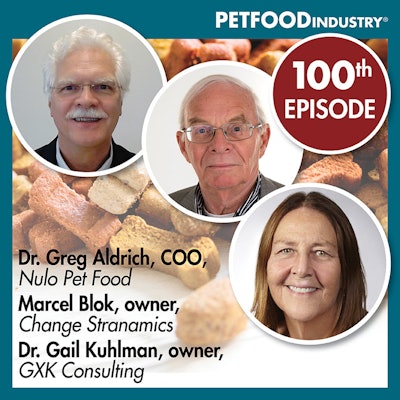
In this episode of Trending: Pet Food, Lindsay Beaton celebrates the podcast's 100th episode by bringing together three industry veterans — Dr. Greg Aldrich, chief operating officer of Nulo Pet Food; Marcel Blok, owner of Change Stranamics; and Dr. Gail Kuhlman, owner of GXK Consulting — to reflect on the pet food industry's evolution over the past four decades.
The panel discusses how the industry has transformed from simple grocery and veterinary brands to today's diverse marketplace driven by humanization, sustainability concerns, and technological innovation. They explore challenges including ingredient scarcity, workforce development, and the need for more affordable products, while sharing insights on minimal processing, personalized nutrition, and the future of pet food manufacturing.
We want to thank Rangen Pet Nutrition for sponsoring this podcast. Rangen Pet Nutrition is your trusted partner in advancing pet health. From antioxidants to custom premixes and pure yeast solutions, they help pet food companies create superior nutrition with innovative science and dependable expertise. Learn more on LinkedIn at Rangen Pet Nutrition.
Lindsay Beaton, editor, Petfood Industry magazine and host, Trending: Pet Food podcast: Hello, and welcome to Trending: Pet Food, the industry podcast where we cover all the latest hot topics and trends in pet food. I'm your host and editor of Petfood Industry magazine, Lindsay Beaton, and today's episode is very special because it is our 100th!
That's right, I've been hosting and you've been listening for 100 episodes, and I want to thank all the guests who've been on, the sponsors who have gotten on board, and of course you, the audience, for finding this little 21st-century industry radio show and giving it a shot that it could grow to what it is today.
Of course, I couldn't do a 100th episode without some very special guests! I'm here today with return guests Dr. Greg Aldrich, Chief Operating Officer of Nulo Pet Food; Marcel Blok, owner of Change Stranamics; and Dr. Gail Kuhlman, owner of GXK Consulting. Hi everyone, and welcome back!
Aldrich/Blok/Kuhlman: Thank you. Hello, Lindsay. Hey, Lindsay.
Beaton: There's almost no chance you don't recognize my guests, as they're all long-time industry experts and also guests of this show over the years—in fact, Marcel was my very first guest! But just in case, here's what you need to know.
Dr. Greg Aldrich currently serves as the Chief Operating Officer at Nulo Pet Food with oversight of supply chain, logistics, research and development, quality, safety, customer care and human resources. He has extensive experience in supply chain, logistics, operations, pet food formulation and production, retail management and sales. Immediately before joining Nulo, Dr. Aldrich had been an Associate Professor and Director of the Pet Food Program at Kansas State University since 2012.
Since 1995, Marcel Blok has been the owner and sole employee of Change Stranamics, a consultancy set up to provide strategy advice to smaller and medium-sized pet food companies. With current and past clients on all five continents of the globe, Marcel has 42 years in the global pet food business, including as a managing director at Iams International.
Dr. Gail Kuhlman is a retired Board-Certified Animal Nutritionist and Pet Food Expert with over 35 years of experience in the pet food industry. Throughout her distinguished career, Dr. Kuhlman has held senior leadership roles at Mars Petcare, Procter & Gamble Petcare, The Iams Company, Royal Canin, and Ralston Purina. Today, she is the Owner and CEO of GXK Consulting LLC, where she provides expert technical and nutritional support to pet food manufacturers and ingredient suppliers.
I have brought these incredibly distinguished guests back on the podcast today to answer a question worthy of a 100th episode: How far has the pet food industry come over the decades, and where is it going in the years to come?
I want to start off this conversation by giving you guys a chance to tell me just how long you've been in the pet industry and what it was like when you first entered it. Gail, let's start with you. What was it like when you first entered it, and how long have you been in the industry?
Dr. Gail Kuhlman, owner of GXK Consulting: I've been in the industry just a little bit over 35 years, and when I entered the industry, pet food was becoming more than just utilitarian. It was really when we first noticed a shift of consumers feeling that their pets were part of the family. That, of course, led to the great growth, knowledge and innovation that I've seen over the last 35 years. Industry segmentation has changed, innovation, the way we staff the basic functions—it's just really been very dynamic.
When I first entered, we had basically your grocery brands and your veterinarian premium brands, and that was about all the industry had, and those were in dry and wet format. In fact, when I first started, there wasn't even an AAFCO nutrient profile. It's been quite a while, I've really seen a lot of dynamic changes. I've been part of them, and it's very exciting.
Beaton: Marcel, I know you've been in about as long as Gail has. What was it like when you first got in?
Marcel Blok, owner of Change Stranamics: Well, first of all, I talk from a European perspective. At least mainly in 1982, the industry was in its infancy. Pet food was not a common thing to consider for the average pet owner. When I say infancy, it was also in its infancy as far as nutritional profiles, and certainly also as process was concerned.
When we were talking dry pet food, it was mainly pelleted—nowadays called cold processed, for whatever reason. Extrusion was much more of an exception than something that was common. It came later, maybe in the early 80s, even later than that, it started to catch on a bit.
We were dealing with one thing, and that was to make people make the shift from home cooked table scraps into something that was industrially prepared, and that was the major shift that we had to deal with: how to convince people that industrially prepared delivered on what it promised. The promise for industrially prepared was not extremely complicated. Quite on the contrary, it had one simple platform called health. That was the only promise that we had.
Later on, maybe in the mid-80s to the 90s, we entered a stage which I call health plus — functional attributes started to get into the recipes, into the formulations. But again, it was still strongly a health focus that was for most brands the key coat hangers for their communication and for their branding.
If we go further — but now we're talking about what was the evolution of industry — the evolution that I've seen, not only in Europe, was because of the attraction of the market, the attraction of the pet food space. We saw an enormous number of newcomers entering the market, new brands, mostly what I call names on the back, but still brands that were all fighting to get a bit of shelf space. Most of them copies of what was already on the market, but one way or another, there was acceptance, both on the trade side and certainly on the consumer side.
In essence, what we've seen is a sharp increase of suppliers of pet food, a shift from, certainly in Europe, cold press or pelleted to extrusion on the dry side. On the wet side, for me, the key change that took place was the introduction of Sheba by Mars. When was it? In 1985, 1986, something like that in Europe. That is what I call a true innovation in pet food, because it put the whole industry upside down. It went from multi-portion to single portion. It went to a price level that was unheard of. It dealt with a different kind of packaging. There were a lot of elements that are now common, but the change was triggered by the introduction—as far as I can see it—by the introduction of Sheba, and I cannot underestimate the influence that that particular introduction has had on the worldwide pet food industry.
Beaton: Greg, you have an academic perspective in addition to an industry perspective, and I think it is inarguable that you have left a mark on academia when it comes to pet food in a very significant way. I'm interested in hearing how you have seen things change from an industry perspective, but also from an academic perspective. How have the opportunities grown in that space since you started out?
Dr. Greg Aldrich, chief operating officer of Nulo Pet Food: I guess let me start by saying my background. I have really two entry points into the pet food industry. The first is after I got out of my undergraduate — my first job was as a feed salesman in a cooperative in western Kansas. It's a livestock area, very rural, and it was my first exposure to not just food for cattle and pigs and sheep, but also for what we call today companion animals. But in those days, they were really working dogs. They were barnyard security and rodent control with the cats, and they were working animals outdoors, otherwise backyard or barnyard.
The big shift that I saw from the mid-80s to when I got out of my graduate school and went into the pet food industry full time in the 90s was that the pets and their association with their families had changed. They went from the backyard and the barnyard to the house, and then in some cases, sharing other parts of the house, beds. They were the surrogate children.
What I've seen over this 30- to 40-year time frame is that it's more of a demand-driven industry change, where we've had to keep up with the sophistication of the pet parent and what their evolution has been to provide them with products that fit their sensitivities, and that has generated a great deal of change in the way in which we talk about pet food, a great deal of change in the way in which we produce pet foods and the ingredients that we select to go into those diets. It's a lot of the things that Gail and Marcel have shared with you, but on the consumer side of the equation, they have pulled some of these things in that we might not have ever considered 10, 20, or 30 years ago. Nutrition has been a key.
But to make a switch here into what your second part of your question is about in regards to the process, we're supplying foods of a wider array of processed types, production styles today than ever before, and in part that's that demand side. It was that piece that sort of motivated me in the middle of the turn of this new century, the late 2000s, to explore academic research, and that's when I tagged up with Kansas State University and their feed science program to begin to look at processing and how that might influence nutrition.
A lot of my work early was on the ingredient side of the equation, and how the rendering industry, as an example, could influence the quality of proteins. I wanted to take some of that learning and apply it further upstream into the process. How does the extrusion or baking or canning or other similar processes — how does that influence the bioavailability of the nutrients, number one, and/or the destruction of nutrients? Or in some cases, what we're learning today is that we might be creating some compounds that we don't really desire as we go through more extensive heat and thermal processing.
That's a long answer to your short question, but I see it demand-driven from the consumer side. We're all trying to answer, what is that unmet need? The consumer and their pets have evolved, and it's up to us to figure out that combination of ingredients and process to deliver what their expectations are.
Beaton: I think one of the most interesting things, apart from the consumer shift, which has been significant just in the 15 years I've been covering the industry—when I first started, we were just starting to talk about humanization, and that was a trend, and was it going to stick around? Well, that's not a trend anymore. That's a given.
The consumer side of things has seriously been a driving force in how the industry has evolved, but the technologies that have evolved alongside with it—we're in an era of technological boom anyway, and to see all of that applied to a manufacturing industry has been really, really fascinating.
I am interested to hear from each one of you which technology you think has had the biggest impact over the years. Greg, I want to start with you, because I know that you have done a lot of work on the machine side of things, and you've been boots on the ground in academia for quite some time. Which technology do you think has really made a difference?
Aldrich: They all have. I don't want to slight any one particular area, but I would tell you that we've made good improvements in the way in which we manufacture extruded or expanded foods. While they are somewhat better than they were in the 1950s and 60s when it first started, I think the biggest advance in technology in the last few years for pet has been in minimal processing. That's kind of an upside-down reply. But in essence, trying to reduce the amount of time and temperature and shear that we apply to a food product so that we keep as much of those nutrients intact as possible has been the Holy Grail.
There are a number of technologies that are marching down that path. Of course, freeze-dried is kind of out there in that front end. Frozen refrigerated, while it's old technology, is something that is somewhat new and still advancing in the pet space. The one that we're seeing move into a prominent position right now is what I'll call air drying, or just mild temperature, long time drying processes so that we get to a shelf-stable product that's also maintained some modicum of safety from a pathogen kill step. All of that kind of rolls into this minimal process.
The next biggest piece is that we deconstruct those ingredients that go into those food products, so that we're only processing or drying those elements that need to be—that we're making sure that the meats are safe, that we're cooking properly the starches that we include but nothing more, and that we don't hamper the vitamins or use the trace minerals as an adjuvant to start some other reaction. I kind of ramble there a little bit, it may seem, but in essence, what we've got to do is get to where the food product is optimally processed, so that the pet has the advantage of all of the key nutrients.
Beaton: Gail, you've worked with pretty much all the big guys. You've had lots of opportunity to see how technologies have affected and expanded the products that these companies with the most significant budgets out there in the industry have managed to pull together. What have you seen in terms of technology and product availability and how the companies you worked for took advantage of these things?
Kuhlman: For me, and being a nutritionist, you would expect me to say this, I feel all the technology and innovation we've seen over the past 30, 40 years in the industry is all due to the core of us being curious and learning the best nutrition and incorporating that science into the product. Whether—as Greg spoke about—the new technologies and the less heat-processed foods, that all comes from the fact that we now understand nutrition more. We now understand the pets' requirements. We now understand better how to deliver those things.
You asked me about innovation and how we've taken advantage of that. I could talk for hours on that subject. I think I look at things the first UTH product, the first over-the-counter urinary tract health product—what a great, significant contribution to cats. I look at breed specific. When I started in the industry, it was very reasonable to say a large breed dog lived five to seven years. Very commonly today we'll say they live to 15. We've almost doubled that lifespan through the good nutrition.
For me, the basis of the technology innovation has been built on our curiosity and our science. Obesity products, products that cater to the microbiome today are very common. I think that the larger companies have either incorporated nutrition to build new technologies, or they've merged, purchased other companies to bring in those technologies. But those technologies, whether they be things that we learned back in the late 80s, incorporating fresh meat into a diet for better nutrition, or how to leverage the use of vitamins and minerals properly—those things all have led through the breakthrough of nutrition.
I'll tell you that when we started learning by nutrition, very unfortunately, we learned through trial and error, and we had some hard times learning. We've learned a lot by mistake, and it feels great for me personally to say that while we had our hard moments, while we had our trials and tribulations, I feel extremely confident that the industry now can feed pets very comfortably, very safely and very efficaciously.
Beaton: Marcel, you've been consulting for a long time, and you have, as you said, the international perspective. How have technologies changed? What's going on in other mature markets of the world, and what have you seen over the years that's really been a huge shift in the way that your clients work and what they're coming up with?
Blok: Well, first of all, what I see in certainly not only in Europe, is that what I call the conventional processes—on the one hand, extrusion, on the other hand, anything that is sterilized in whatever kind of container—these two, conceptually two processes, still take around about anywhere between 90% and 95% of total volume in the market.
Yes, we see change, but it is, as most things in our industry, a slow change, and most of the examples that we see are either straightforward copies or adaptations of what already has happened in the human food industry. Let's not forget that we operate—maybe not totally, but we operate in the wake of what happens in the human food industry. That is where the trends are set. We don't set our own trends. That is one thing that I think we need to be aware of, to consider and to be honest about.
I do see that there is, as Gail mentioned, a lot of trial and error. People want to see something new, novel. Call it innovative. Doesn't matter what you call it, because in the end, and certainly when we talk about extruded pet food, in the end we're talking about what I call little brown balls, and to the average consumer, they all look the same. Where is the point of difference? You can find it back in your branding, in your story. That is correct. But there is nothing truly novel about it.
There is one thing we need to take into account, certainly in the future. We already do it to an extent now, and that is the biggest change that we're going through is not as far as I'm concerned about process or about nutrition. The biggest change we're going through is the awareness about sustainability. Sustainability will—I can't say to a great extent, but will certainly define what we can do in the future, and that will define what kind of processes we can use in the future.
Greg mentioned, rightly, minimally processed or low processed. This is something that a growing number—I can't say worldwide, but certainly in Europe—growing number of people in Europe are concerned about for their own food. If we talk humanization, I assume that they will be as concerned for the food of their pets. These are elements that we see now. We see the nucleus of what I see as a bigger movement in the future. Let's not underestimate the aspect of sustainability, because that fits into a bigger picture, and that is the transition that we're starting with, or we're already in, and it's something that cannot be stopped. For me, this is key, certainly when we talk about process. Minimally processed has another element, which, certainly in Europe, would be considered important, and that is called carbon footprint.
Beaton: I want to talk about all these changes, because there's a lot going on in the industry. There are a lot of different elements to everything you guys are talking about. Sustainability is one of them, functionality is one of them. All the various ways of producing pet food is one of them. There's so much going on now, globally, things that weren't even on the radar 30 years ago, and the wheels of progress can move pretty slowly. Sometimes some of the things have taken some big leaps that moved forward pretty quickly, especially during COVID. All of a sudden we had e-commerce completely explode in the industry, and now we have omni-channel on the consumer side that is a result of that.
Overall, though, how do you think the industry has done at adapting to change? Does the pet food industry overall to hold on to tradition, or are there some progressive threads in there that keep it moving forward? I want to start with you, Marcel, because you were talking about something that is a newish thread in the industry.
Blok: I have—it was not applauded by everybody—described the industry as somewhat traditional and conservative, which means for me that yes, we see change. Change is slow. Nothing is revolutionary, at least not in my point of view. The changes that we see bubbling up are mostly changes that come from newcomers to the industry, because the settled companies in the industry have a vested interest, and that is the balance sheet, the fixed assets which they need to protect and work with. Anything that would go against working with these assets is something that they sort of shrink away from.
I do see that new initiatives, new ideas, do come from people who say, can't this be done differently? They ask themselves the question. We in the industry ask ourselves not exactly the same question. What we ask ourselves is, can't we do this better? I don't say, can't we do this differently? We don't look for change. We look for improvement. That is the status of the industry at this moment. We improve. We try to do better than yesterday, but we do not change because conceptually, we do exactly the same things as 40 years ago.
Beaton: Gail, I want to ask you next because you are part of a wide global media and pet food industry-led initiative called Women in Pet Food Leadership. One of the things that we talk about pretty significantly in that group is change, and particularly personnel change, but also diversity of thought, and all of the things that Marcel just mentioned in terms of new people coming in and kind of switching things up. I want to get your perspective on all of that next, because that ties so nicely with what Marcel was saying.
Kuhlman: I feel that in general—I'll first just mention that the industry actually does a pretty good job of adapting to the changes that happen. As you pointed out earlier, COVID hit. How are we going to get pet food to the masses? E-commerce. I think there are some areas we're not quite as good in. That was an example of being very quick to respond. I also do agree with Marcel. It's a lot of the newcomers that are helping us get through some of this change, and frankly, the newcomers can either be new associates coming into a company or the companies being purchased by other companies. There's a lot of acquisition that has happened over the years in the marketplace.
As far as personnel, though, that is something—as you know—very near and dear to my heart. I think that from my first job in industry versus where I am today, I would have never believed that something Women in Pet Food Leadership would be a focus for many businesses out there, building diversity and inclusion in their workplace. Businesses have really come out to realize that diversity around the table in thought is really what's going to drive change and what's going to push their business going.
I know when I started my first job, I was a nutritionist in R&D, and I worked with a lot of engineers and a lot of pilot plant people. Back then, it was the guys in engineering or the guys at the pilot plant, which has really changed today. We have a wealth of knowledge from women engineers, for example. You see the change. You see it expand in diversity of thinking, which I think helps us adapt quicker. You brought up Women in Pet Food Leadership. I just had to touch on that for a minute.
But I do think to Marcel's point, there are a couple of areas we haven't adapted well to, and one of them, I think, is the area of sustainability. But I also think we are a little slow on adapting to how we can make our products more affordable so everyone can purchase them. With our new technologies and our innovation and our less processed and our freeze-dried and our humanization and our fresh and everything we just mentioned comes a high cost. How can we as an industry work through ensuring that our consumer can still afford the product when we're done delivering upon all these expectations?
While I think we've changed wonderfully, I do think we have a few gaps. I think we've changed wonderfully to the times of technology, but also to the diversity of gender, ethnicity, just around the table, having the ideas. But for me, the bottom line is, we can invent everything we want to invent, but we have to invent it somehow affordably, so that the consumer can actually buy the best, high quality, newest innovation, most pet-friendly product out there for their family member, their dog, their cat, their pet.
Beaton: Greg, you have played no small role in bringing the future generations of pet food into the industry. As the coordinator of the student program at Petfood Forum, I have watched you usher students through their research and into academia to continue your work, into the industry. How does that feel? First of all, to know that you played such a direct role in bringing this diversity of thought to the industry and expanding it. Then how do you feel overall about the work being done in academia to make sure that the industry can continue to grow and remain solvent at a time when one of the industry's biggest problems has always been getting other people to know that it exists?
Aldrich: Well, first off, how does it make you feel? A bit parenting. It's very gratifying to see them change and adapt and learn and get that aha moment somewhere along their journey to get this idea that it's not just a glimmer, it's not just a hope, but it's something that they can actually think through and prove and then publish and go out there and communicate to our constituents what their discovery is. That's terribly gratifying. It does me proud, as my dad would say. On that topic, it gives me great pleasure to see them go out into industry and succeed.
I've had the good pleasure to see a number of my students take positions, both in academia and in industry, in fairly prominent leadership positions, as well as in the R&D and innovations areas, and they're doing extremely well. It's much to their character and their determination, but hopefully somewhere along the line, they learned a trick or two from me in regards to how to navigate through some of those challenges that we're going to face. Because, let's face it, that training is about problem solving. It's about teaching them and getting them to be exposed to the broader array of challenges that they might face, and to understand that most of the solutions are going to be along some pathway of a principle, whether it be physics or chemistry or biology, to understand how they're going to break that down, turn it into a solution and then apply it. It's fun to watch as a professor and as an industry leader. It's fun to see them actually go into the trade and prosper, and I think we're all better for it.
My opinion on the whole area of academia and research, from this industry's perspective, is that we've starved it. If it weren't for the ingredient companies and the equipment manufacturers out there, I don't think we would have as much academic research and as many young people being trained as they are currently. The pet food companies—and they're going to throw knives at me now—but the pet food industry, by and large, the pet food manufacturers, have not been supportive of that kind of education. There are a few companies, of course, there are exceptions out there that have put their money where their mouth is and help train the next generation of their innovators and leaders. But by and large, they're tapping into a supply stream of graduates that the upstream support industry, the allied industry, have helped to produce and fund, including the research.
Most of the grants when I was a professor were all from ingredient companies. They were trying to explore how their ingredient might behave in a manufacturing pet food so that they could then take that message and share it with the pet food companies that they were their target. It made good sense in that regard, but it really smacks of this notion that there's only a part of the industry that's participating.
You and I have talked about this as well. The one area of our industry that's not participating is the pet parent, pet owner. They're not participating in supporting innovation, research, nutrition evaluations, or otherwise. I still contend that there ought to be part of that tonnage tax that every state requires us to pay in the US and the VAT in Europe that ought to go to training the next generation of professionals in our trade, in our industry, in our science. Some of that ought to go back to getting the best people in the industry and the best people trained.
Beaton: Marcel, I want to ask you, because you have the European perspective, what is it over there in terms of training up the next generation of people to enter the industry over in Europe?
Blok: Let me start with one thing. When we say European perspective, we are talking about at least 26 different countries. That is number one. There is no true European perspective. What I do see is, first of all, Gail, when we talk about Women in Pet Food, the vast majority of younger people in the pet food industry actually are women. If I would make a wild guess, I'm not talking about manufacturing jobs, but everything that is not manufacturing today, you see that about 70% would be certainly younger women. That is one thing that is—I would call that an evolution. Some other people will probably call that the revolution. But this is new, certainly for what I see as a conservative and traditional industry.
Is it because, let's say, there is a huge offer of curricula spread around Europe, universities and what have you? I don't know, but probably it's much more to do with people are getting a more enhanced, if you want, opinion about animals, about certainly companion animals, about our responsibility versus these animals, and maybe that influences the area in which they want to be professionally active. But quite honestly, whether it is because the curricula are offered or there is a demand—more correctly, I honestly can't say that. I only can see what the outcome is, and that is more people, younger people, getting really interested in our industry.
Beaton: Since I have the three of you in a digital room together, let's try to solve this problem. I want to know, how do you think the industry can most effectively market itself as a viable career to the next generation, any part of the industry?
Kuhlman: I think where we've come today and the visibility of where we are is very important, and we don't put that out there. I know when I was in graduate school, there was no pet curriculum at all. You were a swine nutritionist, you were ruminant nutritionist, and that's who entered our industry. I came into the industry in a pet role, but to be honest, I had no pet training.
I love seeing programs now that actually have some focus on nutrition, on pet food. Greg was a huge part of that at Kansas State, both for process as well as nutrition. But a lot of people don't know those programs exist, and I will concur that the industry doesn't help that. I can tell you, I've hired very many people over my years in the industry, and I've hired most of them through these key universities I'm talking about. But yet in hindsight—and Greg, maybe you shamed me a bit here—but yet in hindsight, until really now, as I coach and mentor young people looking to go to college, can I actually say and push the fact that there are universities, there are online classes, there are programs out there that can tell you a lot about pet food nutrition, pet food manufacturing, pet food science, as I call it, that didn't exist prior, and it's out there today, and it exists, and it's strong, and it could only get stronger.
I think intern programs—I know when we were at Mars, we had a great intern program, brought students in in the summer, gave them projects, got them exposed to pet food processing, pet food sciences—that's great programs. With the help of universities, these students can now go to graduate school or whatever and study further and become experts. I think that's wonderful, but it didn't exist previously. Continuing internships, continuing visibility, continuing working with some of the ingredient manufacturers we mentioned. How can they help support and get these roles that we have open, get these jobs that exist?
When I started in pet foods, you were a process person. You were a nutritionist. That's pretty much what it is. Today, there's all kinds of pieces within marketing and sales, looking at consumer influencing, consumer knowledge, pet behavior. These are wonderful fields that exist today that didn't exist when I'm sure the three of us started. They're there today. Just getting visibility to those through partnering with students, partnering with universities, partnering with other academic venues, I think really will help people understand that there's opportunities if they want to get into this field. They do exist today, and they're there, and they're strong and they're sound science.
Beaton: Greg, you and I have had multiple conversations over the years about this very topic, which the fact that we've had them over the years only proves that it is still an ongoing issue. Where is the missing link? Where do we need to connect that final chain? Because everybody wants it. What is that missing chain we need to connect to turn this into a thing?
Aldrich: I don't know that there's a big missing link here that we're all going to try to discover. I think it's incremental change, and we've been making incremental change in this industry with education. We suffer from some of the same challenges that food science and nutrition curriculum have of recruiting enough students into the programs across all universities, it's not just a pet food thing. Many of those universities are actively out trying to do things and recruiting and promotion of their areas as viable career choices for young people. I think we've got to do much the same.
Whether it's a particular pet food company or it's the PFI or FEDIAF or any of those organizations, we need to be carving out a small portion of our funds to promote the trade, to promote the discipline, so that young people and their parents can find these places where they might find a way to connect with their own beliefs and their own desires for their future. I know that many of those programs are now merging at some universities, and they're starting to see some traction because of it. I think that's number one.
Number two, and I'm kind of on my soapbox here, but we've got to create opportunities for what I'll call more seasoned folks to enter into the industry. Those are things with short courses Petfood Industry does. Some of the universities have training programs, modules and certificate programs. We've got to create more of those so that the employers can point some of their best and brightest that are currently working within those companies to those advanced training areas, so that we can continue to foster that lifelong learning, as it were, but focused in our areas. Then I think we can sustain our human resources, our critical mass of thinkers and doers to propel this industry into the next generation.
The other is just to cross-pollinate with the foods industry. There's a lot of folks that each of us have worked with over the years that sort of by chance or by happenstance, they found their way from the milk or the meat or the cheese industry or the vegetables and fruits industry to come into pet and to bring some of their experiences that made us all better, and it also created more headcount where we needed the resources, where we needed the talent. We've got to continue to look at all those things.
I want to bring this back around to where you started this thread, and that was about sustainability. There is a sustainability challenge ahead of us, and it may have something to do with CO2 carbon footprint. It might have something to do with the circular bioeconomy and making sure that we utilize all of those resources and don't waste. The pet food trade can be a part of that. But we also have some challenges in human resources to keep our industry vibrant and progressing.
The one area that I want to touch on just a little bit here, I think we've got challenges, and it's been one of the areas that we've done a lot of adaptation over the years, but we're going to have to get really focused on it, and that's packaging. We are wasting a lot of resources in packaging. Not suggesting this is an overnight sort of thing, but we have flexible PE packaging, cans. We have pouches of various laminates. We're doing a fantastic job, and we're creating a huge amount of waste for the environment. We've got to do something about that.
At some point, what I've been encouraging a few academic institutions on is that they need to start adding to our nutrition and our process technology, some focus on packaging and ways that we can improve the transit of food from the factory or the floor, wherever it's being made, to the consumer, and decrease that waste that becomes packaging. It's vital. It's absolutely important, because it's got a lot of information. It's the regulatory, it's the shelf life, it's the safety, it's the communication of all the things that are in that product. But if we don't do it right, it just becomes landfill, and we got to do better.
Beaton: I think that's a really good transition point to my next question, which is about the future of the industry. I don't think there's any panel more qualified than the three of you to answer the question about where you think the industry is heading, and if there are any challenges or big opportunities ahead. Gail, let's start with you. Where is the industry going? What's it going to look five years from now?
Kuhlman: Again, being a nutritionist, I'm going to focus on where I think nutrition is going. I really think that it's becoming more interesting how we look at each individual dog or each individual cat as needing their own unique recipe. The personalization now of pets is very interesting to me. I don't know exactly where it's going to go, but I think that's a very hot topic, and a place where the industry is digging deeper and deeper. I would say that's my number one answer to that would be personalized nutrition, and we see it coming about.
I also think—I don't really remember if it was Greg or Marcel that said this, but sustainability of raw materials. Our industry relies on a couple of raw materials pretty heavily. I would pick chicken as one of those. It's getting harder and harder to get the quality that we maintain and respect. I think we'll be doing lots more research—the industry will be doing continued and lots more research on alternative culture-grown. I know there's a lot of activity today in insects, really transformative ways of how to look at raw materials. Of course, sustainability. I'm not going to touch on that. I think Greg and Marcel both did an excellent job touching on that.
But I mentioned earlier that I think affordability was an issue for all economy classes, and sustainability will only help us get there. Conservativeness in wastes of materials, packaging, energy can help us drive our prices down, which will help us get it into consumers' hands. I believe that those are the sciences where we're going to see the future of the industry and where the industry is growing.
I think e-commerce, AI, technologies, those things are going to continue growing strong. We've started those, and those keep going. I would predict those will be the sciences behind us. I also feel that we'll see even more consolidation within the industry as we want to bring together more and more technologies. We spoke earlier about it being a great way to get those technologies faster than normal for the pet food industry, and that's by seeing consolidation of businesses. I think those are the areas of focus. Again, for me, the biggest questions are affordability and sustainability that we'll be driving to answer as an industry.
Beaton: What do you think, Marcel?
Blok: I think that, as always, we need change, and the change that we need, in my point of view, is more quantum leap than we have done far, certainly the last 20 years or so. We have not changed very much. We have tweaked. We have taken a detail and went into finding the detail in the detail. That is where I feel we are collectively running into a funnel, and that funnel is called an industry jargon, super premium.
I would bet that at least 80% of all R&D funds invested actually in R&D go towards super premium, the top end of the market, which, in value terms, represents probably not more than 20% of the market. What I say is, maybe there is room to do something in the remaining 80% of the market. Can we improve? Irrespective of what that improvement needs to be. Can we improve in the premium end, or in what I call the middle-of-the-road end, taking all these elements of sustainability, of regenerative issues, and taking that into account?
Because I say that, and now I come back to one of the points you mentioned, Gail, if we as an industry claim that the health and well-being of pets are our primary concern, does that only apply to the pets that can afford good food or what is perceived to be good food, or do we take the responsibility of helping people with a smaller wallet? I think that that is an opportunity that we need to look at, and that is the future for me as an industry.
The other thing, and now that is partly related to sustainability, we continue to ship food, in my case, from Europe to the Philippines, because our food is better than theirs. Well, that could very well be, but if I take into account only the carbon footprint consequences, is it still justified? Or do we have to look at—irrespective of the process, small a manufacturing unit, but spread around the world. Do we have to take into account that the recipes that we develop in the mature or saturated markets, with an abundance of ingredients and a huge choice of ingredients, is that the sustainable model for the future? I simply say that there are areas in the world where people survive one way or another with the foods and the ingredients that are locally or regionally available. If humans can survive—again, this is a question I don't know. Can pets survive? In other words, do people on the other end of the world need to have recipes, or their pets have recipes that are our recipes, or can they develop their own recipes based on locally available ingredients? These are the questions that matter for me.
Beaton: Greg, you're the most directly active in industry, because you're currently working at a pet food company. What future are you working towards?
Aldrich: We kind of tied up on the sustainability piece, but there's a flip side to sustainability, and that's scarcity. One of the things that we're dealing with in the trade in the industry, writ large, is scarcity of quality ingredients. In some sectors, part of it has to do with seasonality, such as fish, such as turkey production. Some of it's driven by disease. We've had outbreaks of avian influenza that have decimated certain areas of the US in terms of turkey or even chicken production.
Scarcity is what's sort of driving what's happening from the supply chain side of the equation, and we're working diligently, pretty much every day, to make sure that we're securing the raw materials we need to produce. The thing that we have built in the pet food industry is this notion of no seasonality. We are supposed to have chicken and turkey and fish and salmon, and all of those ingredients available at the same level every week, all year long, according to the consumer and our retailers. Unfortunately, that's not the case. We're bouncing around with normal scarcity. We're bouncing around with normal supply based on various disease states that get into different areas. Then we get the human intervention with tariffs and trade challenges, and then this notion that's kind of hanging over all of our heads with global warming, what that's going to do to influence some of our supply chain, raw materials.
All of that is going to have an effect on every one of us in this industry in some way. It may be a small part, maybe a huge part, depending on what your job is in the industry, but you're going to have to begin to adapt to scarcity of raw materials. We haven't had to deal with that in a large part over the decades before. It was really about sifting and sorting or working with various suppliers that had a higher quality of material or an abundance of supply at a certain period of time and forward contracting. But today, the challenge is securing the quality materials that you need on a routine basis.
I think we're going to have to, as an industry, pivot a little bit and adjust accordingly—stockpiling, creating formulas that are flexible in some way, communicating that to the consumer. We're also getting more global. We're having to source the raw materials. In this era when we talk about sustainability, we want to go local. We want to be able to produce local. We want to be able to grow local, and we want to be able to manufacture local to our local trade, so that we have less freight on it. The unfortunate thing is that we're dealing with the other end of the spectrum, and that is, we're having to source fish from halfway around the globe. We're sourcing vitamins, as an example, mostly from China today.
We've got to adapt to that, or we've got to come up with strategies down the road that we can fulfill those needs in a long-term sustainable way and still keep our retail and our customers pleased about the outcome, the quality of the materials. Right now, today and for the next 10 years, I think we're going to all be dealing with scarcity of raw materials, and how we deal with that and communicate it to our customers is going to be key as to who succeeds and who struggles.
Beaton: As we wrap up today's conversation—you all, we have established, have been in the industry for a long time. You've seen a lot of change, and you've all left your marks. I know you're not done yet, but today, Gail, what do you feel is your greatest accomplishment and contribution to the industry?
Kuhlman: These are always the toughest questions, right? Talking about ourselves. For me, while I've had the privilege of developing and launching many new products and mentoring many talented people, some who I'm sure their skills and accomplishments will outshine mine, I think that my greatest contribution has been keeping companion animal nutrition in the spotlight the best I could—making sure that pet nutrition was recognized as a vital and a credible part of animal science.
Whether I was working with a team of people where we launched the first AFIA Pet Food Council, or establishing, Greg, the Companion Animal Section for American Society of Animal Science, or serving on the AAFCO Canine Expert Committee, or co-founding and co-chairing the Women in Pet Food Leadership Initiative—we just talked about all those things—I really feel have allowed me to keep pet nutrition in the spotlight.
I think what's been most rewarding is for me to see how these efforts have created real momentum, inspiring students, as we talked about earlier, to study in the field, encouraging universities to build programs, and just helping the industry stay grounded in sound, scientific evidence-based data. It's exciting to see a new generation of professionals carry the same passion I had forward, and I'm anxious to see what they can expand and what's possible for pets and the people who care for them.
I myself will always share my life and my home with pets, and I'll always remain dedicated to providing them the best possible nutrition. I will always be part of the pet food industry in that sense, and look forward to us to continue our curiosity, providing the best products and technologies out there for my pets.
Beaton: Greg, what are you most proud of?
Aldrich: A couple of things. I started in 2003 pitching an idea to Clay Schreiber at Watt Petfood Industry magazine to document information about ingredients. After 200 of those articles on a monthly basis, I'm very proud that I was able to take a lot of the learnings from our industry and our research across the globe and capture that in those monthly articles to share with everybody all of the things that we had accomplished collectively together. I hope that that will continue on with others.
I'm very proud of what we've built at Kansas State, with the pet food science program, with the students that we're training there, and that Julia and the rest of the team are continuing on with and the research that we've published. I'm very pleased with the quality of the work, and taking that program that was zero to something that's now well-noted and recognized around the globe, it feels good to be able to have those elements out there.
Then, as a consultant, I've been fortunate to work with a huge number of entrepreneurs and very bright people in the industry, folks Gail and Marcel along that path. I'm very proud of the relationships I built and the businesses that I've helped to launch, because with all of those businesses, and with their success, has been employment and people getting jobs in this trade. I really have been a benefactor and a beneficiary of all of that work.
Beaton: Marcel, what are you most proud of?
Blok: Well, a bit Gail, I feel to an extent uncomfortable to brag certainly about myself. There is one thing that as a proviso that I want to mention, and that is my achievements are not solitary achievements. I have worked in teams, and together with my teams, we came to certain achievements. One of the achievements that actually I'm proud of is putting the Iams and Eukanuba brands on the map in Europe in a sustainable way that was good for all concerned.
It was an ideal way to look at a challenge, to take up the gauntlet, because the contract was very simple—a bag of Eukanuba would cost in most countries in Europe two and a half times what was then seen to be the best-sold brand. There was a bit of convincing to do, and one way or another, we achieved in doing that. As I said, gratifying, very good learning school. The nice thing about that is certainly not all, but the people I worked with, actually quite some time ago, are people that I'm still in contact with. One way or another, it helped to have a social network, and not only a business network in that respect.
Other things that I'm proud of is, over the years, I helped companies to go from the drawing board—they were not in pet food at all, to go into pet food, to help them to devise and design the strategy. These companies are still around and actually are thriving. That is something that, again, is gratifying, and it gave me the opportunity to learn, but not only to learn, also to apply what I had learned in the process of learning. That is what keeps me going in the industry. It is what I call the fun factor. It is a serious industry, but the fun is that, if you're looking for it, every day will provide you with a new challenge.
Beaton: Well, I want to thank the three of you so much for coming on today for this 100th episode of Trending: Pet Food. I couldn't think of anyone better to have on than some of the pillars of the industry. There was no better topic to cover with you all than the history of pet food, where it is today and where it is going. I can think of no one better qualified. Thank you all so much for coming on to this very special episode today.
Aldrich/Kuhlman/Blok: Thanks, Lindsay. Congratulations on 100. Thank you so much, Lindsay. Thank you.
Beaton: Before we go, I always have to do a little plug. Where can people find you guys these days? Gail, where can people find you?
Kuhlman: I'm on LinkedIn, or I'm also on GXK Consulting LLC at gmail.com.
Beaton: Greg?
Aldrich: LinkedIn. I still have an appointment adjunct at Kansas State. You can find me there if you have interest in research or other topics, and I am now full on at nulo.com.
Beaton: Marcel?
Blok: LinkedIn has virtually everybody, and my website is changestranamics.com.
Beaton: Perfect. That's it for this episode of Trending: Pet Food. You can find us on petfoodindustry.com, SoundCloud or your favorite podcast platform. You can also follow us on Instagram @trendingpetfoodpodcast. If you want to chat or have any feedback, I'd love to hear from you. Feel free to drop me an email: [email protected].
Of course, thanks again to our sponsor, Rangen Pet Nutrition for sponsoring this podcast. Rangen Pet Nutrition is your trusted partner in advancing pet health. From antioxidants to custom premixes and pure yeast solutions, they help pet food companies create superior nutrition with innovative science and dependable expertise.
Once again, I'm Lindsay Beaton, your host and editor of Petfood Industry magazine, and we'll talk to you next time. Thanks for tuning in!