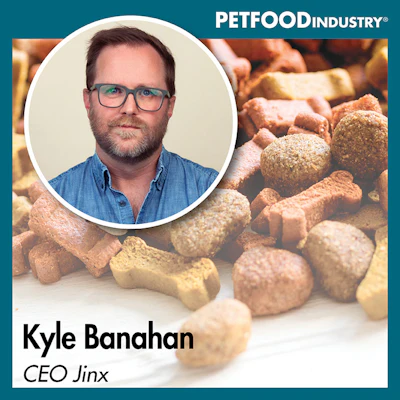
In this episode of Trending: Pet Food, Lindsay Beaton talks with Kyle Banahan, CEO of Jinx, about how human lifestyle trends are reshaping pet food purchasing decisions. Banahan traces the shift from viewing pets as animals to treating them as family members, and explains how that change shows up in claims, packaging and product formats. Banahan also shares his predictions for the rest of 2026, including continued growth in bowl customization, convenience-driven packaging and cat ownership.
Lindsay Beaton, editor, Petfood Industry magazine and host, Trending: Pet Food podcast: Hello, and welcome to Trending: Pet Food, the industry podcast where we cover the latest hot topics and trends in pet food. I'm your host and editor of Petfood Industry magazine, Lindsay Beaton, and I'm here today with Kyle Banahan, CEO of Jinx. Hi, Kyle, and welcome!
Banahan: Thanks, Lindsay. Thanks for having me.
Beaton: In case you're unfamiliar with Banahan or Jinx, here's what you need to know.
Before becoming CEO of Jinx, Banahan served as chief commercial officer at Amplify Snack Brands — home of SkinnyPop — where he was part of the team that helped drive the company's $1.6 billion acquisition. He's brought that same scaling playbook to Jinx, taking the brand from launch to more than $100 million in three and a half years, and most recently expanding into cat. When he's not at Jinx, Banahan can be found with his two English Springer Spaniels, Margie and Beverly — the true loves of his life.
Jinx is a pet wellness brand dedicated to making high-quality, accessible nutrition for cats and dogs, offering kibble, wet food, treats and toppers made with clean ingredients and premium proteins like cage-free chicken and Atlantic salmon. With no corn, soy, wheat or artificial colors or flavors, Jinx is committed to delivering better nutrition to help pets live happier, healthier lives.
Banahan's experience with both human and pet lifestyle brands makes him the perfect person to answer this question: How are the lifestyles of humans influencing their activity in the pet food space? Why do you think the connection between human lifestyles and pet purchasing behaviors occurred? How long were they separated, and when did they start to merge?
Banahan: One of the answers to this question is how you even introduced me, which I think about as funny, too. I'm married and have two children, and the only thing I put in my bio is about my dogs. That should be some indicator of how people think about their dogs as part of the family today. For us at Jinx, I don't know if we think about the exact moment that happened, where it went from human to pet. I think we've always thought of it going from pet to companion to family. I know that seems like just words on a page, but the diets, the brands, the way they talk to consumers — each of those felt distinctly different.
When I think about what's actually occurred, the first thing that probably influenced that is pop culture. You have movies like "Homeward Bound" that talked about dogs and cats being instrumental in people's lives, and I don't know a single person who didn't cry at that movie and want that dog to come over the hill at the end. Then you saw Paris Hilton with a dog in a bag everywhere she went, almost as an accessory. All of these pop culture moments influenced how people view their dog — going from "your dog's a pet" to "your dog's part of the family." We've looked at that trajectory and how Jinx plays a role in it.
The manifestation of that shift is that claims now feel closer to what you'd see in human food — gut flora and probiotics, for example. We see it in proteins, too. Instead of "de-boned chicken," now it's "cage-free chicken." Instead of just "beef" on the back of pack, it's "grass-fed beef" — the same things you'd buy for yourself. It's something that happened in culture and is now manifesting in claims, packaging and formats, and it's something we really lean into. It's no longer a fad — it's ingrained in what consumers think today.
Beaton: What are some of the challenges inherent in humans blurring the line between pets being animals and pets being, quote, people? The industry has a responsibility to do what's best for the animal, but the animal isn't the one with the wallet. How have you seen everyone walk that line, and how do you walk it?
Banahan: We're different species for a reason. What humans need and what dogs or cats need can be — and should be — different. Everyone knows certain things humans can eat that dogs and cats can't, but it's bigger than that. What's the optimal amount of protein, carbs and fats? How do they eat — for a lot of dogs, two meals a day, morning and evening? We have to make sure we're not blurring that line too much. Some brands are taking it a step too far, trying to make that Venn diagram identical, rather than thinking about overlap in usage occasion, convenience, variety or claims, without trying to make every single thing available.
For example, a lot of consumers today want variety in their own food — they don't want the same meal every time. Sure, some people meal-prep for the whole week, but that's a small subset. Most people want variety, but they want the same benefit or outcome from that variety. How do we bring that into pet? That's why we continue to see a rise in "building the bowl" — whether with toppers, a sauce, wet food mixed with kibble, whatever combination drives a little variety from the human's life into their pet's.
The second piece is thinking about usage occasion and packaging as a way to bridge that human gap. Some people think, "Just give them 40 grams of protein, like a protein bar" — but that's not the right amount of protein for every dog. So how do we bring in humanization another way? You can see it in our packaging — we have a kibble sauce, for example, riffing on the idea Graza popularized with olive oil. Before Graza, no one really talked about "finishing" with olive oil in a normal consumer way. How do we bring that structural packaging and those consumer behaviors into pet in a way that makes sense for the human but isn't detrimental to the pet? That's how we've been thinking about it — through claims, structural packaging or convenience — rather than trying to make everything identical to a human diet, which probably isn't the safest thing to do for a dog.
Beaton: Are there any human lifestyle trends leaking into pet that surprise you, or are we beyond being surprised at this point?
Banahan: More things surprise me than don't. I have two English Springer Spaniels, and they're ravenous eaters — starting at 4 p.m., they're in anxiety mode until they get food. So when I came to Jinx and heard so many consumers talk about having a picky dog, that was shocking to me. The concept of a picky dog was shocking, and how many people have one has been pretty surprising.
But back to your original question — and this might sound like marketing, so you can laugh if you think so — there's been a lot of branding for dogs suggesting your dog lives outside, eats organ meats and belongs in a barn in a field. At Jinx, we don't believe in that philosophy. We don't believe your dog is a wolf, and everything we launch and every way we talk to consumers follows that mentality. My dogs have seat belts in the car — that's not very wolf-like behavior.
Another surprise: for something that happens mostly at home, where very few people see it, pet food purchasing is such an identity statement for the consumer. We talk about the consumer constantly at Jinx, and one thing we say is how consequential this purchase feels, because the owner is the gatekeeper for their dog — every decision about food, treats, exercise, the kind of life that dog leads. So what you buy is an enormous signal of your identity and values — similar to buying for a baby, but in a slightly different way. I worked in snacking before, and yes, there's some identity aspect there, but people are trying lots of different things — it's not as much about badge value. You're buying for yourself; it's relatively cheap, and if you don't like it, it's fine. In pet, it's a true signal of who you are and how much you care, and that's something we hear from consumers constantly.
Beaton: How can brands take advantage of that mentality to meet their consumer base where they are, and how do you determine which lifestyle trends matter most to the customer you're trying to attract?
Banahan: Everyone talks about humanization and the next big trend, but the undercurrent of everything — going back to how responsible owners feel for every aspect of their pet's life — is that trust is still king. Human food recalls are a big deal; they're an even bigger deal in pet. If that's not an indicator that people take their pet's food more seriously than their own at times, I don't know what is. No matter what trend or format or marketing campaign you pursue, consumers will never switch to you or try you if they don't trust you. That's at the core of everything we do, and it's a pitfall if you let quality or trust falter while chasing trends.
The second thing is keeping everything simple, clear and understandable. If you're the sole decision-maker for your pet, confusing that person is the worst thing you can do — it makes them second-guess their decisions and their spending. At Jinx, we take that seriously; everything has to be understandable and simplistic for the consumer. Explain benefits in language consumers already understand from their own food choices. I run a pet food company, and there are times I couldn't tell you what "freeze-dried, raw-coated" really means or why it should cost three times more. But I understand why I'd pay more for grass-fed beef, probiotics or superfoods in my own food. It's about toeing the line between premium and understandable.
The third piece, especially important today given the state of the category and the economy, is balancing aspiration — the diet, the brand, the trust — with attainability, a price point that won't break the bank. That dichotomy has to be balanced no matter the trend or type of humanization you're pursuing. Without trust, simplicity and that balance, consumers won't understand it, will think it's a fad, and will go back to what they've always done.
Beaton: Where are you finding the best ways to communicate with your customers these days? Where is everybody?
Banahan: We were recently at a big innovation session with a major retailer, and one thing we discussed is the direction this is heading. We talk to consumers everywhere they are — particularly in pivotal moments: "My dog's getting older," "He's been on this diet for a while and his stomach isn't settling right," or "I've been doing the same thing for five years and should think about something else." We make sure that from SEO to website to social, we're addressing those moments head-on with exactly why our product solves what they're looking for.
But there's a whole other world to it. Think about musicians today — it used to be about getting a song on the radio. Now it's about making a song that someone turns into a viral TikTok dance, so more people hear it in the background of their videos. It's not a perfect parallel for pet, but as we think about innovation and meeting consumers in the cultural zeitgeist, we try to create products that can be social-first. If we see a social trend — a collaboration, the way people show food videos in the human world — how do we use that to inspire innovation or talk to consumers where they're already seeing content?
Pet can feel antiquated in that way, still relying on older ways of talking to consumers. We take cues from beauty, food and lifestyle and try to reach consumers in those spaces. We have Chris Evans as a contracted investor in our business — we sent him product, he reached back out and said his dog loved it and he wanted to be involved, and that's how the partnership came about. We also work with influencers who aren't necessarily "dog influencers" but are trusted voices in van life, beauty or other spaces — if consumers trust them elsewhere, why wouldn't they trust them here? Being part of the cultural zeitgeist and working with trusted voices is something we've leaned into heavily since launch.
Beaton: There are so many potential communication channels today that it can be tempting to just put out a solid product, do the traditional things and hope for the best, because everything else feels overwhelming if you're not one of the big three with endless funds. How do you figure out what to prioritize, and how much of that comes down to how you want to present your brand identity?
Banahan: It's a question we still ask ourselves. We've had incredible growth, but compared to the big CPGs, we're still relatively small, so our budget is much smaller, too. We look at what's most impactful to communicate. I think about it this way: If I had a dollar to spend and one thing to say about our business, what would it be? Even if people know who you are — through something stunt-worthy or PR-able — that's one way in. But knowing who you are doesn't mean people trust your product, and in a high-consequence purchase, that's what matters.
I reference my former brand, SkinnyPop. It was a big, powerful brand, but the difference between that and pet is that if someone knew who you were, they'd try you — they didn't have to trust it first. It was a low-dollar purchase with a clear benefit, and people wanted variety anyway. In pet, just because consumers know you doesn't mean they'll switch to you. Big voices and big TV campaigns only do so much. If I had a dollar to spend, I'd put it toward the middle funnel — where someone says, "I don't know this brand's name, but I just learned it has this ingredient with this benefit." That's more compelling to a consumer than a celebrity saying, "I own this brand, try it." We lean heavily into that middle funnel — trustworthy people, neighbors, people you see with their dogs — telling you why they chose a product and what benefit they're seeing. That's what builds long-term brand loyalty in this category, even though it takes longer to pay off.
Beaton: That's something that's always interested me about the pet food industry — it's such a consequential purchase, but the average pet owner is more likely to describe the bag or the brand's benefits than get the company name right, unless it's a brand that's been around for a hundred years. They'll say, "I liked the image on the bag and what they had to say, but I can't quite remember the name." That adds an extra layer to branding and marketing — you can't just count on your name being remembered.
Banahan: You're right, and there are so many pet brand names that sound similar — some combination of "nature," "nurture" and "wellness," with a dog in a field. There's a lot of brand misattribution. When we survey consumers about what would make them switch, many say they've been buying on autopilot for years, or their family buys it. Consumers change their dog's food, on average, only three times in the dog's lifetime. Think about that — if you're buying the same brand for five-plus years, in some ways it's set-it-and-forget-it.
That's why packaging has to work hard for you. At Jinx, we do all of our packaging design in-house, because if we had zero dollars to spend, packaging would do the heaviest lift, whether on a digital or physical shelf.
First, we want to convey that we're modern, with the dog as a family member rather than a pet — we call it the "school picture" for Jinx, often using rescue dogs to meet people where they are.
Second, the product has to earn trust — through claims, sourcing, and clear feeding guidelines on the back of pack.
Third, since consumers see the package for just a second, it has to be as simple and clear as possible. Everyone wants to put 50 things on the pack, but we have to focus on what matters most to the consumer — for us, that's ingredient simplicity, so it reads like food you'd buy for yourself. Even if someone doesn't walk away remembering the Jinx name, if they walk away thinking it's modern, trustworthy and reasonably priced for what it offers, that's a lot to communicate in one second. That's why we invest so heavily in packaging, whether for kibble — the best billboard you can have — or a can, the worst billboard you can have.
Beaton: How do you avoid coming across as either overly eager to chase a lifestyle trend or disingenuous, given how cynical consumers can be? Or does some of that cynicism disappear in pet because of people's love for animals?
Banahan: It's the opposite of what you might expect — I think consumers are more cynical in pet because of the consequence of the purchase. Consumers today are highly informed. If you change the 15th item on an ingredient statement, they'll notice and they'll care. That cynicism means you have to be consistent and put trust above everything. You can't be just a marketing brand in pet, as much as that might break through the clutter — you have to back it up with investment in the product, the diet, the claims and the quality. Without that, cynical consumers will see through it and understand what's a fad and what isn't.
You might get away with a little more in the treats category or non-habitual purchases, but for daily main meals — the set-it-and-forget-it purchase — consumers want consistency every time: the same quality, working for their dog's gut, digestion, coat and energy every time. Consumers are more cynical because too many brands focus on upper-funnel awareness without focusing on the quality and consistency that actually matters to a pet owner.
Beaton: What lifestyle trends do you think will be most significant for the rest of this year? We're recording this at the beginning of March 2026 — what are you watching, and what should the industry be paying attention to?
Banahan: I think customization will continue to grow — building the bowl, adding variety or extra benefits beyond just kibble. That's no longer a trend; it's the norm now, reflected in subcategory growth rates and in how people present their pets' food on social media.
The second piece is convenience — the continued rise of omnichannel buying, whether that's manufacturing investment or where consumers shop. Why wouldn't someone want auto-ship, or instant access to product information and reviews? That convenience will continue to show up in structural packaging too — resealability without single-use plastic, for example.
Third, I think cat ownership will continue to grow. I don't know if that's a trend so much as what's happening in the world — cat ownership has nearly eclipsed dog ownership, driven partly by smaller living spaces and urbanization among younger consumers. As a non-cat owner, I'm always struck by how self-sufficient cats are when owners need to leave for a day or two.
The last piece — and this might sound cyclical given the past few years — is that the love of your dog isn't indicative of the size of your wallet. I've never met a consumer who didn't love their dog, regardless of socioeconomic background. But I've met plenty who say pet food is expensive. Blending the idea that you can still make great choices for your dog at an attainable price point isn't going away, even if the economy improves. Consumers want both quality and value, not an ever-rising ceiling. Keeping that dichotomy in mind is a trend I think we'll continue to see — those are the four things I'd point to overall.
Beaton: I want to thank you, Kyle, for coming on to discuss pets and their humans. Anyone who's listened to this show long enough knows I love talking to people with crossover experience in the human space, because there are so many similarities — and differences — between the two industries today. It's almost a necessary skill set to track the human consumer space, even without direct experience in it. Thank you for coming on and adding that nuance.
Banahan: When I first joined Jinx, people would say pet is always 10 years behind human food. Today, I'd say pet is a month behind. We're recording this at Expo West, where the big human wellness trends are on display, and I'd guarantee we'll see things there that are already starting to pop up in pet. That gap doesn't really exist anymore. Having a pulse on what's working in human food — and understanding why it will or won't translate to pet — is critical. It's exciting to be part of Jinx; I love the pet space, it's emotional, it's fun, and there's so much opportunity. Everyone should go to thinkjinx.com, follow us on social, and more importantly, give it a purchase. Thanks for having me — appreciate you letting me talk for the last hour.
Beaton: Perfect. That's it for this episode of Trending: Pet Food. You can find us on petfoodindustry.com, SoundCloud or your favorite podcast platform, and if you want to chat or share feedback, drop me an email at [email protected]. Once again, I'm Lindsay Beaton, your host and editor of Petfood Industry magazine. We'll talk to you next time. Thanks for tuning in!