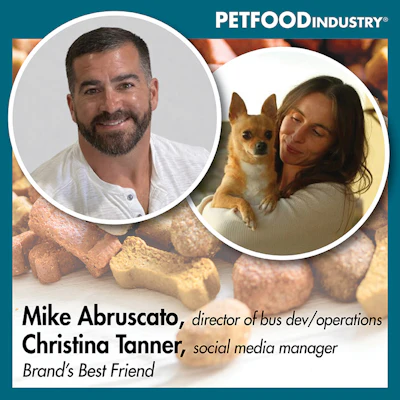
In this episode of Trending: Pet Food, Lindsay Beaton sits down with Mike Abruscato and Christina Tanner of Brand's Best Friend to explore how AI is reshaping the pet food shopping experience. From the rise of conversational search and Amazon's Rufus to ChatGPT and Gemini becoming full-fledged e-commerce platforms, the trio unpacks how consumer decision-making is shifting — and what that means for pet brands trying to stay visible.
We want to thank AFB International for sponsoring this podcast. AFB International is the premier supplier of palatants to pet food companies worldwide, offering off-the-shelf and custom solutions and services that make pet food, treats and supplements taste great.
Lindsay Beaton, editor, Petfood Industry magazine and host, Trending: Pet Food podcast: Hello, and welcome to Trending: Pet Food, the industry podcast where we cover all the latest hot topics and trends in pet food. I'm your host and editor of Petfood Industry magazine, Lindsay Beaton, and I'm here today with Mike Abruscato, director of business development and operations, and Christina Tanner, social media manager, for Cheddy Inc. and Brand's Best Friend. Hello to both of you, and welcome!
Both: Hi Lindsay. Thanks for having us.
Beaton: In case you're unfamiliar with Mike, Christina, or Brand's Best Friend, here's what you need to know.
Mike Abruscato has over 25 years of experience in the pet industry. He began his career managing retail pet supply businesses, gaining hands-on experience in merchandising, customer engagement, and store operations. Building on that foundation, he spent 10 years in sales and distribution, partnering with retailers and brands to drive revenue, expand product placement, and strengthen distribution networks. For the past seven years, he has focused on helping pet brands develop and manage comprehensive e-commerce strategies — working across marketplaces, digital merchandising, and channel growth to build scalable online businesses.
Christina Tanner is a social media strategist with over a decade of experience, beginning her career as an early influencer and e-commerce brand owner. She later transitioned into the pet industry, where she led social media and brand initiatives for a fast-growing startup — driving more than 35 million social views through strategic content and creator partnerships. Her efforts also contributed to the company's ability to surpass $1 million in sales in just 18 months. Today, she leads growth-focused social and creator strategies for pet and CPG brands at Brand's Best Friend, helping them turn content into measurable revenue.
Brand's Best Friend is a full-suite e-commerce agency, aiming to grow pet brands on the world's largest e-commerce platforms.
Mike and Christina's years of experience with business, brands, and consumer needs make them the perfect duo to answer this question: How are pet food customers using AI to enhance their shopping experience?
I like to start with a high-level question, because everything has been moving so quickly with AI that it can be difficult to even know where we're at. How has AI changed the shopping experience in general?
Abruscato: AI continues to evolve at a pace that's hard to keep up with or even imagine, so we really have to stay focused on where we are today and how we can utilize it today, rather than trying to predict tomorrow.
By and large, AI was introduced to public use in 2023 without a ton of noise or attention. In 2024, you started to hear more about it. Then 2025 became the year of AI — when people really started to recognize how it was going to change the way consumers shopped and used the internet.
As of today, reports indicate that around 71% of U.S. consumers are using AI in some form or fashion. Forty-five percent of consumers view AI as positive, and 38% say they will use it to make decisions on pet supplies. Adoption is there, and it's there across multiple generations — from baby boomers to Gen X, millennials and Gen Z. There are some variations in adoption rates within those groups, but we're seeing it across all four, which is significant.
When you look at one of the most popular ways AI is being used, it's the accessibility to information — it's easy and fast. In the traditional e-commerce model, you'd type something like "freeze-dried pet food" into the search bar on Amazon, Chewy or Walmart, and a results page would populate with all these different brands and products to choose from. The consumer then had to do their own search and discovery, which required a lot of time and research — and generated a lot of clicks, which are an opportunity for those platforms to make money through advertising.
With AI, the search becomes much more conversational and long-tail. A consumer might ask, "What is the best freeze-dried food for my Labrador retriever, and I'm on a strict budget?" AI then narrows its suggestions based on that conversation, eliminating options right out of the gate. The ability for a brand to stay in front of a consumer is shrinking because AI is either going to filter certain products out immediately or steer the conversation in a different direction. The consumer has far less engagement with the decision because they're relying on AI's summary of results.
As we move further into 2026, AI is going to be making outright purchase suggestions — and in time, it will actually make the purchase for you. We're seeing the monetization of these platforms, whether it's ChatGPT or Gemini. ChatGPT will be introducing an instant checkout process at some point this year. Google Gemini is in beta with it right now. Both have made partnerships with key retail platforms — ChatGPT with Walmart, Gemini with Chewy — to facilitate product delivery directly to the consumer.
Tanner: The consumer journey has changed dramatically. You can now have a hyper-individualized search that simply wasn't possible before — previously, it was just a string of keywords Google would bring up results for. Now you can have a full conversation with an AI agent, get very specific, and it almost feels like a friend chatting with you and then recommending products based on your needs. That in itself changes the consumer journey.
On top of that, the platforms consumers already use are also integrating AI. Amazon has AI built into its search. Social media channels have AI built into their search bars as well. It's everywhere in the journey, wherever a consumer goes to find information.
Beaton: From a business perspective, what does AI do to the concept of SEO?
Abruscato: We don't necessarily want to say that SEO is dead or going away — it's just evolving. Search engine optimization is ultimately going to become AI or large language model optimization. It's a shift in how you have to think about staying relevant and staying in front of your consumer.
One of the rumors circulating in the Amazon community right now involves Rufus — Amazon's own consumer-facing shopping assistant. Amazon also has a second AI called Cosmo, which operates more in the background, functioning as part of the algorithm. Right now, both the traditional search bar and Rufus are available to consumers on Amazon, but what we're hearing is that Amazon will eventually phase out the search bar in favor of Rufus. Will that happen in 2026? We don't know yet, and that's OK — we'll have to adapt as it unfolds.
The other key thing to keep in mind is that these AI assistants are designed to profile you as a consumer. They remember the conversations you've had with them in the past. They know which products you've liked and purchased versus the ones you passed on. They're learning who you are as an individual and will start to custom-tailor responses and suggestions based on that. Indexing for AI is going to become very personalized, and brands will have to key in on the nuances of customer behavior.
Tanner: Even in those hyper-individualized search experiences, the brands that show up are the ones with content the AI's optimization can pull from. Having a significant volume of content out there about your brand and your products — across different use cases and for different types of consumers — is critically important. You could have a product that perfectly solves a consumer's problem, but unless you're showing up in that search, you won't be found. The brands that repeatedly appear in results for a given language model are the ones that will continue to show up.
Beaton: When SEO first came onto the scene, it was considered neutral — and then it wasn't. There were preferred terms, tiered systems, the whole evolution. Is AI's version of SEO currently content-neutral? Is it simply pulling keywords, or is it already intelligent enough to assign more weight to where a keyword falls in a sentence?
Abruscato: AI is going to continue to evolve and learn — that's the premise of it, so where it is today is not where it will be tomorrow. Right now, it's relatively neutral. It's more about making sure you have content in the right places, addressing the right questions, across as many platforms as possible — social media feeds, online publications, your website, product display pages on the various platforms.
As of today, most AI models appear to be using online publications as their primary source for gathering information. The more you can be published online — whether through trade publications, clinical write-ups, or blogs — the better positioned you are. That said, we know AI is going to expand to incorporate social media feeds, video content and still images, making its own interpretations of that content over time.
There's also the monetization factor. ChatGPT has announced it will be introducing sponsored ad placement within its results. Google Gemini is doing the same. If you ask ChatGPT about a brand and where to buy it, it will frequently list Walmart.com first because of the partnership ChatGPT has with Walmart to facilitate shopping. It's slowly being influenced by pay-to-play tactics — which is something brands will have to navigate.
That also creates opportunity. We work with a third-party advertising platform called PackView, which allows us to manage digital advertising across multiple platforms. We've been in regular conversations with them about ad positions for ChatGPT and Gemini. Those spots are coming, they've been announced, and brands that want to be at the tip of the spear need to be ready to invest in them as they become available.
Beaton: How sophisticated are pet food customers right now in their use of AI? Are they mostly using it like a traditional search engine, looking for specialized formulations, or asking for veterinary advice? And what does that mean for businesses?
Abruscato: We don't have specific data yet on what consumers are asking or how many iterations of those conversations exist. What we can see is keyword search volume data — and across multiple pet categories, including treats, toys, food and supplies, we started seeing anomalies. Search volume was declining, yet sales and growth weren't. New-to-brand customers weren't slowing down. New subscribers to subscribe-and-save programs weren't slowing down. Those things didn't correlate.
When we started thinking through what could explain it, it quickly became clear that this was the effect of Rufus. Rufus operates as its own module within the Amazon ecosystem, separate from the traditional search bar — and for a period, conversational search terms entered through Rufus weren't being captured in keyword reporting. There was about a three-month window where keyword volume appeared to be dropping significantly. Then it came back. Our assumption is that keyword volume was being routed to Rufus and wasn't being reported. Amazon has since published an update to its system to capture keywords from Rufus usage — and it just goes to show the adoption rate.
For anyone who's used AI, you also know that it very quickly becomes conversational. You ask something general, the response isn't quite right, and then you refine it — and AI digs in. Anyone who's used AI to generate an image in the past 12 months has seen just how much more accurate it's become, even compared to six months ago. The way it's being used is much more conversational and long-tail versus short keyword phrases.
Tanner: Regardless of where adoption stands right now, AI is continually changing, and it's here to stay. There will be a point where Google's search is simply AI search. If Amazon gets rid of its standard search bar and replaces it with Rufus, it won't even be the consumer's choice — adoption will just happen.
Beaton: With everything in flux on the AI front, what are the biggest challenges for pet food brands trying to develop a marketing strategy — just trying to keep up, figure out which platforms to prioritize, what to do with their websites, what's happening on Amazon?
Abruscato: We're in unprecedented times. TikTok — which was in a gray area for a while in terms of whether it would even exist in the United States — is now solidified, and TikTok Shop is a very relevant e-commerce platform. ChatGPT and Gemini are racing toward monetization and becoming sales platforms in their own right. For pet brands specifically, there's still Chewy and Amazon — and ChatGPT's partnership with Walmart has made Walmart.com more relevant than it's been in years. All of a sudden, there are six different outlets competing for a brand's focus, time, resources and budget.
I very commonly tell clients today: If everything is a focus, nothing is a focus. We're always going to make data-driven decisions. Initially, we'll have to evaluate and make our best judgment on where to invest, and then let the data guide us toward where we're getting the best return relative to goals.
Tanner: Brands also need to invest in diverse content so they can show up across different forms of search — positive reviews, broad reach, lots of formats. When consumers have those hyper-individualized experiences going forward, there should be a wealth of content for AI to pull from about your brand.
Abruscato: Specifically within the pet category, cost per click is one of the most competitive on Amazon. For the last several years, we've seen year-over-year declines in return on ad spend and increases in cost per click — and that trend has held for five years. The pet category consistently ranks among the highest for cost per click and lowest for rate of return. That doesn't mean abandoning an advertising strategy on Amazon or Walmart, but it does mean asking: What is your goal? If it's awareness, is paid search really the best place to spend that money — or would social media investment do more to educate consumers and help steer their search behavior, both in AI and traditional search?
Beaton: How does a business utilize AI in social media without stripping out the human element? Customers and pet owners want to connect with the companies they're considering, and a lot of social media strategies have been built on that human connection — real people responding to comments, that kind of thing. Are there strategies in place, or should there be, to keep those two approaches running in parallel in their own best-use lanes?
Abruscato: The human element in social media is going to become even more important. We're going to lose some of our ability to connect with consumers within the actual shopping platform — AI is going to reduce our influence at the point of purchase, whether on Amazon or ChatGPT. That means social media is where brands can still stay connected to consumers, educate them and ultimately make the case for why their product is the better choice.
Tanner: There's a time and a place for AI-generated content on social, but people — especially in the pet industry — are still responding best to real content. Consumers want diverse people, diverse pets, and they want to connect with someone who has the same breed, the same experience. That reality reinforces the need for diverse content and a lot of it.
If a brand does want to use AI in its creative content, it should be done in a way that's fun, creative and clearly embraced rather than disguised. Platforms and algorithms are currently preferring real content — fully AI-generated content will be suppressed. And for consumers who clock it as AI, it will hurt brand scores. That said, there's real potential in using it transparently. Automating things like community response in DMs is a perfectly reasonable use of AI. And on the creative side, a fun, clearly AI-generated concept — something that would have cost significantly more to produce in real life — can be a cost-effective part of a content strategy when it's done with intention.
Beaton: It sounds like there might be opportunities to connect with pet food shoppers in new ways using AI — not just reacting to it, but being forward-thinking enough to develop an entirely new arm of a marketing strategy.
Abruscato: A year ago, we weren't having conversations with brands about online publications, podcasts, or where they were investing to have their story told in depth. Now, I'd be willing to bet that AI is already listening to podcasts like this one to inform its answers when a consumer asks a relevant question. Any online publication about your brand, your products, your story — it matters.
What I think will endure is organic human content. I know we're recording video for this podcast, but when we all started talking about our pets at the top of this conversation, we lit up. That kind of human moment — between us and our pets — people will always gravitate toward that. AI will help consumers find the best products for their loved ones, but the organic connection will always have its place.
What we're working on diligently right now is developing what we call AI optimization services — helping brands identify where they need to be and what they need to be doing so their products index properly on AI. That's critically important as this new landscape continues to evolve.
Tanner: As daunting as all of this can sound, it's also an opportunity to personalize your brand. People want to connect with brands they relate to. That means more opportunity to tell fun stories, get creative with content and show up in more places. And things that once required significant production budgets can now be done more efficiently — which opens creative doors for brands of all sizes.
Beaton: As we wrap up, what do you think is coming in the AI space for the rest of 2026? Are we heading for another big leap, or is it more incremental changes from here?
Abruscato: The biggest change we're going to see in 2026 is things that were rumored and in beta in 2025 actually coming to fruition — ChatGPT's instant checkout, Gemini's equivalent, and sponsored ad placement within these AI conversations. As of today, those haven't fully materialized. But I believe we're going to see them roll out this year, and that will be the biggest shift. A brand will need to be on ChatGPT, optimized for Gemini, and appearing as a shoppable option when people are searching those tools. On ChatGPT, you can already apply as an instant checkout merchant — we've already filled those applications out for our clients. Better to have it done than not.
These AI models will not just be AI models. They will become their own shopping platforms and business channels, and brands need to be there.
Tanner: On the social front, organic content used to be primarily about community growth and building a following. It's still important for that — but that content is now doubly important for showing up and presenting your brand across the internet, whether through your own handles or through creators, influencers and third-party voices. How people are talking about your brand, and whether the tone is positive, matters more than ever.
Beaton: How do you figure out if you're making content for AI or for your customers?
Abruscato: Right now, across platforms like Chewy, Amazon and Walmart, we're actively updating all content — titles, bullet points, copy, images, videos — to optimize for AI scrapability and interpretation. A year ago, I'd say content we created was roughly 60 to 70% for the human consumer, with 30 to 40% for AI. Today, that's flipped. If consumers are relying on AI to summarize results and make suggestions, they're not even looking at our content directly. The consumer may not make it to your product display page at all — the next step could simply be "add to cart" without them ever seeing it.
The good news is that AI is learning to think like a human being. The changes to optimize for AI aren't dramatic or jarring — they're subtle, nuanced adjustments to ensure AI can read, interpret and surface that information properly so it feeds it back to the consumer as a recommendation.
Where does this all lead? That story hasn't been written yet. But I believe that as AI handles more of the transactional work, we'll all have more time — and we'll seek out more human connection. The thousands of golden retrievers and their owners at a recent event called Goldens in Goldens reminded me of that. As e-commerce has grown, we've lost some of those interactions at the retail level. Perhaps we start to get some of that back in more social, community-driven venues.
Tanner: There's still so much we don't know about how it's going to play out — which is actually exciting. And there's an element of things that once cost a lot of money to produce now being something you can approach more efficiently. That's a pretty wonderful thing to have access to.
Beaton: Thank you both so much for coming on today to talk about the consumer and business experience with AI. It's evolving so quickly that companies really need this kind of information to figure out their path forward — and it's not a one-and-done path. Every company has to figure out what their audience wants and what they're capable of, and that can be really hard to navigate when everything seems to change every day. Thank you for helping bring some clarity to where AI stands right now.
Abruscato: Thank you for having us and giving us the opportunity.
Tanner: Thank you.
Beaton: Before we go, I always like to do a little plug for my guests. Where can people find more information about you both and about Brand's Best Friend?
Abruscato: There are so many opportunities in so many places that it can be overwhelming even for the biggest brands — and that's exactly what we're here for. We sit down with you, understand your brand and your goals, and execute the strategy, wherever it may lead. To get in touch, visit BrandsBestFriend.io, where you'll find a contact form to reach me directly. You can also find us on LinkedIn as Brands Best Friend, and my personal LinkedIn — Mike Abruscato — is also company-facing and a good resource.
Tanner: Same goes for me — BrandsBestFriend.io, and you can find me on LinkedIn as well: Christina Tanner.
Beaton: Perfect. That's it for this episode of Trending: Pet Food. You can find us on petfoodindustry.com, SoundCloud or your favorite podcast platform. You can also follow us on Instagram @trendingpetfoodpodcast. If you want to chat or have any feedback, feel free to drop me an email at [email protected].
Thanks again to our sponsor, AFB International, the premier supplier of palatants to pet food companies worldwide, offering off-the-shelf and custom solutions and services that make pet food, treats, and supplements taste great.
Once again, I'm Lindsay Beaton, your host and editor of Petfood Industry magazine, and we'll talk to you next time. Thanks for tuning in!