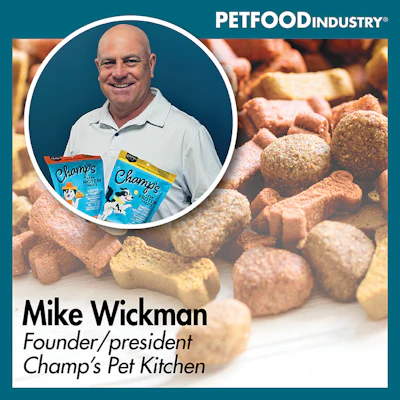
In this episode of Trending: Pet Food, Lindsay Beaton talks with Mike Wickman, founder and president of Champ's Pet Kitchen, about building a retail-first strategy in an omnichannel era. The conversation covers packaging efficiency, marketing spend, shelf variety and how brands can set retail partners up for success.
We want to thank AFB International for sponsoring this podcast. AFB International is the premier supplier of palatants to pet food companies worldwide, offering off-the-shelf and custom solutions and services that make pet food, treats and supplements taste great.
Lindsay Beaton, editor, Petfood Industry magazine and host, Trending: Pet Food podcast: Hello, and welcome to Trending: Pet Food, the industry podcast where we cover all the latest hot topics and trends in pet food. I'm your host and editor of Petfood Industry magazine, Lindsay Beaton, and I'm here today with Mike Wickman, founder and president of Champ's Pet Kitchen. Hi, Mike, and welcome!
Mike Wickman, founder and president of Champ's Pet Kitchen: Thanks, Lindsay. Glad to be here today. Appreciate the time.
Beaton: In case you're unfamiliar with Mike or Champ's Pet Kitchen, here's what you need to know.
With over three decades of experience in the retail and CPG industries, Wickman has built his career around delivering high-quality, wellness-focused products to consumers. Today, he brings that same commitment to the pet space as the founder of Champ's Pet Kitchen, creating nutritious, affordable dog treats that reflect the same clean-label standards long embraced in human food. His background spans brand building, business development, fundraising and strategic partnerships, where he's helped scale wellness-driven product lines in competitive markets and led successful fundraising rounds to accelerate innovation and growth.
Champ's Pet Kitchen is a better-for-you dog treat brand built on the belief that pet parents deserve the same nutritional transparency and everyday affordability for their dogs that they expect from their own food. Launched in 2025, Champ's Pet Kitchen is now available in more than 1,200 retail locations, including regional Safeway, Save Mart Supermarkets and Ingles stores, as well as online, with all products made in the U.S.
From its first-of-its-kind Pet Nutrition Facts panel to a channel strategy deliberately designed so that retail and online complement rather than compete with each other, Champ's Pet Kitchen was built equally for the pet parent and the retail partner from day one.
Wickman's extensive retail and CPG knowledge makes him the perfect person to answer this question: What does a retail-first strategy look like in an omnichannel era?
Mike, I want to start off by talking about how things have traditionally worked and how those need to update for the current landscape. What are some of the retail strategies brands have traditionally used that you think need updating for the current shopping landscape?
Wickman: Originally, as brands came to brick and mortar, it was all about how much money they were going to throw at a brand. They had this massive media spend. We used to pitch or present products, and retailers would say, "What is your media spend, and where is it going to be? How are you going to touch my consumer as a retailer?" If it was $1 million, you had a chance. If it was $100 million, you were probably going to get some distribution.
Those days are far over with. Most brands have now pivoted toward direct-to-consumer and subscription models. It's a far more controllable, more profitable and simpler business model, and they can reach the consumers they want to reach with all the social media and outreach programs available today.
The problem is that strategy essentially abandons physical retail because the focus is now on that consumer, not the retailer. The brick-and-mortar retailer loses out, and there's significant leakage toward online platforms — Chewy, Walmart.com, etc.
We took the exact opposite approach with Champ's Pet Kitchen. We built a brand specifically made for brick-and-mortar retail, from our package efficiency to being only 5½ inches wide versus the 7- to 10-inch-wide shelf hogs that are out there. It's a full package feel, so the consumer walks up to the shelf and feels like they're getting the value for what they're buying — not like a potato chip bag that's half full. I understand why other brands do it; there are efficiencies with the machines.
We took into consideration the shelf height of all the shelves across the country. Nine inches is the typical gap, so we knew our product bag couldn't be higher than 9 inches. A traditional grocery shelf is 22 inches deep. With a two-inch gusset on our bag and a 22-inch shelf depth, we worked out how to get to a case-and-a-half pack out, which is a retail requirement. The number is eight, so our case is eight. All of these considerations went into the brand before we brought it to the retailer, to say: We have brought you the most efficient package, case count, etc.
At the end of the day, 80% to 84% of sales are done in a brick-and-mortar store, whether it's grocery, mass, pet or independent pet. The majority of sales are still done in store. Online is growing — it's 20% to 26%, depending on who you talk to — but that still leaves 80% to 84% of consumers inside a brick-and-mortar store. That's who we're chasing, and we're trying to do that as efficiently as possible, as a partner to that brick-and-mortar retailer.
Beaton: We're going to get back to the packaging and efficiency piece, because I think that's a really important consideration that people might not put at the top of their list when it comes to being in a physical space these days — how to make appropriate use of all that space. But you mentioned marketing spend at the beginning.
Are people budgeting the same amount as they used to, and it's just going toward more channels? Are people trying to do more with less? Is a single marketing dollar going further than it used to? What does that landscape look like right now, with so many different channels?
Wickman: I'd suggest there's more margin to reinvest into advertising, and I think it's less expensive. Back in the day, you only had TV, magazine and maybe TV Guide — to show my age — to advertise in. Today, there are a billion influencers out there who will work for product or for a lower amount per post. There are some higher-end influencers with large followings, but I believe the dollar stretches further while the voice gets smaller, if that makes sense.
There are so many ways to reach consumers today that it's hard to choose where and how to spend wisely. We have a unique marketing strategy that's mostly driven through social media. Because we're a startup without a lot of private equity funding, we need to be scrappy and reach the consumers in and around the brick-and-mortar partners we've earned so far, and in the future.
Beaton: How do you reach those people? So many consumers are omnichannel shoppers now that if you're trying to reach them where they shop half the time, you might be missing them the other half. If you want to focus on retail, how do you effectively reach consumers — do you focus only on people who spend the majority of their time in retail, or split your strategy across both?
Wickman: Great question, and I don't want to give up too much of the secret sauce. Basically, we're trying to create as many impressions as possible in and around the cities and ZIP codes near our retail partners. We've identified influencers who live in specific geographies.
You mentioned Ingles earlier — there are specific influencer partners in that region who visit stores, come to our parking lot events, humane society events and adoption events that we run in parking lots to drive customers into that aisle. That's what we're doing.
Beaton: It can be difficult for companies to figure out what makes sense for their brand identity — e-commerce first, omnichannel, or retail first? Is there a specific type of pet company that leans toward a retail-first strategy right now? Established companies, startups, a specific type of pet food?
Wickman: I'd suggest the bigger manufacturers have control over the brick-and-mortar business. We refer to them as the red, the yellow and the blue, plus the private label competitors, which dominate the shelf. Brick and mortar is locked into a certain size section or pet aisle, while online has an infinite number of brands it can carry. That's where we typically see emerging or startup brands try to gain traction — and, quite frankly, gain the finances to then go to a brick-and-mortar retailer, because there are significant upfront costs involved in doing business with them.
Beaton: Let's talk about those. You mentioned packaging and maximizing efficiency of the space. Most of the industry is made up of small- to mid-sized companies, plus the big three you mentioned. What are the challenges for a company that started direct-to-consumer or is majority e-commerce in breaking into physical retail? Where do they even start?
Wickman: I don't want to get my brick-and-mortar partners upset here, but they have a cost of doing business that has to be covered by their partners as well. There's tremendous expense in getting old products out and new products in, creating slots in their warehouse, and educating their consumers that something new is available. There's a true cost to that, and as a new brand trying to earn space on their shelves, we've got to pay our percentages — our share of those costs — to make it a true partnership.
Beaton: You mentioned doing all this research so you could go to retailers with a plan showing you maximize shelf space and did the legwork to be a good partner right off the bat. How important is that, and what else do retailers value in a partnership with a pet brand?
Wickman: A couple of things. Everybody we've presented to says, "Wow, nobody has put this much thought into our side of the business" — from the case pack to the packaging dimensions, all the things you just mentioned. They acknowledge that.
Then, when we talk about pricing strategy — where you're going to be less expensive per ounce in store than we sell on our own website or any online competitor — we go with a larger bag and a higher price per ounce online, so we're not competing with the retailer.
In store is going to be the best option for a consumer to buy Champ's Pet Kitchen, period. That's our commitment: We're not going to be an omnichannel brand that says, "We don't care where you buy us, just buy us." We want to drive traffic to that store because that's best for the consumer, best for retail and, at the end of the day, best for us.
Beaton: What do retailers need help with in an age when e-commerce and omnichannel are such huge conversations? Are they looking for visibility, cross-branding at a regional level? What are their expectations, and what do they really need help with right now to hold their space?
Wickman: At the end of the day, they're charged with grabbing as much market share as they can within their marketing area and increasing sales over the prior year. That's what a category manager has to deliver to their boss.
How do we help them do that? We help them understand there's a lot of duplication within a category today — a lot of duplication — and voids where they can't compete with the independent pet store or the veterinarian that may be in their parking lot. Do you have enough better-for-you products? Do you have a couple of premium products answering that consumer's needs, or does that pet parent have to go to the veterinarian or independent pet store to get a better-for-you product?
Variety is really important, in my opinion. Category managers struggle with that. They find comfort holding on to those blue, yellow and red brands, and they've got to answer to their private label brands too. So how do you find space for other options? By removing duplication, adding variety and offering something for the consumer shopping across the parking lot.
Beaton: Do shelves in a physical retail space look different from an online space? Is there a lot of overlap in product availability, or are physical retailers specializing more — premium-focused, dog-focused, cat-focused — or still trying to offer everything to everybody?
Wickman: They are sales-driven, period. Brick-and-mortar stores are sales-driven. Online can offer everything under the sun. Brick-and-mortar retailers have the limitation of a 4-foot section, an 8-foot section, a 12-inch section — whatever the size — and they can only offer so much.
They also have to represent the 800-pound gorillas that exist, plus their private label. So where do you find space to offer something different and create variety? I'd say they tend to lean heavily toward proven, existing brands and expand from there.
That's the mentality we're trying to change through education — saying, look, you only need so many bacon-flavored or beef-flavored products. Introduce something different. Not many brands offer ingredients for support — bone and joint support, gut health support. Our products aren't a supplement, but they include ingredients to help. We're adding a new consumer option within the category, not just another me-too or duplicate SKU.
Beaton: Longtime listeners of this podcast know you just said the magic word: education. I'm a big fan of asking about educational opportunities across the industry. As somebody with a lot of retail experience, what does your education to a retailer look like, and where are the biggest pain points where you have to bring them into the modern era, for their own good?
Wickman: This is a tough one. We spend a lot of time trying to reach into their loyal consumers — whether it's a card or fuel points program, whatever that retailer wants to promote at a given time, we want to be part of it and educate their consumer.
While you're fueling up, there's a better-for-you product in the pet aisle with significantly higher protein than anybody else, low fat and added support. It's made in the USA. It ticks all the boxes people are looking for — but we've got to reach out and tell that person. The challenge is that's also a profit center for the retailer, so how do we make it affordable for us to educate their consumer to walk down that aisle and pick up the brand? That's the dance we do every day, but it's the most direct education we can provide to their specific consumer.
Beaton: Over the years, how much has the overall strategy changed? Is e-commerce and omnichannel just the latest wrinkle in retail strategy, or has retail had to go back to the drawing board and come up with an entirely new strategy from scratch?
Wickman: From scratch. Back in the day, the grocery store or mass store was a destination — you went there, bought what you needed from the assortment offered, and that was it. There were no other choices.
Now that there's an online choice and all these other options, retailers have to start fighting for that business. Pet products are bought twice as much online as in store. About 20% to 21% of groceries are bought online today; in the pet world, it's around 36% to 39% — almost double. A lot of that is convenience — not wanting to carry a 40-pound bag in a cart — and, in my opinion, the bigger piece is pricing. I can buy the exact same UPC online today at a cheaper price, and it'll show up on my porch tonight or tomorrow at the latest. That leakage is why pet products are bought online at twice the rate of brick and mortar.
Beaton: When I talk about retail-specific topics, that conundrum always comes up: You can't outdo online on convenience, and you can't necessarily outdo it on price. What retail has that other channels don't is the experience — consumers can come in and talk to a human.
A lot of retail places have expanded into grooming and other non-pet-food services just to make it a welcoming place. What are some of the top things you've seen pet food brands do to be part of that experiential piece?
Wickman: We've hitched our wagon to humane societies, SPCAs, organizations doing great work for pets. We also support canine police units and first responders.
As a brand, we're trying to tie in with as many organizations as we can that are doing great things for people and for pets. As far as a retailer goes, if you have the space to add grooming and those kinds of things, that's great — though where we play, in grocery and mass, that's just not an option.
But retailers can still educate their consumer on what they're doing outside the store. You mentioned Ingles earlier — they have a Flying Dog jumping contest every year that they support, and we'll be a big part of that this year, trying to connect with those folks as well. Retailers have to do things outside their store, in my opinion, and brands have to associate themselves with organizations doing right by pets and pet parents.
Beaton: As we wrap up, I always like to give my audience something actionable to take back to the C-suite or their team. If a brand is listening to this episode and determined to be in the physical space, wants to partner with retailers and is all in but doesn't know the next step — what's the true path to success for brands working with physical retailers, and what's one step a brand can take to figure out what they need to do next?
Wickman: There are a few things. Connecting as a brand to a brick-and-mortar retailer means learning to be efficient throughout their process — order minimums, case sizes, packaging dimensions, pricing, avoiding online pricing pressure. Set the retailer up for success before you get there; I believe that's true in every industry. In sales, it's fix the problem before it's presented to you. Know your channel and know where you're headed.
Then there's talking to retailers about variety. Not just the safe bets — "I can't discontinue this item because it does $100,000 in business, and the new item is going to have to do $110,000. Do I take that chance on a new product to overcome that?"
What a lot of retailers don't see is that if the $100,000 SKU is part of a family of products and the consumer is brand-loyal, they're just going to buy a different flavor within that brand — they're not going to lose all $100,000 of that business. What they can do is bring in that observant, educated consumer who's turning the bag around to read the ingredient label and say, "This is a product I could be excited to bring home to my pet."
Now you can introduce more of those products, and they don't have to do $110,000 — they'll hold $80,000 of that within the brand and only need $20,000 to $25,000 to grow the category overall. That's incremental growth and new customers, and that's what everybody's looking for. But it's a scary position for a category manager to roll those dice, so they've got to feel confident you can drive that consumer into their aisle.
The third piece is pricing pressure. The retailer has to demand from their manufacturers a price that works within their world to be competitive with online. I can't be $2 or $10 a bag more expensive on kibble when Mrs. Johnson can't even get it into her cart. Help me drive my category — I need a pricing structure that allows me to do that. Those are the three things I think are most important to connect with a retailer and be a true partner.
Beaton: Mike, thank you so much for coming on to talk retail strategy. It's a hot topic right now, if for no other reason than e-commerce is a hot topic right now, and omnichannel shopping is a hot topic right now. I think it's become really difficult for brands to figure out where they're supposed to be — there's probably a lot of pressure to be everywhere at once, but resource-wise, that's not necessarily realistic.
There can be a lot of value in focusing on a channel and going all in on it and making those partnerships in the industry. I really appreciate you shedding light on all of that and highlighting actionable items for people who want to do retail but are maybe getting pressured to do other things, or just don't know if it's the best thing for them anymore.
Wickman: Appreciate the time you've given us today, and talking a little industry, a little Champ's. It's always good to do that. We appreciate you doing it.
Beaton: Before we go, I always do a little plug for my guests. Where can people find more information about you and Champ's Pet Kitchen?
Wickman: This is going to sound crazy, but champspetkitchen.com — we'll send you online to find more information about our brick-and-mortar brand. Feels like we're talking out of both sides of our mouth, but that's where you can find out more about the brand. You can go to our store locator to find out where it's available near you, and if you want to get in contact with me, LinkedIn is probably the best way to do that. Feel free to reach out.
Beaton: Perfect. That's it for this episode of Trending: Pet Food. You can find us on petfoodindustry.com, SoundCloud or your favorite podcast platform. You can also follow us on Instagram at @TrendingPetFoodPodcast. If you want to chat or have any feedback, feel free to drop me an email at [email protected].
Thanks again to our sponsor, AFB International, the premier supplier of palatants to pet food companies worldwide, offering off-the-shelf and custom solutions and services that make pet food, treats and supplements taste great.
Once again, I'm Lindsay Beaton, your host and editor of Petfood Industry magazine. We'll talk to you next time!