Pet food is hardly the only industry facing volatility and unpredictability in 2026. The current state of the world challenges U.S. dog, cat and other pet food exports. However, the pet food industry still has advantages on the global market, Dana Waters, director of international affairs, said during her presentation at Petfood Essentials in Kansas City, Mo., preceding Petfood Forum 2026.
U.S. pet food manufacturers must navigate a global trade environment defined by policy shifts, armed conflicts and supply chain uncertainties, but strong international demand and a reputation for quality continue to create growth opportunities. U.S. pet food exports score relatively well compared to other industries, and have export advantages, she said. Not least of which is momentum.
North American trade partners still anchor U.S. pet food exports from the U.S., with Canada leading at US$1.19 billion, followed by Mexico at US$260 million and China at US$244 million.
“While it can be fun and exciting to talk about new and emerging markets… it’s still really imperative for us to keep our good relationships with our neighbors,” Waters said.
Speaking of which, growth in China has slowed, and Japan faces economic pressure tied to inflation, she said.
New challenges balanced by established reputation
Waters identified persistent volatility, geopolitical tensions and inflation as key pressures on exporters.
“We’ve got a volatility problem here,” she said, noting that conflicts and shifting trade relationships are increasing shipping costs and complicating logistics.
Trade policy changes in the United States are adding another layer of uncertainty. The increasing use of tariffs and trade investigations, along with potential retaliatory actions from other countries, affect both costs and market access.
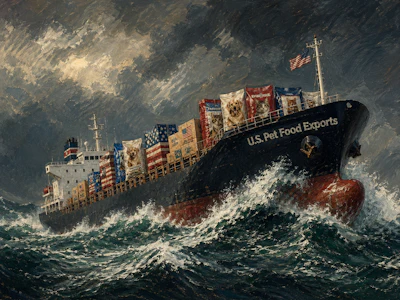
“We’re seeing a pretty top-down approach to trade policy,” Waters said. “Those constant policy changes make long-term planning difficult,” she said. “If the boat is rocking, you’re not going to want to get in that boat.”
Higher costs may be exacerbated by policy changes, particularly for imported ingredients such as vitamins and amino acids. Likewise, tariffs on packaging materials like steel and aluminum further increase production expenses.
Exporters also face growing regulatory complexity. Product registration timelines can stretch significantly due to strained diplomatic relationships.
“When your governments are mad at each other, maybe it takes longer to process paperwork,” she said.
Likewise, reformulation or even repackaging can results in international regulatory hurdles. At the same time, some nations’ cultures influence their pet food standards. For example, Indonesia has expanded halal requirements for pet foods like those for humans, which can influence what pet food products can be imported.
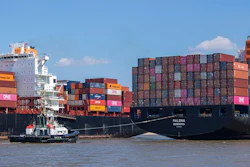
Persistent supply chain instability continues to affect global trade flows. Port congestion, rising freight costs and limited transportation capacity can delay shipments and disrupt delivery schedules.
Even if a product makes it to a port and passes customs, there still need to be people to unload it and trucks or trains to ship it, she said.
Beyond tariffs, dependence on imported ingredients also creates vulnerability to external shocks such as weather events, conflict or disease outbreaks.
Demand and reputation support growth
Despite these challenges, Waters emphasized that global demand for U.S. pet food remains strong.
“The demand for U.S. pet food is pretty strong,” she said, pointing to the industry’s reputation for “higher quality, higher safety standards and good nutritional value.”
Premiumization continues worldwide, driven by rising pet ownership and the growing perception of pets as family members. This trend is particularly evident in emerging markets with expanding middle classes.
Waters noted that the United States’ reputation gives exporters a competitive edge.
“Half of your marketing battle is kind of over already,” she said. “You don’t have to convince people overseas that U.S. pet food is good.”
Latin America, Southeast Asia and Africa promise future growth for U.S. pet food exports, but with different dynamics in each region. Latin America, for example, represents a stable and expanding market, while Africa offers longer-term potential.
“Lots of opportunity there right in our backyard,” Waters said of Central and South America.
Leveraging tools and partnerships
Waters encouraged manufacturers to take advantage of U.S. Department of Agriculture export programs, including the Market Access Program and Regional Agricultural Promotion Program, which can help offset market entry costs and build relationships with buyers.
She also emphasized the importance of making U.S. products more identifiable in international markets, such as denoting U.S.-made products on store shelves.
“People want to know internationally what is from U.S.,” she said.
Waters said that while the current trade environment is unpredictable, it is manageable with the right approach.
“The boat is still rocking and the new normal is just crazy all the time, but it’s crazy that’s manageable,” she said.
For U.S. pet food manufacturers, success will depend on balancing risk with opportunity. U.S. pet food brands must maintain North American export markets while strategically expanding into new regions and leveraging available tools to navigate an evolving global landscape.