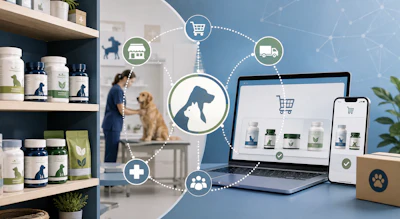
Dog and cat supplement shoppers are more likely than average pet owners to buy products at the veterinarian's office, according to the Nextin Dog Trends and Nextin Cat Trends reports from Nextin Research. About 12% of cat owners and 13% of dog owners said they purchased products from their veterinarian in the past year. Among supplement shoppers specifically, that figure rises to 26% for cat owners and 20% for dog owners.
"The vet office is important, but it is one important channel among many for pet supplement consumers," said Jon Copeland, research manager at MarketPlace. "People who buy pet supplements are truly omnichannel shoppers. The data show they spread purchases for their dogs and cats across multiple channels. They are more likely than the average dog or cat owner to buy products for their pet at pet specialty stores, their vet office, club stores, as well as online via Amazon, Chewy and brand websites."
Copeland said supplement shoppers also turn to a range of sources for advice and research. "Pet supplement shoppers talk to friends, family and their vet to get advice," he said. "They're on Instagram, they go to YouTube and TikTok for video content about pet health. They shop on Chewy and in Petco."
Cat supplement shoppers, in particular, are far more likely than average cat owners to buy directly from brand websites, with 22% reporting a direct purchase in the past year compared with 9% of average cat owners, according to the Nextin data. Copeland attributed that trend in part to how cat owners gather information, noting that 43% rely on online searches for pet health information.
Shift toward e-commerce and DTC
Jane Phelps, CEO and founder of Know Agency, said the shift toward e-commerce and direct-to-consumer buying has been building for years and is closely tied to how pet owners view their animals.
"Consumers have heavily shifted toward e-commerce like Amazon and Chewy and DTC due to convenience, broader product selections, customer reviews and auto-ship subscriptions," Phelps said. "This shift has happened gradually over the years as the humanization of pets and preventive care trends mean pet parents shop for their pets the same way they shop for themselves online."
Phelps said online shopping also gives pet owners access to deals not typically available in stores. "Consumers can search online for promotions, bundles and subscribe-and-save to find better discounts than are typically seen in stores as well," she said.
Channel-specific challenges
Each retail channel presents its own hurdles for supplement brands, according to both sources.
In physical retail, limited shelf space restricts how many products can reach consumers, Copeland said. "In pet stores, shelf space for supplements is limited," he said. "There are only so many SKUs you can display. In contrast, online retail is crowded and sprawling. Pet supplement brands must fight for space in stores and for attention in e-commerce."
Clear communication of a product's benefits is essential to standing out in either environment, Copeland said, pointing to Nextin data showing that more than half of pet supplement shoppers look for a specific health benefit when choosing a supplement.
Phelps pointed to the cost of competing online as one of the biggest obstacles facing supplement brands today. "High customer acquisition costs, search visibility competition, including now with AI visibility, makes it hard for e-commerce to compete," she said. "It is the companies with deep pockets that can afford the omnichannel approach that are succeeding the most."
Veterinary clinics adapt
Phelps said veterinary clinics are losing ground in traditional product sales but are finding new ways to engage supplement customers. "It would seem that vet clinics are losing out on traditional product sales, but I am personally seeing my vet clinic creating new ways to connect with consumers with email marketing, product sales and more of a digital outreach," she said.
Opportunity and competition for new brands
Asked whether the connected marketplace makes it easier or harder for smaller or newer supplement brands to compete, Phelps said e-commerce can be a mixed blessing.
"E-commerce significantly lowers barriers to entry for product launch, testing niche concepts and targeting specific pet needs," she said. "However, sustaining growth is tough due to rising digital ad costs and competing with established brands that have massive budgets. In order to really compete, you must have good capital backing to be found in such a noisy space."