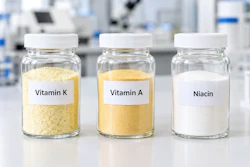
Securing ingredient supply chains requires diversifying suppliers, understanding concentration risks in critical ingredients like vitamins and amino acids, strengthening supplier relationships, and building flexibility into sourcing strategies to respond to disruptions regardless of their origin.
- The U.S. depends on China for 100% of imported vitamin D3 and lysine, and 85-95% of key amino acids and B vitamins used in pet food and supplements.
- Three major challenges threaten supply chain resilience: concentrated ingredient production in few countries, trade and geopolitical uncertainty, and limited flexibility in replacing specialized ingredients.
- Tariff volatility makes cost forecasting and supplier negotiations difficult, requiring companies to evaluate alternative suppliers and regions before disruptions occur.
- Resilience requires both diversification and strong supplier relationships—multiple qualified suppliers reduce risk while long-term relationships provide visibility into emerging problems.
- Companies should monitor trade policy, production capacity, freight conditions, geopolitical developments, animal disease outbreaks, and supplier communications for early warning signals of upstream changes.
Ingredient sourcing is the starting point that defines everything that follows in pet product manufacturing. A reliable supply chain depends on supplier qualification, traceability, careful processing and handling, and consistency. Documentation such as certificates of analysis should be supported by third-party testing and, when possible, supplier audits.
Consistency requires clearly defined ingredient specifications, routine testing for purity, potency and safety, strong long-term supplier relationships and standardized handling and storage protocols.
Mallory Gaines, director of global affairs for the American Feed Industry Association (AFIA), discussed the supply chain resilience challenges facing the pet food and supplement space. Gaines noted that AFIA does not represent pet supplement companies but said the supply chains for pet supplements and animal food ingredients share similarities.
Concentrated production of critical ingredients
One of the biggest challenges is the concentration of production for certain critical ingredients in a small number of countries, particularly China, Gaines said. This is especially true for vitamins and amino acids used across the animal food industry, including pet food and supplements.
"For example, the U.S. is effectively dependent on China for 100% of the imported vitamin D3 and lysine used in livestock feed," Gaines said. "We also rely on China for roughly 85% to 90% of key amino acids like threonine and methionine, as well as up to 95% of certain B vitamins. That level of concentration means a disruption in one country can quickly become a global supply issue."
Gaines identified trade and geopolitical uncertainty as a second challenge. Tariffs and changing trade relationships can affect ingredient costs and availability with little lead time, she said.
The third challenge is limited flexibility in replacing specialized ingredients. "Pet supplements frequently rely on highly specific nutritional or functional ingredients, and switching suppliers is not always as simple as finding the same ingredient somewhere else," Gaines said. "Companies must consider quality, safety, regulatory status, specifications and consistency."
AFIA has long advocated for a more efficient U.S. ingredient approval system, Gaines said, because regulatory delays can limit the number of ingredients and alternatives available to manufacturers.
Tariff volatility complicates planning
Rapidly changing tariff policies make it harder for companies to forecast costs, negotiate contracts and determine whether changing suppliers makes economic sense over the long term, noted Gaines. "The uncertainty itself is a significant part of the problem," she added.
Companies are evaluating alternative suppliers and regions, but diversification cannot happen overnight, Gaines said. A new supplier must meet a company's quality, safety and performance requirements, as well as U.S. regulatory requirements.
"Not all ingredients are created equal," she said. "Companies develop technologies and innovations, so simply finding an alternative is not always an option or quick fix."
Steps to build resilience
Gaines said manufacturers of pet food ingredients should first review their supply chains beyond their direct suppliers, including where an ingredient is manufactured and where its critical raw materials originate.
"Two different distributors may ultimately be sourcing from the same overseas manufacturer, which means apparent diversification may not actually reduce risk," she said.
Companies should also strengthen communication with suppliers, Gaines said. Visibility into suppliers' capacity, lead times, logistics challenges and upstream risks positions companies to react when conditions change.
"Supply-chain resilience is ultimately about creating options before you need them," she said.
Diversification and supplier relationships
"Resilience requires both diversification and strong supplier relationships," Gaines said.
Multiple qualified suppliers can reduce exposure to a disruption affecting one company, country or transportation route, but adding suppliers alone does not make a supply chain resilient, she said. Those suppliers must be vetted and capable of consistently meeting safety, quality and regulatory requirements. Long-term relationships can provide visibility into emerging problems and allow companies and suppliers to collaborate on inventory, forecasting and contingency planning.
"The important question is whether a company understands where its true concentration risks are," Gaines said. AFIA began its supply chain resiliency work because of the industry's overreliance on a limited number of sources for critical inputs such as vitamins and amino acids, she said.
Signals to watch
When it comes to securing your supply chain, Gaines said companies should watch several indicators simultaneously rather than a single warning sign. Trade policy and U.S.-China relations should remain high on that list, including tariffs, Section 301 actions and other policies affecting critical ingredients. She pointed to the ongoing review of Section 301 China tariffs by the Office of the U.S. Trade Representative as a process worth following closely.
Other indicators include production capacity and pricing for vitamins, amino acids and other concentrated ingredients; freight and port conditions; geopolitical developments in major producing regions; animal disease outbreaks; extreme weather; and regulatory changes, Gaines said.
"Just as importantly, companies should pay attention to what their own suppliers are telling them — longer lead times, tightening inventories or sudden price movements can be early indicators that something is changing upstream," she said.
Outlook for the next 12 months
Speaking to pet food ingredients generally, Gaines said AFIA expects continued volatility and uncertainty rather than uniformly better or worse conditions.
Some broader feed ingredient markets have stabilized compared with disruptions earlier this decade, but structural vulnerabilities remain, she said. The U.S. remains highly dependent on China for several vitamins and amino acids, and industry outlooks for 2026 identify U.S.-China relations, tariffs and concentrated vitamin and amino acid production as continuing supply risks.
"Resilience should not be based on trying to predict the next disruption," Gaines said. "The better strategy is to build enough flexibility into sourcing, inventory and supplier relationships that the business can respond regardless of where that disruption originates."
AFIA continues to advocate for policies that encourage domestic production of critical ingredients, expand production among trusted international partners, improve the U.S. ingredient approval process and recognize vitamins and amino acids as critical goods in federal supply chain strategies, Gaines said.
Click here for a new primer from IFEEDER and Kemiex that examines the precursor materials and intermediates behind vitamins and amino acids used in animal feed and pet food.