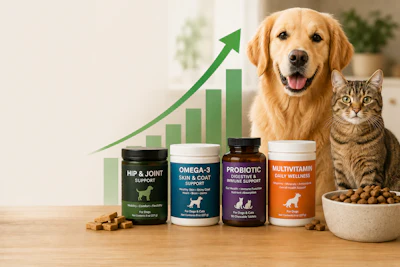
The U.S. pet wellness market is larger and growing faster than many industry estimates suggest, and that combination continues to draw investor interest, Lauren DeVestern, managing director and partner at L.E.K. Consulting, said at the 2026 NASC Annual Conference in Phoenix, Arizona.
DeVestern, who heads L.E.K.'s pet and animal practice in North America, defines the category broadly as products that deliver a health benefit or address a health issue, typically with active ingredients in dosage-based formats. By that measure, she said, the market totals more than $5 billion — roughly double many published figures that capture only portions of the category.
"This industry is misunderstood and often underestimated," she said.
Common estimates often reflect only dog supplements, while cat supplements add another 15% to 20%, DeVestern said. Dental chews, though sometimes excluded, add more than $1 billion, and products such as sprays, wipes and topicals, often untracked, add roughly $600 million. Scale-up assumptions for unmeasured channels also vary across data sources, she said.
"When you add all of that up, dog and cat, we think it's easily over $5 billion currently, and a lot of estimates you'll see are half of that," she said.
What's driving the growth
The category has grown at a compound annual growth rate of 14% to 15% from 2019 to 2025, DeVestern said, among the healthiest rates in the pet industry. Unlike pet food and treats, where recent gains have come largely from price increases amid flat volume, supplements have posted both volume and price growth.
"It's healthy volume growth and price growth, but not like this crazy, crazy high inflation that we're seeing in other categories, and that speaks to the health of this category," she said.
DeVestern outlined several drivers behind the growth. Pet population growth is positive but below pre-pandemic rates, she said, with the total number of pets expected to grow about 1% annually going forward. Dog numbers have been flat to slightly down, while cats are growing 1% to 2%.
A key tailwind, she said, is what L.E.K. calls the "silver tsunami" of aging pandemic-era pets. About 35 million to 40 million pets were adopted during the pandemic, many of them puppies and kittens now approaching the ages at which supplement spending typically rises.
"As pets age, they need more supplements, so this is a really nice tailwind that's ahead of us," DeVestern said.
Pet humanization is deepening, particularly among younger and prospective owners who increasingly treat pets as first children, she said, and awareness of pet wellness products continues to climb.
"Humanization is not over," DeVestern said. "Yes, everyone thinks pets are family, but there's still room for us to spend even more and treat our pets even better going forward."
Consumer sentiment is strong, she said, with 93% of current users reporting they were satisfied with the products they use and 98% saying they were likely to keep purchasing. Interest among non-users is also high once the products are explained, she said. She also noted a growing number of brands are investing in clinical studies.
Retail shelves seen as the next unlock
Pet wellness products remain heavily online, but expanding into brick-and-mortar retail represents a significant growth opportunity, DeVestern said.
"Brick and mortar can be an unlock, a huge unlock," she said, adding that broader shelf placement builds awareness and consumer comfort. "We're really still in the early innings of that."
Penetration remains low, about 20% of dogs and cats take at least one supplement consistently, leaving substantial room for growth relative to human supplement use, she said.
"We've still got a big difference between that number and where we know human vitamin and supplement adoption is," DeVestern said.
Investors weigh the deals
On deal activity, DeVestern said the category continues to see a healthy number of transactions each year, despite a slower 2024 that mirrored a broader pullback in dealmaking. Investors weigh several concerns, she said, including brand staying power in a fragmented market, perceptions of limited product differentiation and reliance on a single SKU, category or channel.
Some investors favor contract manufacturers as a way to gain exposure without selecting individual winners, she said. "You get exposure to the category and to a lot of brands without having to pick one, so some investors will find investing in that angle an easier bet," DeVestern said. She cited Morgan Stanley-owned Food Science as an example of an investor combining brands with vertically integrated manufacturing.
Despite those concerns, DeVestern said the category's fundamentals support its value, citing long-term demand, proven success across online and retail channels, high customer satisfaction and retention, and clear brand differentiation through clinical evidence, innovative formats or veterinary recommendation.
"This is a proven category," she concluded.