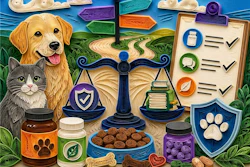
The National Animal Supplement Council (NASC) has unveiled the Animal Health Supplement Act, a proposed federal law that would establish a statutory category for animal health supplements — products that have operated for decades under regulatory enforcement discretion with no permanent legal standing.
NASC President Bill Bookout and Todd Harrison, partner at Venable and the organization's legal counsel, unveiled the proposal during a webinar attended by nearly 500 industry stakeholders and state regulators.
What the act would do
The Animal Health Supplement Act would formally define animal health supplements as products intended for structure/function use only — meaning disease claims would remain prohibited. It would establish an ingredient pathway supporting innovation, create a national product listing system, set cGMP standards modeled on existing NASC practices, require adverse event reporting, and preempt inconsistent state-by-state requirements in favor of a uniform national framework.
The act would also mandate that FDA establish and publish a grandfather list of currently marketed ingredients within one year of passage — a provision its creators say corrects one of the Dietary Supplement Health and Education Act’s (DSHEA) most significant structural oversights.
Why now
NASC was founded 25 years ago in response to FDA's position that DSHEA does not apply to animals. DSHEA, passed in 1994, is a U.S. law that established a framework classifying supplements as food rather than drugs, requiring FDA to prove a product is unsafe before taking it off the market, and allowing structure/function claims provided they include a disclaimer. Because Congress did not extend those protections to animal products, most animal health supplements have instead been marketed under enforcement discretion — a policy-based arrangement that can be reversed at any time by any administration.
Bookout said that vulnerability, combined with the industry's continued growth, makes the current framework untenable.
"Enforcement discretion is never permanent," he said. "It is policy, not law. One bad ingredient, or irresponsible company, can impact hundreds of good ingredients and cast a disparaging shadow on the entire industry. It also creates business uncertainty and discourages long-term investment. It's simply not a good place to be."
The act is also designed to address the inability of U.S. companies to obtain certificates of free sale for export, a growing obstacle as international markets increasingly require proof that products are lawfully marketed domestically.
Key benefits
According to NASC, the act would deliver several long-sought outcomes for the industry:
- Legal certainty: Removes the risk of automatic drug classification and establishes a clear, lawful marketing pathway.
- National uniformity: Preempts inconsistent state requirements related to claims, ingredient safety, cGMP, listing and fees, creating a single national framework, while not limiting individual states from enforcement action.
- Innovation support: Establishes a 75-day ingredient notification process and permits bioidentical, synthetic and semi-synthetic ingredients provided they meet safety equivalency standards.
- Market transparency: Requires 30-day post-market product listing in a publicly accessible database, intended to deter bad actors and build consumer trust.
- Export access: Enables U.S. companies to obtain certificates of free sale, opening doors to international markets.
Harrison noted that for most responsible companies, compliance costs should not increase. "You should already be doing everything that's in this bill," he said. "If you're not, you need to seriously look at your business."
What it is not
Bookout was direct in drawing boundaries around the act's scope. It does not apply to pet food, treats, topical products or food-producing animals. It is not the PURR Act, and it is not DSHEA for animals nor does it open DSHEA in any way to potential changes.
"This is narrowly focused on products that are unapproved drugs marketed under enforcement discretion — products that have no legal home," he said.
Timeline
Draft legislative language is expected to be available within weeks. With 2026 being an election year, Bookout said 2027 is likely the more realistic target for passage, however, this is an issue that would impact millions of voters nationally.
"NASC members have always said they contribute to a cause greater than their own individual self-interest," he said. "This legislation will be the culmination of those efforts."
NASC said it will launch a dedicated website with supporting materials and plans to keep industry stakeholders informed as the legislative process moves forward. The domain — www.saveanimalsupplements.org — has been reserved, and the site will be up and running very shortly.