My news feed recently surfaced an article that ran with an alarming headline, “The Grain in Your Pet’s Food is Classified as a ‘Hazardous Chemical,’” published on Truth About Pet Food.
I bit on the click bait, just as a pet owner scrolling through social media or search results would, thinking the implication seems obvious: Corn, wheat or rice in pet food has somehow been officially classified as dangerous.
The article was about how OSHA classifies grain dust.
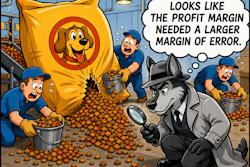
The article provides a case study in how technically accurate information can be framed to produce an inaccurate impression. My first thought was not to dignify such behavior with a response, but the News Hound's hackles were up. I had to call out this manipulation of pet owners.
The headline suggests something the evidence does not
The “hazardous chemical” classification discussed in the article comes from workplace safety regulations related to combustible dust.
Finely divided grain dust can become a fire or explosion hazard when enough of it becomes suspended in the air around an ignition source. This is a legitimate occupational safety concern in facilities that handle large quantities of grain, flour, feed ingredients and other powdered materials.
A headline such as “Grain dust poses combustible-dust hazard in pet food plants” would accurately describe the issue. It would also be considerably less frightening and get far fewer clicks. In fact, I might end up writing that legitimate article someday.
Instead, the article removes the critical word dust from the central claim and connects “hazardous chemical” directly to “the grain in your pet’s food.” The result is technically defensible wording (maybe) that encourages a scientifically incorrect inference.
The article’s comment section shows how this kind of framing can influence readers beyond what the evidence actually supports. A commenter speculated about whether grain dust in kibble could damage pets’ lungs or cause other health problems over time. That leap is significant because the article presents no evidence establishing such a risk from normal feeding.
Journalism depends on context, not merely factual accuracy
A statement can be factually correct and still be misleading. Responsible journalism does more than determine whether individual sentences are technically true. It asks whether the audience will come away with an accurate understanding of the subject.
Imagine a headline declaring, “The flour in your bread can explode.”
Flour, like grain dust, can be hazardous inside an industrial facility where enormous quantities of fine particles may become airborne. Denzel Washington's character in the Equalizer 2 set a trap using just that explosive phenomenon.
A workplace safety hazard (or action move concept) tell us absolutely nothing about whether grain in kibble presents a health hazard to a dog. Yet the headline encourages readers to mentally connect those two unrelated situations.
The cognitive biases and psychology of “hazardous chemicals”
The framing works because the words hazardous chemical carry emotional baggage far beyond their regulatory meaning.
Most consumers do not hear “chemical” and think about regulatory definitions involving substances and mixtures. They think about pesticides, industrial contamination, toxins or poisonous compounds. People rarely think about the scientific fact that they are made of chemicals, as is pretty much every object around them, including their pets.
Likewise, “hazardous” sounds like a warning against exposure.
Put the two words together and the emotional message becomes powerful: There is something dangerous in your pet’s food.
That reaction can happen before a reader even opens the article. Psychologists call this type of effect priming. Exposure to emotionally charged words influences how people interpret the information that follows.
Once readers have been primed to think about toxicity or contamination, subsequent discussion of OSHA classifications, safety data sheets and workplace hazards may reinforce the original fear, even when those regulations relate to an entirely different type of risk.
The reader’s comment about potential risks to pets’ lungs illustrates this. Once readers are primed to think of an ingredient as a “hazardous chemical,” they begin generating additional possible dangers on their own.
Fear also benefits from negativity bias
Humans naturally give more attention to threatening information than neutral information.
“Grain dust requires appropriate controls in industrial processing facilities” isn't likely to spread widely on social media.
“The grain in your pet's food is classified as a hazardous chemical” might.
That difference creates an unfortunate incentive in online publishing to create click bait. Fear generates attention, and attention generates clicks, shares and engagement. The result can be yellow journalism that encourages the most alarming, albeit incorrect, interpretation of otherwise mundane information.
Authority makes the message stronger
The article also invokes the authority of the Occupational Safety and Health Administration (OSHA), a federal workplace-safety agency. Psychologically, that makes the claim more persuasive.
Readers may reasonably think: If the government classifies this as hazardous, shouldn't I be worried about feeding it to my pet?
But regulatory classifications are meaningful only within their intended context. OSHA is concerned with protecting workers from occupational hazards. Food safety is the jurisdiction of other federal agencies. However, using one regulatory context to imply another is a powerful rhetorical technique because the authority is genuine even though the implied conclusion is not.
The article eventually undermines its own headline
Perhaps the most revealing part of the article is that it ultimately acknowledges that the combustible-dust issue has nothing to do with the safety of pet food in the home. The body of the story supplies information necessary to understand the situation correctly, while the headline encourages readers to understand it incorrectly.
This is one reason headlines carry such an important journalistic responsibility.
"The difference between the almost right word and the right word is really a large matter. It's the difference between the lightning bug and the lightning." - Mark Twain
Many people never read beyond them. Others enter an article already influenced by the frame established in the headline. Corrections and qualifications buried farther down cannot entirely undo that first impression.
Pet food is an emotional subject because people care deeply about their animals. That makes pet owners particularly vulnerable to frightening claims involving ingredients, contamination or hidden dangers. When those claims aren’t backed by facts, that’s concern trolling.
Journalists covering pet food therefore have an obligation to distinguish among hazard, exposure, dose and actual risk. Without those distinctions, virtually anything can be made frightening.
Drinking too much water can kill. Oxygen contributes to fires. Flour can explode. Salt can be toxic at sufficient doses.
None of those statements tells consumers whether normal use presents a meaningful danger.
The same principle applies to grain dust.