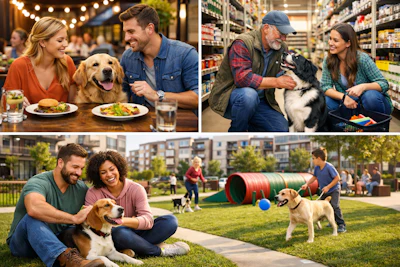
Restaurants increasingly have pooch patios where patrons can dine al fresco with their dogs. A pet food brand could partner with those restaurants to offer consumables to gourmands’ dogs. Perhaps there could even be a dog menu.
After a long drive, a family checks into their pet-friendly hotel. In their room, they find mints on their own pillows and a dog treat waiting for their pooch, along with a welcome note from that treat’s brand.
Apartment complexes designed specifically to cater to pet owner’s needs, such on-site dog parks and pet washing facilities, are among the most in demand properties. A pet food company could partner with those residential developers to promote and distribute the pet brands products, such as installing a refill station for reusable pet food containers.
Those are just a few potential means for pet food companies to forge strategic partnerships as the pet-friendly trend reshapes where pets are welcome. At Global Pets Expo's Pet Summit, Luis Zamora of Petsvivo discussed how pet ownership is influencing consumer decisions across housing, travel and workplaces. In turn, housing developers, the hospitality industry and employers are changing their policies and infrastructure to accommodate dogs, cats and other companion animals. Zamora described this shift as a “pet cultural revolution,” as pets increasingly accompany consumers across daily life and into places pets weren’t allowed before. Zamora founded Petsvivo to help pet brands integrate into these spaces.
“Pets are now going wherever people are going,” he said. “So, the opportunity map for you to get your brand in front of them just got a whole lot bigger.”
For pet food companies, this expansion creates nontraditional distribution channels, including residential housing, hospitality, workplaces and retail environments. Zamora argued that these settings offer more meaningful engagement than standard advertising.
“Every one of these environments is a distribution channel, a relationship, a place where your brand can show up, not as an ad, but part of the experience,” he said.
Zamora noted that the most effective collaborations are not always intuitive but must be intentional and experience-driven. He used the example of a collaboration between Dunkin’ and Native deodorant. The two companies joined forces to create donut-scented body care items. As odd as that sounds, the products were a hit.
“If Dunkin and a deodorant company can find common ground, your pet brand has zero excuses for not finding the right revenue-driving partnerships,” he said.
Not transactions but embedded experiences
Partnerships can unlock audiences and brand positioning that traditional advertising cannot, but that has to be done with finesse. He distinguished between transactional partnerships and embedded ones. Zamora cautioned against superficial collaborations such as discount code exchanges.
“Real partnerships are about aligning on principles, on the customer you're both serving, on the experience that you want to deliver,” he said.
He further differentiated between simply selling via a business partnership and integrating into its customer journey.
“Selling means, okay, you've signed the paperwork, you ship them product and you're off the deal. Embedding means you're talking about how your product is actually going to be seen,” he said.
This embedded approach can be particularly relevant for pet food brands seeking to reduce customer acquisition costs, which Zamora described as increasingly unsustainable.
“Partnerships let you show up in a context that they've already opted into instead of forcing them into it,” he said .
Identifying and managing effective partnerships
Zamora advised companies to look beyond traditional pet industry partners. While veterinary clinics, pet stores and groomers remain important, he highlighted housing operators and hotels as high-value opportunities due to prolonged customer engagement.
“Multifamily communities have tens of thousands of pet-owning residents over a span of years. The lifetime value of a getting into that relationship is enormous,” he said .
However, he warned against misaligned partnerships, citing common failure points such as unclear value propositions and overly complex bundled offerings. To improve outcomes, Zamora recommended focusing on simplicity, shared audience alignment and clearly defined success metrics.
“Agree on what's going to be tracked and what success looks like,” he said .
Case studies: from welcome kits to behavioral solutions
Zamora highlighted Petsvivo initiatives, including distributing welcome boxes in housing and hospitality settings. These programs place partner products directly into key moments, such as move-ins or hotel check-ins, linking brands with positive emotional experiences.
“We put our brand partners directly in front of them, so that they can now associate this amazing moment that they're having experience at this new hotel with those brands,” he said.
Another example involved integrating DogTV to address pet anxiety in residential housing complexes. Zamora stressed that successful partnerships solve real problems rather than simply increasing visibility.
“This isn't just slapping a logo on something. It's about solving a problem in the ecosystem that everyone has interested in,” he said.
Zamora concluded by urging companies to rethink their growth strategies.
“If you're wondering where your next growth channel is, I'd argue it's not a better ad. It's the right building, the right hotel, the right employer,” he said.
As pets become integrated into more aspects of consumer life, partnerships that embed products into those experiences may offer a more sustainable path to growth than traditional marketing alone.