Major pet food companies use artificial intelligence to develop and manufacture products, but they rarely patent the AI itself. Instead, they patent the nutritional compositions and manufacturing processes created by AI while keeping the algorithms confidential as trade secrets, which provides stronger long-term competitive advantages than public patent disclosures.
- Few AI Patents Exist: Despite widespread industry discussion of AI at conferences, published patents rarely claim artificial intelligence as the invention in pet food formulation.
- Trade Secrets Win: Companies protect resulting nutritional compositions and manufacturing methods through patents while keeping proprietary AI models confidential for indefinite competitive advantage.
- Patent Disadvantages: Filing AI patents requires public disclosure of how software works and provides only limited-term protection, while software patents face greater legal scrutiny than composition or manufacturing patents.
- Major Companies' Strategy: Hill's Pet Nutrition, Mars Petcare, and Nestlé Purina focus patent portfolios on nutritional innovations and health outcomes rather than AI systems.
- Software Exception: Formulation software developers like BESTMIX publicly promote AI as a core component, unlike pet food manufacturers who keep algorithms hidden.
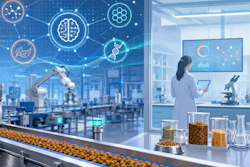
Artificial intelligence is rapidly becoming part of pet food formulation and manufacturing. Companies are promoting AI-powered formulation, predictive analytics and digital production systems at conferences and in commercial software. Yet a search of the patent landscape reveals surprisingly few inventions that explicitly claim artificial intelligence.
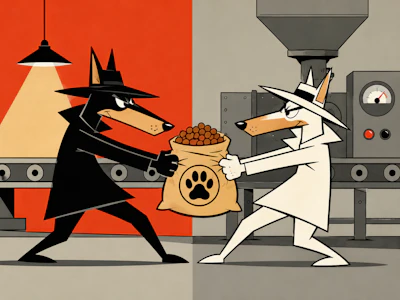
Instead, most major companies appear to be patenting the nutritional discoveries and manufacturing processes that AI helps create while keeping the algorithms themselves as trade secrets.
Where are the AI pet food patents?
Over the past decade, relatively few published patents have claimed AI or machine learning as the invention in pet food formulation. Instead, patents continue to focus on novel nutritional compositions, manufacturing processes and methods of feeding companion animals.
This contrasts sharply with the industry's public messaging. AI has become a common topic at Petfood Forum and other industry conferences, where speakers describe it as a tool for improving formulation, production consistency and manufacturing efficiency.
Many companies appear to favor protecting the resulting nutritional compositions and manufacturing methods while keeping AI models proprietary.
Unlike a new nutritional composition, an AI model can often be maintained indefinitely as a trade secret. Filing a patent would require companies to publicly disclose how the software works while providing only limited-term protection.
Software patents also face greater legal scrutiny than patents covering compositions of matter or manufacturing methods. For many companies, keeping proprietary AI systems confidential provides stronger long-term competitive advantages.
How pet food companies are using AI innovations
Although companies rarely patent AI directly, they increasingly describe using advanced computational tools throughout product development.
Hill's Pet Nutrition
Hill's Pet Nutrition continues to publish patents covering therapeutic diets, nutritional compositions and methods for improving pet health. Recent patents address areas such as weight management, urinary health, gastrointestinal function and nutrient metabolism. Rather than claiming artificial intelligence systems, Hill's published patents focus on the nutritional formulations and health outcomes themselves.
Mars Petcare
Mars Petcare maintains one of the industry's largest patent portfolios, spanning pet nutrition, health and manufacturing. Its recent patents emphasize novel nutritional compositions, functional ingredients, processing methods and therapeutic diets. Publicly available patents rarely identify artificial intelligence as the invention, even as AI has become an increasingly common topic in food and consumer packaged goods research. The published record suggests Mars continues to prioritize patent protection for nutritional innovations rather than software technologies.
Nestlé Purina
Nestlé Purina's patent activity likewise centers on pet food compositions, ingredient combinations, palatability, processing technologies and health-focused diets. While digital technologies have become increasingly important throughout the food industry, Purina's published patents generally protect the resulting products and manufacturing methods rather than AI-based formulation systems.
Pet food formulation software
Software suppliers represent one of the clearest examples of AI's growing role in formulation.
BESTMIX has demonstrated AI systems that connect formulation software with real-time production data, allowing nutritionists and plant operators to adjust formulations using production feedback rather than relying solely on laboratory assumptions. The company describes AI as a "copilot" that helps bridge formulation and manufacturing while reducing variability between designed and produced nutrient levels.
Datacor, formerly Format Solutions, pioneered optimization software for feed and pet food formulation long before today's AI boom. Its optimization engines solve complex least-cost formulation problems across multiple products, ingredients and manufacturing constraints.
The future of AI-powered formulations
As AI becomes more capable, companies may eventually begin patenting novel AI architectures tailored to nutrition and ingredient discovery. For now, however, the patent landscape suggests a different strategy.
Companies are using AI to accelerate research, optimize formulations and improve manufacturing, but they continue to seek patent protection for the pet food compositions, processing methods and production technologies that emerge from those systems, not the AI itself.
For intellectual property watchers, the absence of AI patents may be just as revealing as the patents that are published. It suggests the industry's most valuable algorithms are likely remaining behind the firewall, while patents continue to protect the innovations those algorithms help create.