Including ever higher quantities of fresh meat into dry pet food has challenged traditional production models. While pet food companies have adapted to meet that task, the method of doing so often remains a trade secret.
However, patents provide clues as to how companies achieve high levels of fresh meat in shelf-stable dry foods. While relatively few patents have been published in this niche, the filings reveal a consistent trend. Rather than improving conventional extrusion, inventors are exploring manufacturing methods designed around fresh meat from the beginning of the process.
The most significant patent family originated with Cambrian Investco and has since been published or granted in multiple jurisdictions, including the United States, Europe, Japan, China, Canada, South Korea and the United Kingdom. The inventions describe manufacturing dry pet food using substantially more fresh meat while reducing reliance on rendered meat meals.
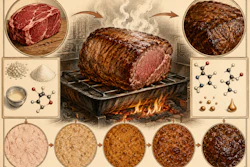
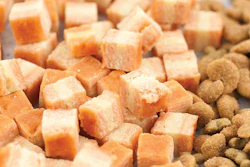
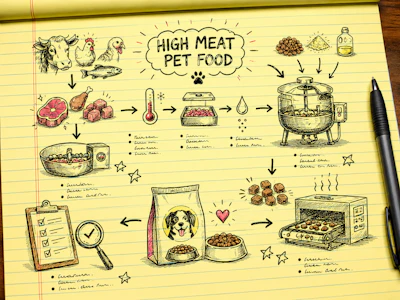
Instead of mixing meat meal into a dry blend before extrusion, the patented process begins with raw meat. The meat is ground, formed into slabs or strips, cooked with steam, cut into kibble-sized pieces and dried to produce a shelf-stable product.
According to the patent, this approach offers several potential advantages. Processing fresh meat directly may help manufacturers increase fresh-meat inclusion, preserve ingredient identity and provenance, reduce oxidation associated with rendered ingredients, and provide greater formulation flexibility for premium products.
- Traditional kibble: rendered meat meals + extrusion
- Emerging approach: fresh meat + steam cooking + drying
Other patents for high meat pet food
Subsequent patents suggest other companies are exploring similar concepts. A 2022 Chinese patent application from Wuhu Weishi Biotechnology describes producing staple dry pet food containing at least 90% fresh meat. Notably, that application cites the earlier Cambrian patent family as prior art, illustrating its influence on later inventions.
Beyond these patents explicitly focused on high-fresh-meat dry pet food, numerous equipment and process innovations appear aimed at solving the practical challenges of manufacturing. Recent filings describe improvements in steam cooking, moisture management, low-shear processing, controlled drying and forming systems that could support greater use of fresh meat while maintaining product stability.
The relatively small number of published patents is noteworthy. Given the rapid growth of premium fresh-meat pet foods, companies may be relying heavily on proprietary manufacturing expertise, trade secrets and continuation patents rather than publishing entirely new inventions.
Although patents do not guarantee commercial adoption, they often provide an early indication of where research and development investments are headed. The patent landscape suggests that manufacturers continue to seek production methods capable of meeting demands for higher fresh-meat inclusion while preserving the convenience and shelf life of dry kibble.