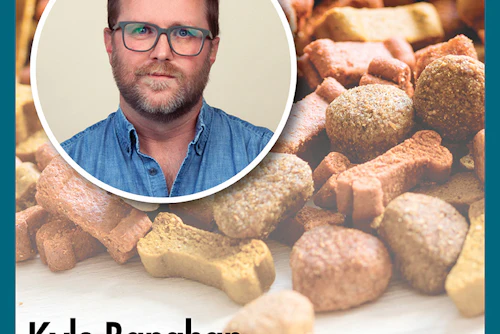
In this episode of Trending: Pet Food, Dr. Tim Hunt, practicing veterinarian, sled dog musher and founder of Dr. Tim's Pet Food, explores the gaps in veterinarians' nutrition knowledge. Dr. Tim explains how limited nutrition training in vet school leaves many practitioners relying on pet food company representatives, and how funding from large manufacturers shapes veterinary curricula.
We want to thank Scoular for sponsoring this podcast. Scoular is the all-in-one partner for pet food ingredients, helping brands create wellness-focused products that support digestion, immunity, mobility, heart health and more. Learn how they’re shaping the future of pet nutrition at scoular.com/pet.
Your host is Lindsay Beaton, former editor of Petfood Industry magazine.
Lindsay Beaton, former editor, Petfood Industry magazine and host, Trending: Pet Food podcast: Hello, and welcome to Trending: Pet Food, the industry podcast where we cover all the latest hot topics and trends in pet food. I'm your host, Lindsay Beaton, and I'm here today with Dr. Tim Hunt, founder of Dr. Tim's Pet Food. Hi, Dr. Tim, and welcome.
Dr. Tim Hunt, founder, Dr. Tim's Pet Food: Thank you very much, Lindsay. I appreciate you having me on.
Beaton: In case you're not familiar with Dr. Tim or Dr. Tim's Pet Food, here's what you need to know. Dr. Tim Hunt is a practicing veterinarian and a sled dog musher. For more than 35 years, he's helped pets live healthier, more active lives by creating nutrition solutions inspired by the questions and challenges he sees in practice every day.
Founded in 2004 and based in Marquette, Michigan, Dr. Tim's Pet Food formulates high-performance foods, treats and supplements using science-backed nutrition and quality ingredients to support pets ranging from family companions to working and sporting dogs. Dr. Tim's dual expertise in veterinary medicine and pet nutrition makes him the perfect person to answer this question: Where are the current knowledge gaps in veterinary practices when it comes to companion animal nutrition?
Dr. Tim, as we launch into this conversation, I want to know how veterinarian knowledge of nutrition has evolved over the years. I think it probably wasn't much of an issue before. It was more of a transactional thing: People brought their pets in when something was wrong, they fixed the problem and sent them on their way. As pet owners ask more and more about nutrition, I have to believe veterinarians are doing more on their own or taking continuing education courses. What has that looked like over the years as pet owners have become more interested in their animals' nutrition?
Dr. Tim: Great question, Lindsay. I've been waiting for this one my whole career. It hasn't changed at all since I was in college in the '80s. It's still pathetic, and veterinarians really are a very poor source of nutritional information for the pet owner. Many clients come in with more knowledge than veterinarians I have talked to in the past, and that's where it becomes difficult: What do they listen to?
Customers think everybody is a shill for Hill's, and their knowledge is the alphabet — z/d, c/d, whatever it might be — this is what you're going to get. Once they start to do some research and they see what's in Hill's, and they see corn and everything else, they think the vet's full of s---. Literally, that's what I have heard for many, many years, which is unfortunate.
When I was in vet school — again, I graduated in 1989 — I was taught nutrition by a large animal nutritionist, so it was primarily horses and cows. I think we might have had two days when a Hill's rep came in, ate a can of i/d in front of us and gave us books. That's a terrific marketing idea Hill's has, which is the same as Colgate toothpaste. It's the same company. The idea was to reach the students of those professions, dentists and then veterinarians, starting in the mid-'70s, and it has continued. You get the students' ear; they're broke, they get some stuff.
Nutrition, unfortunately, is more of a DO approach, and veterinarians take more of an MD approach, which means nutrition isn't a big part of their curriculum. Many vet schools don't have a nutritionist on staff. There are very, very few that do. There might be laypeople who teach it, or Hill's or one of the other companies with a nutritional background comes in to give some lectures and free pizza.
Unfortunately, as I've seen students come out — and I was no different — they're scared to death of nutrition. Why? Because it was all rote. It was all vitamin B6 and vitamin B12. I couldn't keep those things straight, let alone the important stuff. Vitamins are important, but there's so much more to it than that.
When I started to look into nutrition myself, it wasn't out of curiosity. It was out of working with sled dogs, actually racing sled dogs, and seeing how I was getting beat by people who were much older than me, feeding a food mixture that made no sense. What's all this meat? What's all this stuff they're putting together, and how do these animals perform so well? That's what piqued my interest in nutrition.
I've taken some continuing education on it. The stuff I came across wasn't super helpful. I learned my stuff in the real field, in the battles. We used to mix our food with a cement mixer in our garage, with all the different things that went into the food for a racing sled dog team.
Getting back to the veterinarian's side of nutrition, unfortunately it isn't very strong, and I'm not trying to slam my fellow professionals out there. I think many of them understand their shortcomings with nutrition and rely on other companies to do their bidding, so they just direct it to them because there's enough else they must learn — which could lead us down a whole other rabbit hole.
Nutrition in veterinary medicine is different than treating a case of diabetes, for instance. In my opinion, it almost uses a different side of your brain, and I think that's why many practicing vets don't have a firm handle on it. They just had to survive vet school and know all these diseases, let alone all the functions of the vitamins. It's very foreign. It's very rote, like I say. It's kind of like calculus: You memorize the formulas, and then you forget them as soon as you're done with the test.
Beaton: Is there anywhere for veterinarians to go to get nutritional information right now, or are they out in the wind trying to figure it out on their own? What are they supposed to do?
Dr. Tim: What they're supposed to do, honestly — it's the salespeople who come in. It's the representatives from Royal Canin, from Hill's, from Blue Buffalo, whomever it might be. That's where they're really encouraged to find their nutrition needs.
When I've talked to many vets over the years, at conferences and otherwise, their knowledge base of nutrition is very, very low. Again, they're going to lean on something that was formulated, and honestly, they spew out the talking points the companies tend to broadcast versus looking deeper and seeing how a food is constructed or built, or the actual ingredients that are put into it.
It's pet food. You're not going to use human-grade stuff in pet food. Human-grade stuff goes to humans. If you choose to use truly human-grade stuff, you're going to have to make it yourself. The majority of companies aren't going to put that supply line into a pet food. Ninety-six percent of all pet foods are controlled by really four or five companies, and the rest are the small ones that may have these human-grade food lines out there. But the majority are not, and that's just the economics of it — affordability and so on.
When you're trying to learn, you must be a motivated person to start to look and find the avenue that affords you the ability to do it. You can get certifications in nutrition through various continuing education formats, mainly online versus in person, which are helpful. I encourage other vets to do that. There's a lot to be learned and a lot to be conveyed.
Honestly, Lindsay, when I first started making dog food, it took me nine different plants to have it made consistently the way I wanted. Then it started to become very rewarding for me. I could get before-and-after pictures of animals from, let's say, Arizona — I'm in Michigan — and see the difference a month of good nutrition makes for an animal. It was so rewarding as a vet. I never put it together until then, and that might have been 2010, let's say. That was 20 years after I was out of school, before I really got a grasp of how nutrition plays into the health of a pet. It's really tantamount.
Beaton: What's your backstory? How did you get interested in nutrition, become knowledgeable in it and decide the best thing to do was to start a pet food company?
Dr. Tim: I graduated in '89 and decided to open my own practice in '93. I moved north to Marquette, Michigan, in the Upper Peninsula, where we get a lot of snow — more than 200 inches a season. I enjoy snow, but what I didn't realize at that point is that, starting a practice from scratch, I had no clients. There happened to be some sled dog kennels around with 60 or 80 dogs, and I thought, "Wow, this is going to be a good place to get a customer base."
Little did I know that most mushers have no money — and that I would find myself really enjoying it. I hunted and fished and everything like that, and I found working with and training the sled dogs was really fun. I really took a liking to it. Pretty soon, somebody bartered with me for four dogs, then I got eight, then I got 16 dogs, and I was racing starting in about '94.
I thought, being young and strong and fit, I could beat these guys, but I got smoked. There's genetics in the dogs. There's the training of the dogs. There's the expertise or skill of the musher and their equipment, and then there's nutrition. The big three were genetics, training and nutrition.
As I got exposed to different things, I came across a musher named Arleigh Reynolds, whom you may or may not know, and he was instrumental in getting me interested in nutrition. Very smart guy, from Cornell, moved to Alaska. He was a sprint musher. Anyway, it piqued my interest in looking at nutrition more and more, and soon I had a lot of meat and different ingredients in my garage. One day my wife came in and said, "Holy cow, what are you doing here? Why don't you just make it all into one thing?" That was the first time I thought, "Maybe that's a possibility" — taking these things and making them into a kibble.
Still, with these high-end sporting dogs, you can't fuel them with kibble alone. You have to bring in the raw meat and everything. But you can make it simpler. I thought, "What can we do to make it simpler, by including everything and also by how it's processed, to get digestibility and an animal protein base that's really in the realm of a high-end sporting dog?"
I always equate this to trying to fit a round peg into a square hole. There are lots of good foods out there, but they're meant for certain lifestyles, and the lifestyle of a husky running across Alaska pulling a sled is much different than Fonzie, who's sitting on the couch and plays Frisbee once in a while.
The difference maker was breaking out the diets put together by folks who were high school educated. These weren't necessarily super-duper college-educated guys, but they figured out how to make these dogs work so well. I broke those diets out and started to put it together, and it was a learning curve. Like I say, it took a number of different plants to get it done consistently and honestly, and it was fascinating when it started to click and work. It was really, really fun. I get bored kind of easily, so getting into nutrition and different things in the veterinary field keeps my interest. I'm still doing it. We're still looking at different things to utilize.
Looking back at it, thinking I could beat people much older than myself because I was fit had almost nothing to do with it. It had to do with the nutrition, the genetics of the dog and how you trained them. It was fascinating trying to put the pieces together over time, and I really respect the folks I learned from, whether someone as educated as Arleigh Reynolds or someone who lives in the bush in Alaska and can win the Iditarod.
Beaton: That is a pretty involved way to get really good at companion animal nutrition, and I think most veterinarians are probably not going to do that. What can be done to help veterinarians overall be in a more informed position when it comes to pet nutrition?
Dr. Tim: I think it starts with the curriculum in vet school. It's got to start somewhere, and they're not getting any exposure. They're just saying, "Trust the companies. You've got enough on your plate. We can't get a nutritionist to come in here and teach or have veterinarians who are skilled in it." They might not be board-certified nutritionists, but you don't need to be a board-certified nutritionist to teach some basic nutrition to a small animal veterinarian.
Look at the cat. The cat's a carnivore, right? Cats live in a barn. Do you see cats eat baby mice, or bring baby mice to their kittens? Kitten food versus cat food — is there a difference? No. But there are some basic tendencies in how we want to build a cat food and the quality thereof.
Getting back to the root cause of the lack of knowledge, I think it's imposing to try to learn all the vitamins in school. Let's make it simpler. Maybe streamline it so new graduates have some understanding of nutrition and how it applies to the overall being.
It's a DO approach. I was always MD approach, meaning medicine, diagnosis, surgery and everything, whereas DOs look at the whole picture — the so-called holistic side of medicine — and how you look at the living being, whether a person or a dog. In the veterinary world, you like to have a couple of different medicines to cure something. Nutrition is much vaguer and wider.
Even if you go into the people realm — if you go to Scandinavia, the lifespan of people is much longer. Why is that? It's the omega-3 fatty acid diet, the fish-based diet that's used in those countries versus processed food and otherwise. There are many examples of lifespans of people that can be compared to animals. What I'm driving at here is that dogs aren't meant to be fed corn-based diets and be expected to be long-lived.
I think dogs' lives are much longer than they ever used to be, and nutrition's a big player, but I think it can be bettered. Understanding how these animals are supposed to eat really helps the overall picture, versus just trusting a food company to do what's best for the pet. As I've been in the profession, both on the veterinary and the pet food side, that's not how they think. It's unfortunate. Maybe initially the thought was there, and I'm sure there are still some motivated people, but when a pet food company is on the stock market and has to have certain returns, certain things are going to be eliminated because of the bulk nature of it and the profit.
I'm not saying there's evil out there. I'm just saying there is a better way to build a machine or skin a cat. It's just not used, because it's geared toward box stores and huge production runs. You don't get cost efficiencies until you're running a million pounds at a time. Then you can get to a price point that's affordable to 80% of people. Small companies like mine aren't doing anything near that kind of run each time. We may do multiples of that for the year, but we can't afford to do a run of a million pounds at a time. The price point's always going to be higher, but in doing so, you're allowed to do something with your ingredients to improve on it.
Beaton: What do you think is stopping veterinary education from shifting along with the trends and incorporating more nutrition-based courses into the curriculum?
Dr. Tim: It's about the companies and the money they bring to the veterinary colleges, pure and simple. When I've approached different vet colleges about doing some things, they say the problem with companies like mine is that I would come in and offer such a small amount of money to their program that it would upset the cart with the big guys.
The big guys bring a lot of money to the table because they're spurring the vets, once they graduate, to promote their company, either directly or indirectly. The vets don't even realize what they're doing. The pet food companies know what they're doing. When I've had innovations or ideas and approached different vet schools — "Hey, what do you think about doing a study using this or that or the other thing?" — I was flatly turned down. I can name three different colleges that turned me down because they have things set up with the big companies, and it would rile the waters and risk the funding they get from them.
You know what? Henry Ford wasn't a rich guy when he started. I'm from Detroit. I'm not saying he's a great person or anything; I'm just saying he was a guy who started with an idea and took it forward. He wasn't already established. A lot of innovation comes from the small companies, and I've been told directly by the big companies that the big companies don't innovate anymore; they follow. They look for something and then grasp onto it or buy it. Innovation is still out there. It still happens. Do we have to reinvent a mouse for a cat? Is there a better mouse to formulate into a can of cat food? Again, there are lots of ways to put a food together.
Getting back to the school aspect — can you make a difference? We're looking 20 years out versus changing it tomorrow. I think there are things that can be brought into play to help students learn. As for the veterinarians who are already out, they struggle with trying to diagnose and treat things and pull things out of the fire versus looking at the long-term plan for the pet. That's what has to be conveyed and changed: There's a way to look at the long game versus the short game. In the short game, they come in with a cut and we sew it up. The long game is, let's feed them a certain way, and over time you're going to see a lot better overall health with your pet.
Beaton: Whose responsibility do you think it is at this point to get nutrition education out there and make sure veterinarians have it? Do veterinarians need to hunt it down on their own? Is it veterinarians who are also industry players, like yourself? If we're cutting out the education aspect and they're already practicing veterinarians, how can this gap realistically be filled?
Dr. Tim: That's a great question I've really struggled with over time. When I've tried in the past, I just beat my head against the wall trying to have any sort of impact. It just doesn't happen. It has to start with the deans at the vet schools. They have to buy into this and somehow get it into their programs. The deans of vet schools have a budget to fit; they've got to make everything work. But the importance of nutrition needs to be conveyed to them somehow. You've got to start somewhere.
That would be No. 1 — the schools themselves, trying to make an impact in the academic realm in how they structure the classes and the years of training we have to go through to graduate and actually be proficient. There's just so much on the table in vet school. We have seven species to learn about, and we're expected to learn that in four years, come out and be proficient, which doesn't happen. Amplifying the whole approach really happens at the dean level.
The second thing is, how do we get people who are already out of school interested in learning about this? I think there have to be incentives for them to learn easily, in a way that doesn't require getting into all the really specific vitamin stuff and getting tested on it to pass. It has to be a broad-leaf kind of approach to teaching someone who's already graduated about how good nutrition works.
Honestly, it's as simple as looking at the poop. People who are already out of school say, "How do I know the food is good?" Just look at the end result, and from that, work backward. End result: good poop. Despite what they're doing, that's a lifestyle approach. You're feeding X food to this dog that's doing this or that. Are the stools consistent with this versus that?
There are lots of foods you pay a lot of money for — you know what? If it's a hunting dog, a $150 bag of food might not be the place to go, because it's not built for that dog. It has good ingredients and everything behind it, but it's not made for the sporting dog. Or vice versa: The sporting dog food might be the ultimate food for every dog, but there's the caloric density, and we're in America. In America, nobody actually weighs or measures their food.
I'm in Europe right now, and people here measure everything. There are a lot of intact animals. In America, we're all busy; we fill up the food dish. The No. 1 thing I see come across my exam table is overweight animals, and everything that goes with an overweight animal, like inflammatory conditions.
I want to make it simple so we can all learn. You've got to incentivize and teach vets that nutrition plays a huge part in long-term overall health, and we start to judge that with simple things: the stool quality, the hair coat and such. I think there's room for it out there. It has to begin at the school level, but we can't forget all the people who are already out. We just have to start to imprint nutrition back into play.
Beaton: Where are consumers getting their nutrition information? Is it reliable enough for veterinarians to jump online and do the same thing?
Dr. Tim: That's a great question. With the internet, of course, clients can find anything out there, and they can be led astray easily. A case in point is a company that started off very small and decided to launch an ad campaign about byproducts and how they were bad, and it grew to the point of selling itself for $8 billion. Byproducts are everything in pet food, guys. Byproducts are pet food. How else do you make it?
Getting back to customers, television and advertising is where they gained a lot of information. Now, people are online searching. Is there one truthful place for it? Honestly, I have difficulty saying, "Here it is." There are a lot of groups out there that share information, whether through social media posts or a vet school with a foundation in nutrition, like Cornell. A lot of people turn up information that I honestly find amazing. I wish I had a good answer for this, Lindsay, about where to go to learn. It's a tough one. Everything seems to be geared, advertising-wise, toward the company in the end versus the benefits of an ingredient.
Beaton: This is such an important conversation to have, because there aren't any clear answers, and it feels like at this point there should be some. I'm very interested in the fact that it's still so muddied and so complicated, given that nutrition is playing such a huge role these days in pet longevity, health and wellness, and consumers are so focused on it as they focus more on their own health or just gain more information.
There's the danger of consumers directly translating human health and wellness to pet health and wellness, and I feel like there needs to be an intermediary to step in and say, "Pets aren't people. Here's what nutrition looks like for them." If there's not a clear answer, what are consumers supposed to do? I don't think there's a clear answer. Maybe there should be one, but then how do you create that?
Dr. Tim: Is it all about doing podcasts with people like me — small companies with passion and knowledge to bring forth versus toeing the company line? I'm not sure. I wanted to start a podcast called "Between Two Hydrants." I have two actual fire hydrants I would sit between. You've seen "Between Two Ferns" with [Zach] Galifianakis; it would be just like that. I would have people come in, and we would talk about exactly what we're talking about here, where we can bring up specific things and see what credence they have. It's just a matter of finding people who can actually speak on a real level, because nutrition is so vague.
It's really tough, but to me, there are a few basic understandings. If you look at dogs and cats, like you were saying before, dogs are not little people, and cats are not little dogs. There are differences. It used to take about two years for something to move from the human side into the animal chain, because people knew or had familiarity with that product. Now it's three months. If something starts to make headway on the human side, all of a sudden it's window dressing in a pet food.
Wow, blueberries. Do you know how many blueberries it takes to actually do something for a dog? It takes 20% of a bag of food to actually deliver the antioxidant profile that's always bragged about. It looks nice, but dogs are colorblind. Trix cereal is fun for a little kid, but a dog doesn't see a difference. You get into that kind of stuff, and it is confusing.
You can't save the world, but you can try to make a difference. Like I was saying earlier, getting a before-and-after picture of a dog, or a dog that actually loses a bunch of weight on a properly built diet food, is so rewarding to me. I like fixing broken legs and doing other things, but nutrition is more of a slow burn. As I got older, I understood it better because I was more patient. I think that's where the problem comes in vet school: Nutrition isn't immediate, versus you have a disease and you need to fix it.
I think the essence of nutrition is patience. How do we gain insight on it? Look back in history at the lifespans of dogs or cows or whatever it might be, and at the things that made major changes, like suddenly getting a dog living from six to 12 years — vaccinations, proper health care, improved nutrition. Those are ways to try to get students to buy in, and also ways to get vets to buy in, because, again, they're in an MD approach. They look at it very specifically versus broadly.
Beaton: Earlier in the conversation, when you mentioned MD versus DO, a light bulb went on for me, because that really is the difference. In the human space, DOs have only been a more common part of the conversation for a certain number of years. I think both have an important role to play overall, but it is a different approach, and I think that's a really good analogy.
Dr. Tim: I was brought up thinking DOs were second-rate. They weren't as good as MDs, because Yale doesn't have a DO program or whatever; the best go to the best schools, and they're going to be MDs. That's how it was presented, right or wrong. After a while of living life and trying to figure stuff out, versus believing that getting into Yale is the thing to do — they all have application, man. Like you say, DOs absolutely have their place.
Beaton: How important do you think this conversation is going to be two, three or five years from now? Are pet owners going to be more and more invested in nutrition? Do you think it's going to swing back the other way? What do you think the future will look like in terms of pet health and nutrition and its importance?
Dr. Tim: Honestly, what I've seen since COVID is that people have been more willing to drop coin on food. They're willing to spend on it. Now, things have changed this year, and they're changing really quickly. The plant where we make our food just sent out its pricing for the next quarter, and it went up almost 4% from last quarter. It had been going down, and it's only going to go up again. This is going to be percentages on top of percentages, so the next quarter might go up another 8% on top of what we just saw.
During COVID, prices went up almost 60% with supply and ingredients, and it got passed on. We deal with Chewy, like everybody does, and it used to be very difficult to get price increases accepted by them. They would never take anything more than 3% per year. If you did, you had to verify why and all this other BS — unless you're a big company, of course. When COVID hit and prices went through the roof, they just gave up and would accept any price increase.
What I'm trying to drive home is that it's across the board. It's not just a few people. Everybody saw the price increases, and what we're going to see this year is exactly the same. Prices are going to take off again. What do you do? You change the ingredient profile to make it cheaper, you go with smaller bags or you figure out your transportation method. Diesel prices have almost doubled. The same goes for ships moving food across oceans and everything else. Everything's going to go up.
How do we approach that? As a company owner, I'm looking at price point. People used to be OK up to a certain price, and regardless of how good a product was, they just weren't going to go past it. That used to be how we looked at it. Now everything's been thrown up in the air, and I'm looking for insight from you. How do people perceive that? Is it a price point thing — "I'm not going to spend more than this on a bag of dog food"? Or do you think people are going to look at the quality?
I really think with people having smaller families these days, or not having kids at all, they look at the quality of things much differently and are willing to spend the money. I absolutely see that with different age groups. People between 25 and 40 will pay it. Over that, you start to get resistance. There are exceptions, but I really see a difference in the generations as they come along. With this year's price increases, I think we'll probably see it play out along the same age demographic among pet owners.
Beaton: Thank you for coming on to talk about all of this today. It's a conversation I've had casually with various members of the industry over the years. As I suspected, there are no clear answers, but there are a lot of things that would need to change and need to happen, and a lot of moving parts. It's interesting to talk about something where the need doesn't match up with the reality in such a significant way.
I think it's important that the industry and veterinarians continue to hear that. Whatever needs to happen, even if it's very slow-moving, if conversations like this can help move things even slowly in the direction they need to go, then it's an important conversation to have. Thank you for coming on and talking about it.
Dr. Tim: I appreciate it. There's one thing I haven't brought up yet, and that's the advent of corporate medicine in the veterinary field. More than 50% of all clinics are now owned by corporations. That's a lot. That's significant. They can change the standard of care with a dictate. They can say, "Use this medicine for this thing," and have enough of an impact across the board that it actually starts to change what's expected to be done.
I really dislike corporate medicine in the veterinary field. I absolutely can't stand it. I wouldn't hire a vet from the corporate side of things, because they're not allowed to do anything. The money-making is in laboratory and specialty, so everything gets pushed up the food chain, and there's a profit to be made and shareholders to appease. There's no sense of individuality there for the veterinarian. Veterinarians are truly, I think, the last vestige of professions that people trust. When they go to a corporate office and nothing is brought up in the way of nutrition because they have to toe the company line, that sucks.
It also means the corporate line could include nutrition. Do you sell out to that to try to get nutrition changed? It's an avenue the corporate side hasn't looked at, and I think there's a lot of validity there as an effort to bring about a change in veterinarians' nutritional knowledge. But in the corporate field, the money isn't made with the food. It's made with laboratory work and sending complicated surgeries up the chain to a board person, blah, blah, blah. How do you change that, when they own more than 50% of all the clinics in the United States? I don't know.
As we speak on this and I think on it, would it be a sellout to get nutrition into the corporate field or not? I don't see a profit motivator there for the corporations. Royal Canin and some others have been buying up different groups of veterinary clinics, and we'll see if that has any impact. Again, I'm not a conspiracy guy. I just get fed up with certain things, and the whole nutritional idea can be very frustrating, to say the least, like you've brought up.
In the end, I want what's best for the pet. I always have and always will. If there's a better way to do it, I suggest it. If they can't afford it, then we figure out the next best thing. There are options there with a veterinarian. Primarily, they're all lone wolves when they go into school, and then things change. I wish we could bring it back.
Beaton: Let's say people want to continue this conversation with you or get to know more about you or Dr. Tim's Pet Food and the ethos behind it. Where can people find more information?
Dr. Tim: I answer all the emails sent to our company that are meant for me. They go to me, and I answer them after work or during work. The Dr. Tim's Pet Food website is a great place to start. We've got different social media out there too.
We work with a lot of different sponsorship groups in the United States, from Street Vet — the veterinarians who work with people who are homeless and have pets — to many different humane societies. Philanthropy is a big part of what we do, so you can find us through those sources as well. But the main place to look would be our website, for dog food, or the CBD website we have as well. In essence, if you need to talk to me, just drop me an email, and I'll answer you quickly.
Beaton: Perfect.
This episode was sponsored by Scoular, delivering the ingredient access, quality and partnership pet food companies rely on to stay ahead of industry trends.
Your host was Lindsay Beaton, former editor of Petfood Industry magazine.
You can find more Trending: Pet Food podcasts at petfoodindustry.com, SoundCloud or your favorite podcast platform. If you want to chat or share feedback, please email [email protected].