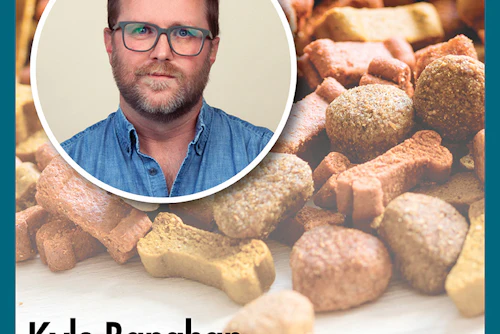
In this episode of Trending: Pet Food, Satoru Wakeshima, partner at CBX, sits down to discuss how human consumer trends are shaping pet food branding. Wakeshima explained that, as millennials and Gen Z treat pets as family members, trends now move from human products to pet products in real time rather than years later. Other discussion focused on how to educate consumers through e-commerce and social media, and why smaller companies should start with an authentic brand story. Wakeshima closed with a look at what’s next, including growth in pet health care, grooming, insurance and products built around family moments.
We want to thank Scoular for sponsoring this podcast. Scoular is the all-in-one partner for pet food ingredients, helping brands create wellness-focused products that support digestion, immunity, mobility, heart health and more. Learn how they’re shaping the future of pet nutrition at scoular.com/pet.
Your host is Lindsay Beaton, former editor of Petfood Industry magazine.
Lindsay Beaton, former editor, Petfood Industry magazine and host, Trending: Pet Food podcast: Hello, and welcome to Trending: Pet Food, the industry podcast where we cover all the latest hot topics and trends in pet food. I'm your host and editor of Petfood Industry magazine, Lindsay Beaton, and I'm here today with Satoru Wakeshima, partner at CBX. Hi, Satoru, and welcome.
Satoru Wakeshima, partner, CBX: Hi, Lindsay. Thanks for having me. It's great to be here.
Beaton: In case you're unfamiliar with Satoru or CBX, here's what you need to know. Satoru is the driving force behind CBX's key client partnerships, business management and operations. With a career spanning more than 30 years in brand consulting, he has spearheaded strategy, creative, innovation and transformative campaigns for some of the world's most loved brands, including M&M's, Canada Dry, Clorox, Coca-Cola, Hershey's, Milk-Bone and countless others.
CBX is an independent agency specializing in brand strategy and design services, including branding, innovation, packaging and retail design. Founded in 2003, the company employs nearly 100 creative and support staff at its New York City headquarters and Minneapolis office. Its client list includes General Mills, Hormel, J.M. Smucker Co., Kroger, Wawa and Merck.
Satoru's extensive expertise in branding, as well as his trends knowledge, make him the perfect person to answer this question: How are human consumer trends affecting pet food branding?
The first thing I want to talk about is timeline. Whenever we talk about human trends bleeding into pet, one thing that has become incredibly apparent over the years is that the timeline between something popping up on the human side and its transference to the pet side is shrinking, and has been for quite some time. From your perspective, how has the timeline changed, and where is it right now? Does it depend on the type of trend in terms of how long it takes to hit the pet space?
Wakeshima: What we're really talking about has to do with the cultural shift of pets in our lives. If we look at some statistics, an estimated 71% of all U.S. households have a pet. That's roughly 94 million households. That's a lot. It's the highest number in history, and it's going to continue to grow. What's really interesting is that 97% of pet owners consider their pets part of the family, and that hasn't changed much in 10 years. Ten years ago, it was about 95%.
What has changed is that millennials and Gen Z have taken over as the primary pet-owning demographic, and 51% of that audience say pets are exactly equal to a family member. The reason we're seeing trends in the human product space carry over into pet faster and faster is that we're thinking about pets differently — much differently than generations in the past.
Food and snack flavors, ingredients, health care, grooming services — all the things that are top of mind for pets are also top of mind for us as humans. It used to be that when you saw something trending in the human space, you'd see it in pet maybe three years later. Now it's happening in real time. As things pop up, people are already thinking about them in the context of their entire lives, and pets are part of our lives.
Beaton: Do you think consumers are aware that they're doing this, or is pets as family members so ingrained now that they're just considering a trend as a household item rather than human and then also pet?
Wakeshima: I think that's exactly right, Lindsay. People aren't compartmentalizing. They're not thinking about a trend as related to humans versus related to pets. It's much more fluid, and there isn't really the separation of categories there was many years ago, especially when you look at things like foods and snacks.
Beaton: A lot of top trends in the pet space right now are ones I know are in the human space, because I'm part of those trends on the human side. I use them, and then I've started looking at them for my pets, partly because I'm in the industry and partly because it's already happening in my household, so I start to think about it for my dog and my cat. What are some of the latest examples of pet borrowing from the human space, and what does it mean for the industry to deal with trends that are happening in the human space and now in the pet space as well?
Wakeshima: We're starting to see more human product brands show up with pet products, so the brands themselves are crossing over.
I don't know if you've seen Crocs for dogs. They come in different colors with names like Sunflower, Orange Zing and Marina. The intent is for you to have the same affinity for the brand for your pet that you have for yourself. You might ask why a dog would need Crocs. Some dog owners live in cities, and if you live in an apartment, you want to keep your dog's feet clean. It's not that unreasonable. Beyond that, there's also the novelty: "Hey, I have green Crocs with little sunflowers on them. I want the same thing for my dog."
Ben & Jerry's has doggy desserts, and if you look for them, they're placed right in the same freezer section as the human ice cream. They're very distinctly packaged and say "For Dogs," but they come in flavors like pretzel and peanut butter, and pumpkin and cookie. These are all things that would appeal to a human. The human is the one buying. People are shopping in the stores, not dogs, so you have to appeal to the human. I haven't tried them myself, but I'm told they're really good.
Burt's Bees has a whole line of dog products at Petco and Chewy, including shampoos, conditioners, dry shampoos, nose balm, paw balm, wipes and all different kinds of products. Again, these are the types of products we use on ourselves from human brands, and that crossover into pet is very natural for us. When brands we like, know and trust have a pet version, it becomes very appealing.
Beaton: You mentioned what we're going to talk about for most of this conversation, which is branding. Ben & Jerry's has pet ice cream in the same place as its human ice cream, but with distinct branding. What are some of those considerations right now? So many human brands are taking a look at the pet space. They don't necessarily have the institutional knowledge of pet, but they're taking advantage of a certain trend. What is the difference in branding strategy for a human company getting into the pet space versus a pet company borrowing from the human space? Do they look different at all?
Wakeshima: Yes and no. In many ways they're very similar, and that's by design. That's intentional.
From the time we're very small, we're trained — unfortunately, by marketers — to look for certain things. When we look for cues that suggest quality, whether it's the shape of the cartouche around a logo or the fonts used, there are visual cues we look for. We look for elements like bursts, violators and seals of approval. We've been trained to look for these things over many years as shoppers and consumers. We recognize these symbols, shapes, colors and fonts in our own products, so when we see them in pet products, they're not unfamiliar. By contrast, products made exclusively for pets sometimes look very clinical. They can look very cold, like they were made by a scientist in a lab, and they don't have the emotional appeal that human products do.
Especially with food and beverage, it's the pet owner who is shopping. Appetite appeal, quality reassurance and source of origin all become critically important, because we're shopping for our family. You're doing the same thing for your dog that you would for a child or another loved family member.
Beaton: Do human companies that are also in the pet space have a leg up in branding over companies that are only in the pet space? Do they have extra consumer insights or knowledge that allow them to market and brand more effectively to purchasers of pet products?
Wakeshima: I think so, and part of that leg up has to do with the equity in the brands they have.
We're seeing more and more crossover brands. For example, you're seeing Milk-Bone with Jif peanut butter. Once upon a time, it was, "Ooh, don't do that," because consumers would think the same place that makes the dog products makes the human products. That stigma is gone for the most part. People look at brands as symbols of quality, and if there's recognition of brands you know, love and trust, crossing over into the pet space is a very positive thing. A lot of brands are able to leverage the power of their equity as they cross over to pet.
In terms of having a leg up on consumer insights, of course. They have insights on shoppers and how people shop — the behaviors and the journey in terms of communication. That's deeply ingrained in most CPG food companies. Those insights inform their decisions around branding, sales and marketing. All of that applies because, again, it's the same consumer.
Beaton: For the pet-focused marketers and brand identity people listening right now, what do they need to be looking at in the human space? What segments should they look to for inspiration, and what should they straight up steal?
Wakeshima: When it comes to care products — shampoos, treatments, even supplements — those are things we want to look at. Child care is absolutely critical. People equate their pets with their children. We see cues that provide reassurance, such as "No. 1 vet recommended" or "No. 1 ingredient," in products for our kids, and we tend to imbue our pets with those same attributes. Looking at those categories is critically important.
With food and beverage products, flavor and ingredients are also key. People want to make sure first and foremost that their pet is going to enjoy it and that it's going to be a great experience. There's also a fine line, just like with human food: You don't want the smell to be so overpowering that it's a negative experience for you. You want appetite appeal that's relevant to your dog. People know dogs don't eat birthday cake on a regular basis. Products that depict certain flavors can go too far. We've seen in research for pet products where people say, "Ooh, teriyaki chicken? My dog doesn't eat teriyaki chicken." There's a fine line you can cross. When it comes to sheer appetite appeal, ingredients like beef and chicken, and cues like slow-roasted and slow-cooked gravies, are things people associate with their pets, recognize from their own products and value in the products they seek for their pets.
Beaton: I've always found it interesting that pet is one of the few segments where the purchaser is almost never the consumer. The only equivalent anybody has floated in the industry — the one I hear most — is the baby segment. I have two boys, and we absolutely tried baby food when they started on it. Some of their snacks are amazing; there were definitely some puffs that my husband and I ate just as much as our kids did. When our kids were babies, they didn't have a say in what we purchased until the point of consumption, which is basically the same situation as pets. Does that add an extra element to branding and marketing? For someone in the branding space, is it a difficult challenge or an interesting one? Is it enjoyable or more stressful, and how prevalent is it?
Wakeshima: It is a challenge, particularly with food and snack products for pets. We all want variety and new experiences. We want to make sure our dogs aren't getting bored of the same treats all the time, so we want to try different things, and that can be a daunting proposition. Buying a different treat for your dog isn't a huge expense — it's a low-investment product — but you want to try different things and see if your dog will like them. If your dog doesn't like it, it's a complete waste. There has to be a balance: offering new flavors, new varieties, new innovation, even new forms, in a format that's low investment and easy for someone coming to the product for the first time to try.
Introducing completely new innovations can sometimes be challenging where there isn't familiarity. There has to be some education so people understand what the product is and what it does, especially with different kinds of toys or new supplements. Supplements are a big area for pets right now. Again, you're educating the pet owner. The pet doesn't care. The pet doesn't know it needs glucosamine. These things aren't even in its consideration. It just wants a delicious treat that tastes good, or a toy that will entertain it.
You're appealing to the pet owner, and you have limited time and a limited opportunity, whether online or in store, to capture their attention, have an impact so they see you and communicate very clearly the value proposition you're offering: How does this make my experience with my pet better?
That's also a little unique to pets versus children. When we talk to pet owners, the experience of engaging with their pet is very important. Beyond treat time, it's not just about giving the pet something it enjoys. They want that bonding moment. I don't think we really think about bonding moments when we're treating our kids; they enjoy it, but we have other bonding moments with our kids. With dogs and cats, the treating moment is an opportunity to connect. That's very unique when marketing to pet parents. Anytime you can show that sort of engagement, or offer the promise of a more enriching experience in exchange for a pet owner's moment, that's critically important.
Beaton: You mentioned education, which is the No. 1 way to get me to sidebar on this podcast, because I'm constantly trying to figure out, through people's various expertise, how to most effectively educate consumers. It's a constant struggle in this industry when you're announcing something new, especially right now in the supplement space, like you said. What are some effective education methods right now? Is it social media? Websites? Putting information right on the packaging? How in-depth do you go — QR codes? What are people trying that's actually working, and what's no longer relevant?
Wakeshima: E-commerce is a very important communication channel for many consumers. Amazon, Walmart and other online retailers offer a great deal of information on their websites. When shoppers are looking at products there, you have an opportunity to call out benefits and provide education in small sound bites, and you have a captive audience: someone who's already looking at your product.
One common challenge we see is that many marketers want to put everything on the package, and that's a mistake. You'll have too many things competing for attention. You'll lose your communication hierarchy — what you want people to look at first and in what order — and the clarity of those messages. We always advise clients not to try to put everything on the pack. You need to prioritize which communication points are most critical for your audience to understand.
There are other vehicles. Social media is also critically important to how people learn and how they're informed and influenced. The amount of information and ads we're bombarded with every day grows exponentially, but social media is where you can get someone's attention when first introducing them to a proposition or idea. Once people have some interest and have scrolled a little more, they usually want to see the comments. What are people saying about this? Is this crap? Does it really have value? Are people really standing behind it?
They also want to look into the company. If it's a brand or company no one's ever heard of, there's a trust factor. Like products for your children, you hold products for your pets very carefully in your heart. You want to make sure the product comes from a trustworthy company, that it's safe and that the company shares your values when it comes to your pet — that it's not just putting out a quick product to make a fast buck. You want reassurance that it's a good company that will stand behind its products and brands.
The way people learn about products has changed. I think it's important to study the journey of how people first learn about and understand products. Once they have some interest, where are they engaging? Are they doing a search? Going to their favorite online retailer for the best price? Going to the comments first? Understanding that journey is an important consideration in providing information in the right order and in the right amount. If someone really wants to learn about your product, they'll do the homework. They'll invest the time and effort to find out exactly what your product offers them.
Beaton: I really feel for modern-day marketers trying to provide all of that information. I've said it before on the podcast: When I started covering this industry, it was very transactional. We have food, you buy the food, you take it to your pet, the end. This isn't the only industry dealing with that change — I'm noticing it in other industries too — but it's the one I'm in. I'm a consumer as well, and I want to know where my money is going. People kind of wanted to know before, but I feel like it's more of a norm now.
Marketers have to figure out who their target consumer is versus who their actual consumer is. Once they figure out that mix, they have to figure out where those consumers are so they can get the messaging to them — or, if they're trying to capture an audience they don't currently have, how to get their message to that audience. I'm not sure how marketers don't spend all their time in despair or having an existential crisis.
A lot of small to midsize companies listen to this podcast. Let's say your marketing team is two people, and you can't possibly cover all of these channels. Are there key things that can get a company going in the right direction if it doesn't have endless funds for all these channels and all this introspection? Companies have to start somewhere. Where is a good place to start to make sure you're branding properly right now?
Wakeshima: People love a good story, whether you're marketing to pets or humans. You have to have a compelling story for someone to take notice and have interest, and it has to be differentiated.
We get approached all the time by brands that want new packaging, new graphics and new brand support, but they don't have their story figured out. They haven't taken the time to identify what will make the brand different from all the other similar products out there.
Let's be honest: A truly differentiated product proposition is few and far between. Many products offer very similar propositions. It's about the brand story they're telling and how they can back that story up. It also has to be genuine. You can't tell a story that isn't genuine; there has to be authenticity behind it. People have to believe you, believe in your brand and want to root for you to be successful.
If you can do that — tell a great story, be genuine and have people believe you — then you have advocates. You have people who will go online and say, "Hey, I started buying this product and this brand, and I love it. I want to talk about it and share it with others." That's how your tribe continues to grow. You have to reward those people and let them know how much you appreciate them.
As you mentioned earlier, it's a two-way street. It's not a transactional exchange between customer and marketer. Customers have input, they have the ability to help the brand, and they have the opportunity to engage with the brand and the people behind it.
That would be my advice for a smaller startup trying to launch a new product and go up against the big boys: Start with a great story, find your tribe, be as authentic and genuine as possible, and reward customers when they engage and share your story. Let them know they count and that it's meaningful.
Beaton: Are there any human-focused companies doing that particularly well?
Wakeshima: There are. Brands like Oatly have a wonderful story. They present their brand in a category that can sometimes be old-fashioned or take itself too seriously when it comes to healthier products. They're not the cheapest product out there, and they've created a visual and verbal language that appeals to their audience. It feels very genuine and very real. If you look at their social media and how they engage their customers, they treat their customers like people. They want to be seen as a genuine brand, and they want their communications to be brutally honest and very real — almost to the point of, "Whoa, I didn't expect a brand to speak to me that way." But it works.
Beaton: As we wrap things up, I try to look to the future so people have some idea of what's coming next, or can at least start looking in that direction. What do you think is the next evolution of humanization in pet? Is there a next evolution, or have we arrived?
Wakeshima: We all want to live longer, and one of the greatest travesties of owning a pet is that they don't live as long as we'd like. Health care for pets is already growing and booming, and it will continue to grow in ways we wouldn't have expected in the past. People naturally want their pets to live long, healthy and happy lives, so we'll see more of that. We'll see more and more human health products — supplements, therapeutic products, preventive care, over-the-counter treatments — that look and sound just like the products we use.
With things like digestive health, we're just scratching the surface. That will continue to grow. We'll see more grooming products than we've ever seen before. It's just like personal care for humans: We want healthy, luxurious hair, and we want that for our dogs as well. We'll see familiar ingredients that nourish skin and hair.
Services like pet insurance will grow, too. The cost of pet care and health care is going to increase. Pet insurance is soaring today, and it will continue to grow so people can provide the best care they can for their pets without worrying about cost.
It's not all serious, though. People also want to enjoy their lives with pets as family, so we'll see a lot more products that consider pets in family moments, whether that's food, treats and gifts for birthdays, holidays and celebrations, or things that make traveling with your pet easier and more positive.
You'll see more impulse purchases for pets in convenience stores. When you're on the road, just like you stop at Starbucks and get a cake pop, maybe there will be the equivalent of a Slim Jim — a jerky stick for your dog — as a snack while you're traveling. These kinds of products will become much more pervasive in where we take our pets and where they experience life with us.
How many people do you know who have an Instagram account for their pets? Lots of people. Our pets are becoming a much more integral part of our lives and of how and where we live them. Having something that's just for your pet allows us to impart more human qualities on them and show them we love them, and that's part of what makes them feel like family.
Beaton: Satoru, I want to thank you for coming on to discuss branding in the pet space and the human-to-pet convergence. It's not even a transfer anymore; it's all just converging. As human trends continue to influence pet, it's a good idea to take the pulse of where things are and where they're headed, because branding will have to continue to evolve. There are more influences out there, and also more opportunities, as we start to merge these branding ideas. Thank you for chatting with me about all of that.
Wakeshima: Thanks for having me.
Beaton: Before we go, I always do a plug for my guests. Where can people find more information about you and CBX?
Wakeshima: If you'd like to contact me, reach out via email at [email protected]. To learn more about CBX, visit us at cbx.com.
Beaton: Perfect.
This episode was sponsored by Scoular, delivering the ingredient access, quality and partnership pet food companies rely on to stay ahead of industry trends.
Your host was Lindsay Beaton, former editor of Petfood Industry magazine.
You can find more Trending: Pet Food podcasts at petfoodindustry.com, SoundCloud or your favorite podcast platform. If you want to chat or share feedback, please email [email protected].