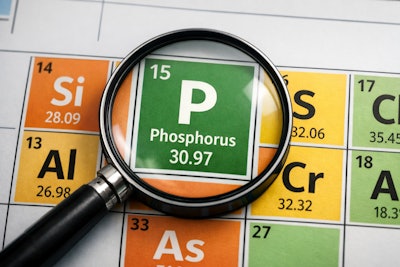
Phosphorus, although essential in dog and cat diets, may harm animals’ kidneys or cause other health problems if eaten in excess, especially from added inorganic phosphate salts used for texture, water binding and palatability.
What’s more, scientists observed that canning can mask the presence of added inorganic phosphates in common laboratory screening approaches, even when the same amount was added before processing.
They published their results in the Journal of Animal Physiology and Animal Nutrition.
“The findings of this study indicate that the amount of added Pi in commercial pet food is probably even higher than can be expected by measuring Psol1 [Phosphorus soluble after 1 min in water],” researchers at Ludwig Maximilian University of Munich wrote.
Experiment to measure phosphorus levels
The researchers prepared a complete, loaf-style wet cat diet and produced 18 variants, including a control without added inorganic phosphates and samples supplemented with commonly used sources such as phosphoric acid, monosodium phosphate, monopotassium phosphate and dicalcium phosphate.
They compared raw and canned versions using a fractionation method that measures how much phosphorus dissolves in water after 1 minute, a fraction previously shown to track added inorganic phosphates in unprocessed materials.
In the raw diets, added inorganic phosphate aligned closely with the 1-minute water-soluble phosphorus fraction once dicalcium phosphate-containing samples were excluded. After canning under conditions modeled on commercial thermal processing, the same samples showed markedly lower 1-minute water-soluble phosphorus values and a weaker relationship to added inorganic phosphate. In practical terms, a canned product could contain substantial added inorganic phosphates while appearing lower when screened with a rapid water solubility test.
For pet food labeling, this matters because neither total phosphorus nor the amount and source of added inorganic phosphates must be declared on pet food labels in the European Union, according to the authors’ discussion. Companies aiming for transparency, especially for senior and renal-health-positioned products, may need internal documentation that tracks phosphate additive inclusion directly rather than relying on solubility-based estimates. They suggested that voluntary communication strategies could also shift toward clearer identification of phosphate additives in ingredient statements and more consistent disclosure of total phosphorus on-pack, where possible.
For formulation and nutrition teams, the data also suggest caution in assuming canning reduces phosphorus availability. Although rapid water solubility declined, phosphorus solubility after 90 minutes in a mildly acidic solution was strongly related to phosphate addition in both raw and canned diets and did not differ between processing states. Adjusting calcium-to-phosphorus ratios within a typical practical range also did not change recovery of the rapid-solubility fraction.