NASC is finalizing language for the Animal Health Supplement Act and plans to seek congressional sponsors starting in September, with formal introduction likely in 2027.
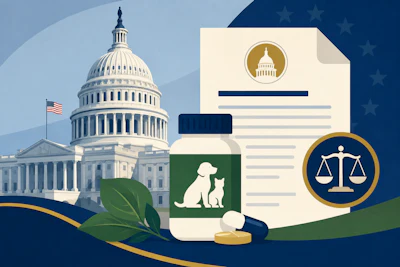
The National Animal Supplement Council is finalizing the Animal Health Supplement Act, which would establish permanent legal status for animal health supplements currently operating under regulatory discretion rather than law. The legislation, expected to be introduced in Congress in January 2027, would create FDA oversight, establish manufacturing standards, require product registration, and provide legal protections similar to those given human dietary supplements under DSHEA in 1994.
Animal health supplements currently operate in a regulatory gray area under enforcement discretion, which can be reversed by any administration at any time.
The Animal Health Supplement Act would establish FDA oversight, set cGMP standards, require product registration, and create a national listing system for transparency.
The bill specifically covers only structure/function claims—disease claims would remain prohibited—and does not apply to pet food, treats, topicals, or food-producing animals.
NASC plans to seek congressional sponsors in 2026, with formal bill introduction expected in January 2027 when the new Congress convenes.
Product registration with unique identifiers would help combat fraudulent companies, protect consumers, and give retailers confidence in the products they recommend.
NASC first unveiled the proposed federal legislation in April. The act would establish a statutory category for animal health supplements, products that have operated for decades under regulatory enforcement discretion with no permanent legal standing.
Animal health supplements currently exist in a regulatory gray area, explained Bookout. The Dietary Supplement Health and Education Act (DSHEA), passed by Congress in 1994, classified human dietary supplements as a category of food rather than drugs and allowed structure/function claims with a disclaimer. Congress never extended those same protections to products for animals, leaving most animal health supplements to be marketed under enforcement discretion as unapproved new animal drugs, a policy-based arrangement, not a law, that can be reversed at any time by any administration.
Bookout said that vulnerability is untenable given the industry's continued growth.
"Enforcement discretion is never permanent," he said. "It is policy, not law. One bad ingredient, or irresponsible company, can impact hundreds of good ingredients and cast a disparaging shadow on the entire industry. It also creates business uncertainty, limits growth potential and discourages long-term investment. It's simply not a good place to be."
What the act encompasses
The act would formally define animal health supplements as products intended for structure/function benefits only, meaning disease claims would remain prohibited. It would also establish an ingredient pathway supporting innovation, create a national product listing system which would increase consumer confidence, set current good manufacturing practice (cGMP) standards modeled on existing NASC practices, require adverse event reporting, and preempt inconsistent state-by-state requirements in favor of a single national framework. The U.S. Food and Drug Administration (FDA) would be required to publish a grandfather list of currently marketed ingredients within one year of passage.
The legislation would also address a growing export obstacle: U.S. companies' current inability to obtain certificates of free sale, which international markets increasingly require as proof that products are lawfully marketed domestically.
Todd Harrison, partner at Venable and NASC’s legal counsel, said the bill shouldn't raise compliance costs for companies already operating responsibly. "You should already be doing everything that's in this bill," he said. "If you're not, you need to seriously look at your business."
Bookout has also been careful to draw boundaries around what the act does not do. It does not apply to pet food, treats, topical products or food-producing animals, and it is not the PURR Act. Nor does it open DSHEA itself to any changes.
"This act is narrowly focused on products that are unapproved drugs marketed under enforcement discretion — products that have no legal home," he said.
Where things stand now
Since the unveiling of the act in April, NASC has engaged with numerous industry trade groups, the Association of American Feed Control Officials (AAFCO) and regulators to strengthen the bill's text, Bookout said. The organization has also discussed the legislation with the American Veterinary Medical Association (AVMA), which provided feedback that NASC incorporated.
"We are in the final stage of refining the language, and we'll begin seeking sponsors in Congress starting in September," Bookout said.
Introduction likely in 2027
While NASC hopes to identify congressional sponsors before the end of 2026, the bill's formal introduction will likely wait until the next Congress convenes.
"We're hoping to have sponsors identified in 2026, but since this is an election year, the Animal Health Supplement Act will likely be introduced when the next Congress is seated in January 2027," Bookout said.
FDA, AAFCO engagement continues
NASC has made both AAFCO and state regulators aware of the legislation, Bookout said, though he emphasized the bill's narrow scope means it will have limited effect on most states' existing frameworks.
"Since the bill is intended to address animal health supplements, which are not regulated as food or feed, it really doesn't impact most states and doesn't change how animal food products are regulated or the recommendations of AAFCO," Bookout said.
The proposed legislation does include language supporting AAFCO's new Scientific Review of Ingredient Submissions (SRIS) program, Bookout said. While the act would establish FDA's Center for Veterinary Medicine (CVM) as the primary regulatory authority for animal health supplements, Bookout said it could also open the door to expanded cooperation between the agency and states.
"We believe the AHS Act will provide additional benefits to state regulators and expand the possibility for FDA contracting with states to assist the agency with compliance, such as inspections, for example," Bookout said.
Registration requirement targets bad actors
Among the bill's provisions is a mandate that each product be registered with FDA, giving veterinarians, retailers and pet owners a way to verify that a company is legitimate and complying with responsible conduct and oversight requirements, Bookout said. He pointed to the rise of artificial intelligence as a factor increasing the urgency of that safeguard.
"With the rapidly growing impact of AI, it's becoming far too easy to create a virtual company that offers products for sale on the internet, when in fact the company may not actually exist," Bookout said. "By having a requirement for a unique identifier or registration number on the actual product label, it would go a long way to protect the responsible industry participants, give retailers increased confidence in the products they recommend and, most importantly, benefit the animals themselves."
Stay informed
Visit the website SaveAnimalSupplements.org to find updates and resources as the legislation moves forward.
What the AHS Act would do
Covers companion animals only: Applies to supplements for dogs, cats, horses and specialty pets — not food-producing animals.
Requires clear labeling: Mandates proper administration instructions and safety warnings so consumers can make informed decisions.
Establishes federal preemption: Creates consistent national standards, preventing conflicting state requirements.
Grandfathers current ingredients: Protects existing products and manufacturer investments from costly new approval requirements.
Creates a safety notification process for new ingredients: Mirrors the human dietary supplement model, balancing innovation with consumer protection.
A resource for pet supplement professionals
Pet Supplements Pro, a semi-monthly newsletter from Petfood Industry and the National Animal Supplement Council (NASC), covers regulatory developments, compliance considerations, supplier innovation and market trends for the professionals navigating this space. Visit PetfoodIndustry.com/pet-supplements-pro to sign up and get industry news and insights delivered to your inbox twice a month.