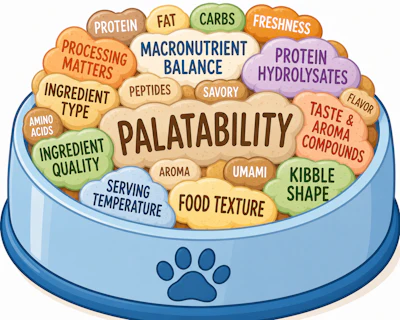
Pet food palatability depends on multiple factors beyond flavor, including macronutrient balance, protein hydrolysates, aroma compounds, kibble shape, texture, serving temperature, and ingredient freshness. Cats and dogs have different nutritional preferences, with cats preferring higher protein levels and dogs preferring higher fat, requiring manufacturers to tailor formulations and presentation strategies to maximize food acceptance.
- Cats prefer approximately 52% protein, 36% fat, and 12% carbohydrate, while dogs select roughly 30% protein, 63% fat, and 7% carbohydrate when given dietary choices.
- Protein hydrolysates enhance palatability by breaking proteins into smaller peptides and amino acids that improve taste and aroma cues in pet food.
- Specific aroma compounds like nonanal and 2-propylpyridine increase palatability in cat food, while others like nonanoic acid ethyl ester reduce acceptance.
- Kibble shape and texture influence feeding behavior, with almond-shaped kibbles designed for brachycephalic cats and varied shapes affecting eating rate in dogs.
- Serving temperature matters for cats—warm food at 37°C releases more aroma compounds and increases acceptance, especially in aging or selective cats.
Palatability goes far beyond flavor. A literature review explored the wide range of factors influencing palatability.
“Macronutrient balance, protein hydrolysates, taste and aroma compounds, kibble shape, food texture, temperature, and ingredient quality all strongly influence pet food palatability,” study author Scott McGrane, PhD, of the Mars Petcare’s Waltham Petcare Science Institute, wrote in the journal Advances in Small Animal Care.
For pet food manufacturers, this distinction is especially important when developing therapeutic diets, alternative-protein products or recipes that depart from an animal’s preferred nutrient profile, McGrane said. Successful palatability strategies must account for both the chemical composition of a food and the way it is processed, presented and consumed.
Macronutrient balance sets the foundation
Cats and dogs differ in the proportions of protein, fat and carbohydrate they select when given a choice among diets.
According to research results published in the journal Journal of Experimental Biology, adult cats selected an energy distribution of approximately 52% protein, 36% fat and 12% carbohydrate (Hewson-Hughes et al., 2011). According to research results published in the journal Behavioral Ecology, dogs selected approximately 30% protein, 63% fat and 7% carbohydrate (Hewson-Hughes et al., 2012).
These findings show that both species favor protein and fat over carbohydrate, but the balance differs. Cats select proportionally more protein, reflecting their status as obligate carnivores. Dogs select proportionally more fat, consistent with their broader dietary flexibility.
The review also notes that although cats can digest carbs, they appear to have a carbohydrate intake ceiling of about 300 kilojoules per day, particularly when consuming dry diets, while a comparable ceiling has not been identified in dogs.
That issue becomes especially relevant in veterinary diets, McGrane wrote. Renal diets for cats are often lower in protein, placing them farther from the macronutrient profile cats would select voluntarily. In these cases, manufacturers may need to rely more heavily on aroma, taste-active compounds and physical presentation to maintain intake.
Protein hydrolysates provide taste and aroma cues
Protein hydrolysates are widely used in pet food as palatability enhancers. Hydrolysis breaks proteins into smaller peptides and free amino acids, which may contribute directly to taste and may also serve as precursors for aroma compounds generated during thermal processing.
According to research results published in the Journal of Agricultural and Food Chemistry, chicken liver-derived protein hydrolysates improved the palatability of dry cat food. Cats consumed more of the hydrolyzed diets and selected them first more often than control diets. The authors linked these responses to low-molecular-weight peptides, free amino acids and volatile compounds that enhanced savory and aromatic cues (Wei et al., 2024).
Dogs also respond to hydrolyzed proteins. According to research results published in the journal Italian Journal of Animal Science, spray-dried hydrolyzed chicken liver maintained or improved voluntary intake when used as the sole animal-protein source in dog diets (Pinto et al., 2021).
Fish protein hydrolysates have shown similar potential. According to research results published in the journal Journal of Animal Science, fish meals, fish components and fish protein hydrolysates were evaluated as pet food ingredients, with hydrolysates offering potential palatability benefits through peptides and free amino acids (Folador et al., 2006). A later review published in Food Reviews International concluded that fish protein hydrolysates can support pet food formulation by contributing flavor, digestibility and functional value (Ribeiro et al., 2025).
The available evidence suggests hydrolysates are most useful when treated as part of a complete flavor system rather than as stand-alone ingredients. Their effects depend on raw material, degree of hydrolysis, inclusion rate and subsequent processing.
Taste and aroma compounds depend on formulation
The review emphasizes that specific aroma compounds can increase or reduce palatability.
According to research results published in the journal Journal of Agricultural and Food Chemistry, nonanal, 2-propylpyridine and 3-octen-2-one were associated with improved palatability in cat food attractants derived from chicken liver hydrolysates. By contrast, nonanoic acid ethyl ester and 3-methyl-pentanoic acid were associated with reduced acceptance (Wei et al., 2024).
In dogs, according to research results published in the journal Animal Feed Science and Technology, benzaldehyde, vanillin and 2,5-dimethyl pyrazine enhanced the performance of a dog food attractant (Chen et al., 2017).
These findings highlight a practical limitation of broad ingredient labels. Two foods may both contain chicken, fish or yeast, yet differ greatly in palatability because processing has produced different mixtures of volatile and taste-active compounds.
Kibble shape and texture influence feeding behavior
Physical form also affects acceptance.
The review notes that sharp-edged kibbles may be less preferred by cats because they can be uncomfortable to grasp or chew. Kibble shape may also be tailored to anatomy. One commercially available Persian cat diet, for example, uses an almond-shaped kibble designed to make grasping easier for brachycephalic cats.
For dogs, kibble design can influence eating rate and chewing behavior. According to research results published in the journal Research in Veterinary Science, different kibble shapes altered voluntary intake and palatability in dogs consuming weight-loss diets (Sagols et al., 2019).
Texture therefore serves two roles. It contributes to sensory acceptance, but it can also shape how quickly an animal eats and how easily it handles the food.
Temperature changes feline food acceptance
Serving temperature appears particularly important for cats.
According to research results published in the Journal of Veterinary Behavior, aging cats preferred food served warm at 37 C compared with food served at 6 C or 21 C. Warmer food released more aroma compounds and was closer to the body temperature of prey (Eyre et al., 2022).
Earlier work also reported that feline preference peaked near 40 C and declined at higher temperatures (Edney, 1973). Together, these findings suggest that warming wet food may improve acceptance, especially among older or selective cats.
Temperature is less commonly discussed in commercial formulation, but it may affect feeding instructions, package design and consumer education for refrigerated or therapeutic products.
Ingredient quality and oxidation remain critical
Freshness and oxidation status can override otherwise successful formulation decisions.
The review notes that lipid oxidation produces peroxides, aldehydes and other compounds associated with rancid or off odors. Cats appear particularly sensitive to these changes. Processing conditions, including retort time and temperature, can also alter aroma and physical characteristics.
According to research results published in the Journal of Nutritional Science, retorting conditions affected both the palatability and physical characteristics of canned cat food (Hagen-Plantinga et al., 2017).
For manufacturers, this means palatability must be protected throughout shelf life. Ingredient selection, antioxidant systems, oxygen control, packaging and storage conditions all influence the sensory profile that reaches the animal.
Palatability is a system
Acceptance emerges from the interaction of nutrient balance, protein chemistry, aroma, texture, shape, serving temperature and freshness.
Cats generally require stronger alignment with meat-associated sensory cues and preferred macronutrient patterns. Dogs offer broader formulation flexibility, but still respond strongly to fat, aroma and physical presentation.
References
Chen, M., Chen, X., Nsor-Atindana, J., et al. (2017). Optimization of key aroma compounds for dog food attractant. Animal Feed Science and Technology, 225, 173–181.
Edney, A. T. B. (1973). Feeding behaviour and preference in cats. The Bulletin of the Feline Advisory Bureau, 12(3), 1–5.
Eyre, R., Trehiou, M., Marshall, E., et al. (2022). Aging cats prefer warm food. Journal of Veterinary Behavior, 47, 86–92.
Folador, J. F., Karr-Lilienthal, L. K., Parsons, C. M., et al. (2006). Fish meals, fish components, and fish protein hydrolysates as potential ingredients in pet foods. Journal of Animal Science, 84(10), 2752–2765.
Hagen-Plantinga, E. A., Orlanes, D. F., Bosch, G., et al. (2017). Retorting conditions affect palatability and physical characteristics of canned cat food. Journal of Nutritional Science, 6, 1–5.
Hewson-Hughes, A. K., Hewson-Hughes, V. L., Colyer, A., et al. (2012). Geometric analysis of macronutrient selection in breeds of the domestic dog, Canis lupus familiaris. Behavioral Ecology, 24(1), 293–304.
Hewson-Hughes, A. K., Hewson-Hughes, V. L., Miller, A. T., et al. (2011). Geometric analysis of macronutrient selection in the adult domestic cat, Felis catus. Journal of Experimental Biology, 214(6), 1039–1041.
McGrane, S. J. (2026). An overview of factors affecting diet palatability in cats and dogs. Advance online publication. https://doi.org/10.1016/j.yasa.2026.06.005
Pinto, C. F. D., Bortolo, M., Marx, F. R., et al. (2021). Characterisation of spray dried hydrolysed chicken liver powder: Effects on palatability and digestibility when included as single source of animal protein in dog diets. Italian Journal of Animal Science, 20(1), 2086–2094.
Ribeiro, T. B., Maia, M. R. G., Fonseca, A. J. M., et al. (2025). A comprehensive review of fish protein hydrolysates targeting pet food formulations. Food Reviews International, 41(5), 1321–1359.
Sagols, E., Hours, M. A., Daniel, I., et al. (2019). Comparison of the effects of different kibble shape on voluntary food intake and palatability of weight loss diets in pet dogs. Research in Veterinary Science, 124, 375–382.
Wei, Y., Xie, L., Muhoza, B., et al. (2024). Generation of olfactory compounds in cat food attractants: Chicken liver-derived protein hydrolysates and their contribution to enhancing palatability. Journal of Agricultural and Food Chemistry, 72(28), 15906–15919.