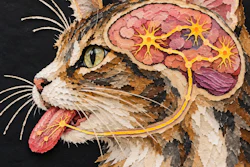
A new study on cats’ feeding patterns and motivations by seven researchers from Iwate University in Japan revealed that the smell of food influences cats’ eating behavior, particularly their tendency to eat small, frequent meals, a pattern that until now had gone unexplained.
Cats’ natural tendency to graze and walk away from their food, only to return to it later, is not always a sign of physical satiety but can stem from olfactory habituation to the smell of the same food, the study said.
The study, “Olfactory habituation and dishabituation dynamically regulate feeding motivation in domestic cats,” published online in April 2026 in the journal Physiology & Behavior (vol. 311, article 115328), concluded that an odor-driven mechanism explains why cats tend to eat sparingly.
To demonstrate that olfactory habituation to the smell of food contributes to feeding cessation and that sensory novelty can restore feeding motivation, the researchers studied 12 healthy, mixed-breed domestic cats ages 3 to 15, including six intact males and six intact females.
The cats, kept in individual cages, first underwent a 16-hour fast, followed by six consecutive 10-minute feeding cycles with 10-minute intervals under several conditions. The cats were fed six types of commercially available dry cat food purchased from local pet shops in Japan.
A new scent restores appetite
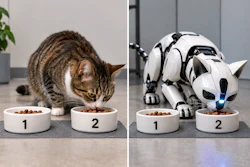
The researchers found that “repeated presentation of the same food resulted in a progressive decline in intake; however, offering six different foods markedly attenuated this decrease and increased cumulative intake. Introducing a different food after repeated feeding on the same food restored intake, regardless of the palatability of the new food.”
The study also showed that a similar recovery occurred when only the odor of a novel food was introduced using a two-compartment dish, without altering the food itself. Continuous exposure to the same food odor between feeding cycles suppressed subsequent intake.
These findings show that olfactory habituation caused by repeated presentation of the same food contributes to feeding cessation, while the introduction of a novel food or food odor causes dishabituation and restores intake in domestic cats, the researchers said.
“The results suggest that feline feeding behavior reflects a strategy that balances internal energy regulation with external environmental and sensory influences, rather than being determined only by metabolic need,” the study said. "Among these external influences, olfactory cues are particularly important for cats, which rely heavily on smell during food selection and evaluation."
The researchers said they hope their findings could guide cat owners on using food-odor exposure to help support their cats’ appetite during illness and to limit overeating in cats prone to obesity.
The study’s authors are Takumi Takahashi, Shota Ichizawa, Sara Kikuchi, Nanami Hara, Reiko Uenoyama, Tamako Miyazaki and Masao Miyazaki.