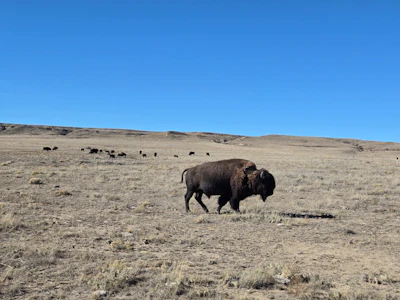
East of Denver, the dry shortgrass prairie exemplified the centuries old story of exploitation told by Byron Shelton, senior program director at the Savory Institute. Cactus grew in soil degraded by overgrazing. While still majestic, the hundreds of bison Shelton manages on West Bijou Ranch’s 8,000 acres provided only a glimpse of the millions of buffalo that once roamed where the deer and antelope play.
The old cowboy ballad came true. We did indeed see both a prancing doe and pronghorn antelope during the Pet Sustainability Coalition (PSC) Impact Unleashed conference’s tour of the bison ranch near Strasburg, Colorado on Nov. 9. Looking further into history before cowboys or conquistadors came, Shelton pointed out numerous ways that the bison and the ecosystems they facilitate can be restored through careful land management. Likewise, the often-cited, but true, Indigenous people’s tradition of using every part of the bison provides an example for efficient co-product usage.
Despite echoes of antiquity, thoroughly modern economic concerns influence the success of West Bijou’s regenerative agriculture. The Savory Institute, a nonprofit organization focused on grassland restoration, and the Ranch attempt to restore and steward natural systems while providing products for human use. That’s where the pet food industry comes in.
Bison co-products as pet food ingredients
For bison ranchers, the pet food industry offers an important market for organ meats, bones and other byproducts, or co-products, that can improve the economics of raising animals on regeneratively managed grasslands. During tour, Dave Carter, former executive director of the National Bison Association and a co-owner of the ranch's bison herd, emphasized the relationship between utilization and the financial sustainability of bison production.
"If we don't get the best carcass utilization, we can't be sustainable," Carter told pet industry professionals attending the tour. Carter now serves as technical assistance director for Flower Hill Institute, a Native-owned nonprofit that supports Tribal food sovereignty and expanded meat-processing capacity.
As Petfood Industry previously reported, demand for bison organ meats and other co-products can provide additional revenue to ranchers while reducing the amount of an animal that goes unused. Carter said this is particularly important to a relatively small industry that has deliberately avoided competing with commodity beef.
"We made a deliberate decision, as an association, when I was there early on, that we never wanted bison to be a commodity," Carter said.
Rather than maximizing production at the lowest possible price, Carter said the bison industry has sought consumers who appreciate the animals' distinctive characteristics, slower growth and relationships with native ecosystems.
"We're not going to feed the world with bison," he said. "Bison will always be a niche."
 Byron Shelton, senior program director at the Savory Institute, (left) and Dave Carter, former executive director of the National Bison Association (right).Tim Wall
Pet food markets could improve bison carcass utilization
Carter estimated that a market-ready bison bull typically weighs approximately 1,200 pounds, while a heifer weighs around 1,000 pounds. Approximately 60% of live weight becomes a hanging carcass, with about 70% of that carcass becoming finished meat.
Those estimates would yield approximately 500 pounds of finished meat from a 1,200-pound bison. The remainder includes hides, bones, organs and other materials with various commercial applications.
He described markets for bison leather, bone broth, organ meats and pet products as opportunities to capture greater value from each animal.
"Bison pet products," Carter said, identifying another outlet. "It's great stuff. It's really an important piece of the puzzle."
Organ meats represent one particularly promising opportunity. For pet food manufacturers, those materials can provide animal proteins for formulations, treats and other products. Their use also creates another potential revenue stream for producers whose primary market is meat for human consumption.
The challenge is gathering enough material to establish a dependable supply.
During the tour, Petfood Industry asked whether bison processors could generate sufficient co-products to supply the pet food industry consistently.
"That's why I'm glad you guys are working with Growing GRASS," Carter responded, referring to a project involving PSC.
PSC participates in Growing GRASSa U.S. Department of Agriculture-supported initiative intended to develop higher-value supply chains for co-products from regeneratively raised beef and bison. The project connects livestock producers, meat processors and buyers in markets including pet food, textiles and other ingredients.
Carter also works with the Flower Hill Institute, which coordinates technical assistance for smaller meat and poultry processors through a USDA program. He said the institute has an agreement with Growing GRASS and is exploring how smaller processors might aggregate ingredients.
Some smaller processors already produce dehydrated products, he explained. Others need additional infrastructure before they can economically collect, preserve and market co-products.
"So if we could get some support from USDA, so that these processors could have meat-bone grinders and plate freezers and things like that," Carter said, describing equipment that could help preserve material until enough accumulates for commercial distribution.
"We can aggregate and get that critical mass."
Carter identified Rocky Mountain Natural Meats and Double J Meat Packing in Colorado as major processors serving the bison industry. He said larger processors have sufficient volume to supply some existing commercial customers, while smaller processors face greater challenges accumulating marketable quantities.
The opportunity for the pet food industry extends beyond purchasing ingredients. Developing relationships with regional processors, establishing consistent specifications and creating demand for co-products could help make processing infrastructure more economically viable. For ranchers, additional revenue from those materials could support the financial sustainability of grazing operations.
Bison provide ecological functions beyond meat production
Although West Bijou Ranch currently supports bison, Shelton said its regenerative grazing principles could also be applied to cattle, sheep and goats.
"Buffalo fit here; they're natural for here," Shelton said.
Carter explained that bison evolved alongside North American grassland ecosystems. Historically, large herds moved across the prairie, grazing vegetation, disturbing the soil and depositing manure before moving to other areas.
"But the hooves were actually digging the soil," Carter said. "The bison have got almost pointed hooves, so as they were going through, it dug depressions in the soil. That's where the seeds would land."
He said bison wallows also create depressions that can collect moisture, while shed hair provides nesting material for birds. Grazing and movement influence the vegetation and other organisms inhabiting the prairie.
At West Bijou, ranch managers attempt to replicate some of those historical interactions through controlled herd movements.
"We're the predator; they're the prey," Shelton said, describing how managers replace some of the carnivores that once kept large grazing herds moving.
The ranch has 24 fenced pastures, and managers sometimes herd animals within individual pastures to distribute their effects more evenly.
"When you bring those animals in, you're managing two things: grazing, the timing of the grass, and then the animal impact, the urine, the dung, the hoof traffic, the scratching, the rolling, the trampling," Shelton said.
Shelton emphasized that the presence of bison alone does not guarantee ecological restoration. When asked how replacing the herd with cattle would change the land, he said the results could be similar under comparable management.
"It's the management," Shelton said.
The ecological effects of bison and cattle are influenced by their behavior, stocking rates, grazing duration and the opportunities vegetation receives to recover.
Regenerative ranching requires planning and water management
Shelton described holistic management as a broader decision-making framework encompassing ecological processes, financial viability, people and long-term goals.
"If nothing else, just remember: it's more than planned grazing," he said. "It's how do you manage complexity? Managing holistically. That's what we're about."
At West Bijou, managers use grazing charts that account for pasture conditions, seasonal growth and livestock movements. Each pasture receives recovery time based on environmental conditions rather than a fixed rotation schedule.
"The job of the manager on the land is to be moving animals at the speed of plant regrowth, and that's a real art," Shelton said.
Water availability makes those decisions especially important in Colorado's dry climate. He explained that bare soil, erosion around plant bases and displaced vegetation can indicate problems with water infiltration and retention.
Improving water retention could increase the productivity of existing land without requiring additional acreage.
"If we could double our rainfall by going from six to twelve effective inches, and manage the land to hold it, we just bought another ranch, or at least another ranch," Shelton said.
Greater ground cover, root growth and decomposition of dead vegetation are among the processes managers seek to encourage.
"We're managing the plants to be able to put down roots," Shelton said. "That's the real key to building soil structure."
Connecting ecological and economic cycles
Shelton emphasized that ranchers need to observe ecological changes regularly rather than rely exclusively on measurements taken years apart.
He distinguished leading indicators, including ground cover, plant diversity, litter decomposition and biological activity, from lagging indicators such as measured carbon sequestration, water infiltration and changes in wildlife populations.
"And the soonest way you can tell if you're improving the land is at the soil surface," Shelton said.
He encouraged ranch managers to spend time each year observing those indicators, while conducting more comprehensive measurements approximately every four or five years.
"Most ranchers should take a day or two every year and go monitor and see how it's coming," Shelton said.
On the prairie, bison consume vegetation, return nutrients through manure, disturb the soil and move to new grazing areas. The bison continuing the cycle of plant growth, while meeting their own nutritional needs.
In the commercial system, the animal provides meat for human consumption while its organs, bones and other co-products can supply additional markets, including pet food.
Carter's emphasis on whole-animal utilization connects those systems economically. Greater demand for co-products could improve returns to bison producers and processors, potentially helping support the long-term viability of ranching operations.
Regenerative ranching seeks to maintain the ecological processes that support the herd. Pet food manufacturers, by creating markets for more of each animal, can contribute to the economic processes that help sustain the ranch.