Given all the hype and seemingly nonstop news about AI, it’s difficult to not fall prey to concerns about it taking over everything, replacing humans in many jobs and other functions, even posing an all-out threat. I sometimes succumb to those fears myself, even as I use AI programs for certain tasks.
So, it helps to gain perspective from people who have studied AI’s origins, strengths and weaknesses. For example, I just read an essay by Zeynep Tufekci, Ph.D., a professor of sociology and public affairs at Princeton University who writes about the social effects of technology, including as a guest for the New York Times.
She explained why AI programs based on large language models, despite their advances and ability to do some tasks very well, also still make huge errors or hallucinate (read: flat out make up stuff): “Large language models are not reasoning machines. They’re plausibility engines. It’s not just that they don’t test their outputs to make sure they’re correct or logical, or that they fail to do so in certain instances. They can’t, and they’ll never be able to on their own.” Later in the essay, she emphasized: “Generative AI as it currently exists cannot easily replace human beings, because it cannot manifest human intelligence.”
This resonated with me, not only because it was reassuring, but also because it brought to mind a truism in pet food, especially when it comes to safety: The human element, backed by knowledge, experience and expertise, is essential and irreplaceable.
AI can help with pet food auditing but not replace humans
During a presentation at Petfood Forum Europe 2026, David Rosenblatt, DVM, head of learning and academic services for Sher Consulting and Training, made a strong case for using AI to strengthen pet food supply chain auditing, particularly with third-party audits. In addition to providing an overview of the benefits and a helpful list of “how to” tips, he also gave a key “why” relating to people.
“Most facilities are audited by human food auditors, because there are far more of them than pet food auditors. Human food auditors frequently overlook pet food-specific risks,” Rosenblatt said. “A good example is nutritional adequacy for complete pet foods — a significant risk category that simply does not exist in most human food contexts, except for products like infant formula. This is the kind of gap that has to be actively managed and assessed in a pet food audit, and it is routinely missed when the auditor’s frame of reference is human food.
“This is where AI can help us improve both effectiveness, meaning a better audit, and efficiency, meaning a faster, easier audit,” he continued.
Yet, while obviously being a strong proponent of using AI for these audits, Rosenblatt also stressed that it can’t — and shouldn’t — replace humans. “The fundamental nature of auditing is listening; the Latin root of “audit” is audire, to listen. When you find a nonconformance, you need to have a conversation: “’How did this happen? What have you done about it? Has this happened before? Can I see the corrective action record?’”
Machines will not be having those conversations within five years, or ever, Rosenblatt said. “They may help generate the follow-up questions — which is useful for less experienced auditors. But the story behind the finding, and what that story reveals about management commitment and organizational culture, is what experienced auditors are truly assessing. That remains a human capability.”
‘If you see something, say something’
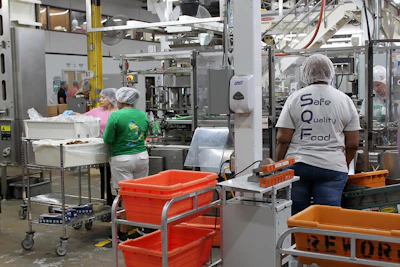
The importance of the human factor was a key theme in a discussion between Paula Schwarz, senior director of key accounts at FlexXray, and Teki Lyons, director of food safety, quality assurance and sanitation at Brightpet, during an Ask the Pet Food Pro Zoom chat about preventing foreign material contamination in a pet food line. Besides closely monitoring suppliers and controlling for the ingredients and other materials they provide, the most underutilized prevention tool, both speakers agreed, is the people on the line.
“The people on the line are your first line of defense to food safety, and they will talk to you if you just spend the time to talk to them,” Lyons said. “Encourage them: If you see something, say something.”
Schwarz echoed that philosophy; and during a Q&A period, both experts agreed that encouraging employees to follow it should start in, and continually be reinforced by, training. That doesn’t always happen.
Another way to encourage line employees to speak up is to cultivate an environment where they feel safe doing so — for example, if the line must be stopped due to foreign material contamination, they won’t be punished for that happening, and their alerts will be acted on. Schwarz described a personal example that illustrated the cost of ignoring the “if you see something, say something” principle: At a previous employer in the human food industry, a metal detector wand was lost and chopped into the product. The employee who lost it had told someone — but nothing happened. The result was blue plastic in product shipped to 3,000 restaurants the Wednesday before Thanksgiving.
Which speaks to the overall culture and management of the company; if the leadership doesn’t adopt and encourage an environment where people feel empowered to speak up, the costs can be huge, in the form of potential recalls, lost time and product, and lost trust among retailers and consumers. And guess what? Those leadership and management teams are comprised of people, too.