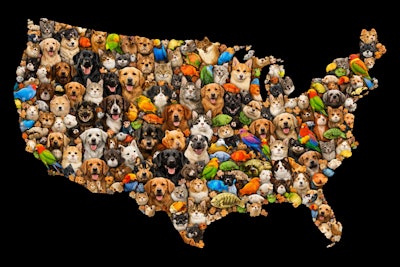
The U.S. pet food industry is global in scope, but production is far from evenly distributed, as seen in the map at the end of this article. The interactive map features pet food companies listed in Petfood Industry's Top Companies database.
Manufacturing facilities, corporate headquarters and ingredient suppliers tend to cluster in specific regions, reflecting decades of decisions shaped by transportation networks, access to raw materials, labor availability and proximity to major consumer markets. Understanding where pet food companies operate, and why, provides insight into cost structures, supply chain resilience and future expansion trends.
Midwestern manufacturing core
The largest concentration of pet food manufacturing facilities is in the Midwest, particularly in Missouri, Kansas, Iowa, Ohio and Illinois. This region has long been the backbone of U.S. grain production, meat processing and animal agriculture, all of which supply essential ingredients for dry and wet pet food.
Corn, wheat and soybeans are readily available in the Midwest, reducing inbound transportation costs. The same is true for animal proteins and fats derived from beef, pork and poultry. Rendering operations, likewise, are often located near slaughter facilities, creating an efficient ingredient supply loop for pet food plants.
The Midwest also benefits from extensive rail and interstate highway systems, allowing manufacturers to ship finished products efficiently to both coasts. For shelf-stable dry pet food, centralized production with national distribution has historically made economic sense.
In the Midwest, several major pet food companies maintain headquarters or significant operations in long-established industry hubs. The beautiful, culturally rich St. Louis area in Missouri, for example, has been home to pet food and animal nutrition companies for decades, supported by nearby agricultural universities and a skilled workforce. Similarly, the Kansas City region in both Kansas and Missouri has attracted manufacturers because of its central location and strong transportation infrastructure.
These legacy locations often influence where companies expand. When adding capacity, manufacturers frequently choose sites within the same region to leverage existing supplier relationships, institutional knowledge and experienced labor pools.
Proximity to population centers
While ingredient access has historically driven plant location, proximity to major consumer markets has become increasingly important. As demand for fresh, frozen and refrigerated pet food grows, manufacturers may be placing greater emphasis on reducing outbound transit times.
As a result, more facilities are being built or expanded near large metropolitan areas along the East and West coasts. States such as Pennsylvania, New Jersey and California host plants that serve dense populations and major retail distribution centers. Shorter delivery distances help preserve product quality and support direct-to-consumer fulfillment models.
The Southeast’s growing role
The Southeast has emerged as a growth regions for pet food manufacturing. States such as Tennessee, Georgia and South Carolina offer lower land costs, business-friendly tax policies and access to expanding Sun Belt populations.
The region also benefits from proximity to poultry production, a major source of animal protein for pet food. Additionally, ports along the Atlantic and Gulf coasts support imported ingredients, packaging materials and export opportunities.
Western specialization and logistics challenges
In the western U.S., pet food manufacturing is more dispersed. California stands out as a center for premium, natural and niche brands, reflecting consumer preferences and startup activity. However, higher operating costs and stricter regulatory environments may limit large-scale expansion.
Geographic location will continue to shape where pet food companies invest. Access to reliable ingredients, efficient transportation and skilled labor remains critical, but changing consumer expectations are shifting priorities. The rise of e-commerce, fresh pet food and sustainability goals are encouraging a more regionalized manufacturing footprint.
While the Midwest is likely to remain the industry’s production core, growth in coastal and southern states suggests a more balanced national network.