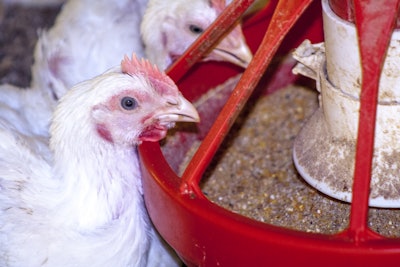
Coccidiosis is caused by protozoan parasites called coccidia that belong to the Eimeria genus, which are species-specific. Chicken coccidia do not infect turkeys and vice versa.
Several Eimeria species vary widely in disease severity, from subclinical to fatal infections. The challenge is compounded in turkeys, where gross lesions are more difficult to observe than in chickens, requiring microscopic detection methods.
Coccidiosis is endemic in almost all poultry operations, although it can remain in the dormant form in the environment for quite a while before it begins to spread throughout poultry flocks. Because of this, the challenge for poultry farmers is managing the spread as opposed to preventing the disease.
There are a variety of treatment approaches, including ionophores and chemical coccidiostats, as well as newer feed additives, in place to help poultry producers control coccidiosis. In addition, environmental management is critical to minimizing the chance of infection.
Three classes of in-feed control
Current coccidiosis control strategies for broilers and turkeys rely on three main classes of in-feed products.
The first is ionophores, which have been available for 60 years and remain the foundation of many programs despite being classified as antibiotics in the U.S. market.
The U.S. market's antimicrobial debate has created two distinct production approaches: no antibiotics ever (NAE) versus no antibiotics important to human medicine (NAIHM). The classification affects available tools, as fermented products like ionophores are classified as antibiotics in the U.S., though not internationally. This means that only NAIHM production allows the use of ionophores.
"They work by not necessarily killing all of the Eimeria, they just damage it, so it doesn't replicate very well," said Francene Van Sambeek, DVM, poultry technical consultant at Elanco.
"It gives the bird's immune system a chance to respond to that foreign agent and actually the birds build immunity toward that Eimeria protozoa. And that's one reason why ionophores have been around for 60 years and not built a bunch of resistance because there's just enough leakage that they can replicate themselves and keep going, but not really overwhelm the bird."
Strong chemicals represent the second class, offering powerful but short-lived control.
"They usually work great for approximately one production cycle, and then you get a lot of resistance built up in the coccidia, and then they don't work very well at all," Van Sambeek said. "It's like a one and done kind of situation. You use it, and then you got to put it on a shelf."
Weak chemicals act similarly to ionophores by allowing some leakage while building immunity, though Van Sambeek noted they lack dosing flexibility.
A third category combines ionophores with weak chemicals, which, according to Van Sambeek, offers the "advantages of both ionophores and the chemical world."
For integrators developing coccidiosis control programs, Van Sambeek stressed comprehensive planning.
"Sit down with whichever provider you want to go with and actually write out your program for the next two to three years. Actually sit down, pencil it out," she advised.
Boosting natural immune support through gut health
Producers must look across all production areas — housing, husbandry, genetics and nutrition — for solutions for coccidiosis control.
"The leading work now seems to be focused on natural products and enhanced immune support," noted Lloyd Keck, Ph.D., a consultant with dsm-firmenich and principal of Keck & Associates.
For poultry integrators developing control programs in 2025, Keck emphasized that coccidial control requires long-term planning.
"Rotating vaccine and anticoccidial products based on careful observation is essential. Researching and testing newly developed products and supplementing with these is important," he warned.
Certain coccidiosis species can damage intestinal tissue, creating conditions for secondary necrotic enteritis caused by Clostridium bacteria. As the parasite goes through its normal lifecycle, it infects and infiltrates cells in the gastrointestinal tract of the host. The parasite causes a weakened immune system, looser droppings, poor nutrient absorption, reduced performance and sometimes death.
Early gut development plays a critical role in disease resistance for broilers and turkeys.
"Establishing the proper intestinal microorganisms early can not only help prevent coccidiosis but can have a 'blocking' effect on many disease organisms," Keck explained. "The correct microbiota also has a significant impact on enhancing the bird's immune system."
Looking ahead, newer genetic engineering technologies may yield more effective vaccines within three to five years, offering additional tools for an industry grappling with this persistent challenge.
No silver bullet for coccidiosis control
Drug resistance has accelerated the industry's search for antibiotic alternatives to control coccidiosis in broilers and turkeys. Current strategies incorporate organic acids, probiotics, enzymes, phytogenics and essential oils as part of comprehensive programs.
"Organic acids work by lowering gut pH, which inhibits the growth of harmful pathogens and improves digestion, ultimately enhancing growth and gut health," Vanessa Iseri, business development manager at Kemin, noted. "Probiotics promote the development of beneficial gut flora as well as reducing pathogenic bacteria, supporting the immune system and improving gut integrity."
Phytogenics and essential oils offer additional protection mechanisms.
"Phytogenics offer anti-inflammatory, antimicrobial and antioxidant properties that affect the intestinal microbial and intestinal environment," she said. "Essential oils disrupt microbial membranes and modulate immunity, providing broad-spectrum antimicrobial activity."
For integrators developing control programs, Iseri emphasized the importance of comprehensive planning.
"Coccidiosis control strategies in poultry production are most effective when approached as a holistic, integrated system rather than relying on a single intervention," she said. "This integrated approach not only helps reduce the risk of coccidiosis but also supports overall flock welfare and long-term sustainability."
The shift represents a fundamental change in disease management philosophy, moving from reactive, single-product solutions toward proactive, multifaceted programs designed to build resilience throughout the production cycle.
Environmental management is key
Litter moisture control and ventilation management have emerged as the most critical factors in preventing coccidiosis outbreaks.
"The two most important environmental conditions that increase the risk of a coccidiosis outbreak are increased litter moisture and inadequate ventilation," emphasized Maggie Thompson, DVM, MAM, DACPV, technical services veterinarian, Zoetis.
"Focusing on drinker management, including prompt repair of leaks and ensuring appropriate height for the age of the bird, is critical for controlling litter moisture," while "ventilation should always be managed based not only on ambient temperature, but also on humidity and moisture levels," she added.
Litter management is one of the easiest ways to control coccidiosis, but requires careful balance, as both extremes create problems.
"It's like the domino effect; one wrong move can negatively impact the entire process," Thompson noted, adding that "overly dry, dusty litter delays sporulation until later in the production cycle, when enough fecal material is present to increase litter moisture to the appropriate level."
"This means birds will likely undergo a late cocci challenge when there is less time for compensatory growth," she continued.
Excessive moisture presents even greater risks.
"Increased litter moisture leads to increased sporulation, which means more infective oocysts are present in the litter to be consumed by a bird," Thompson said.
Differences in management practices between broilers and turkeys can make coccidiosis control even more challenging.
"Turkeys are longer lived and generally are shedding lower numbers of oocysts by the end of their grow-out period," Tim Cummings, DVM, DACPV, senior technical services veterinarian, Zoetis, explained.
"This in turn translates into a lower cocci load for the next flock on well-managed built-up litter, which helps lower overall pathogen load."
Conversely, for broilers, downtime between flocks varies based on management capabilities.
"There really is no predefined downtime that magically reduces coccidial load — rather, it is all about litter management during and between flocks," Thompson said. She recommends decaking followed by heating litter to temperatures more than 105 F for three to five days to weaken oocyst cell walls.
Cummings cautioned that program changes require patience.
"What comes out of the back end of the birds is what the next flock is going to get exposed to in the litter," Cummings said. "Some program changes need to look at two to three cycles to fully assess, as it takes time to fully change the microbiome of the litter."