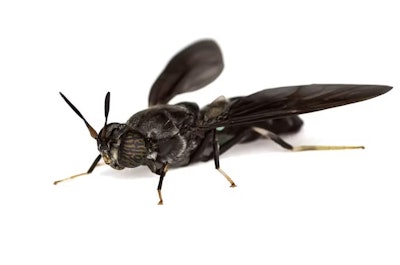
Black soldier fly larvae (Hermetia illucens) represent an opportunity for the pet food industry to address both sustainability challenges and nutritional customization, according to research presented at the American Feed Industry Association's (AFIA) Pet Food Conference during the International Production & Processing Expo (IPPE) 2026 in Atlanta, Georgia, U.S.
Dr. Jeff Tomberlin, AgriLife Research Fellow and Presidential Impact Fellow at Texas A&M University, detailed how the insects can be tailored nutritionally by manipulating their diet substrates, potentially creating customized ingredients for different life stages and animal types in pet food formulations.
"We can tailor the diet to generate the insect that the industry wants to be used as a ingredient for cats, for dogs, for puppies, for kittens," Tomberlin said during his presentation. "There's lots of opportunity there."
Tomberlin's laboratory at Texas A&M has demonstrated that single nutrient additions can significantly impact production efficiency. Research showed that manipulating zinc or tryptophan alone reduced variability in larval mass by 20% to 30%, while methionine supplementation increased larval weight by 50% and decreased production variability by nearly 50%.
The insects, which can grow from 0.01 milligrams to 180 milligrams, can digest diverse waste streams including food waste, manure and plant-based materials. Tomberlin noted that facilities can process waste at scales ranging from backyard operations to industrial facilities handling 100 tons daily.
Current pet food applications
Research specifically focused on pet food applications remains limited but shows promising results, said Tomberlin. His literature review revealed only six veterinary science publications on canine applications and two on feline applications throughout the insect's research history.
Published studies have demonstrated that black soldier fly larvae can improve feed conversion rates and digestibility in dogs. The larvae's oil can boost fatty acids, though Tomberlin acknowledged palatability challenges that require formulation solutions.
For cats, black soldier fly larvae can serve as a dietary ingredient with benefits extending beyond basic nutrition, though research in this area remains in early stages.
Production and safety considerations
Tomberlin advocated for implementing a grading system similar to agricultural commodities to differentiate larvae produced on various substrates. Currently, larvae produced on high-quality brewers grain receive the same price point as those raised on food waste, creating no economic incentive for premium production practices.
Quality assurance remains critical regardless of production location or scale. While regulations in some global regions allow broader waste stream access, Tomberlin emphasized that safety protocols must remain consistent.
The researcher also proposed a hub-and-spoke production model similar to the poultry industry, where centralized nurseries supply young larvae to smaller-scale farmers who digest waste locally, then send harvested larvae to centralized processing facilities for quality verification.
"This is really good for rural America, creating jobs," Tomberlin said. "They digest this waste, those larvae are centralized, they go through quality assurance to make sure it's safe, and that leads to greater stability."
Beyond whole insect applications
Tomberlin suggested the pet food industry should move beyond viewing black soldier fly larvae as a single ground ingredient toward extracting specific high-value components. His laboratory has identified bioavailable vitamin B12, essential amino acids including leucine and tryptophan, and chitin as potentially valuable isolated compounds.
The insect's exoskeleton contains chitin, a polysaccharide with applications in animal feeds and human medicine. Fats extracted from larvae have potential uses in biofuel production.
Black soldier fly larvae are approved in the U.S. for use in poultry, swine, select aquaculture species and pet food. The residual material from larval digestion, called frass, serves as a fertilizer replacement with robust NPK content and beneficial microbial communities.
Tomberlin noted that basic research institutions including UC Berkeley, University of Chicago, Harvard and Cambridge have begun studying black soldier fly larvae as model organisms, suggesting long-term industry growth potential.