Cats remain a small slice of the pet supplement market, but industry data and experts agree they're the segment to watch. Dogs held 77% of the pet dietary supplements market in 2025, yet Mordor Intelligence projects cats will be the fastest-growing segment, at a 9.5% compound annual growth rate through 2031.
Here are 10 trends producers should know as they develop products for cats.
1. Cat owners feel like second-class citizens
Packaged Facts has tracked a growing share of cat owners who agree cats are treated as second-class citizens, a sentiment that has worsened across survey waves, said Shannon Landry, research director for Pet.
"Cat owners feel left out in the pet market," she explained. "Given that most supplements are either dog-only or dog/cat, what most cat owners want is to find supplements specific to their feline friends."
2. Demand is rising, but the category remains underserved
Supplement use among cat parents rose from 20% in 2018 to 34% in 2024, according to American Pet Products Association (APPA) data cited by Ravi Sheth, Ph.D., co-founder and chief scientific officer at Kingdom.
"Despite this, cat supplements remain an underserved category, creating opportunities for brands to address cat parents' top health priorities with new products designed specifically for cats," Sheth said.
3. Close bonds make cat owners watchful
Cat owners' frustration with the market coexists with deep emotional investment in their pets. Packaged Facts data shows 91% of cat owners consider their cat part of the family and 86% say their cat is central to their home life. In addition, 81% keep cats in the family eating or living area, 60% keep their cat indoors full time and 56% share their bed with their cat.
"The more time cat owners spend with their cats, the more likely they are to notice health and wellness issues," Landry said. "That's absolutely where pet supplements can come into play."
4. Adoption is early, and supplements fill a vet-visit gap
A Nextin Research survey found 17% of cat owners bought a supplement in the prior 12 months, compared with 32% of dog owners.
"Cat nutrition trends produce lower volumes than dog, so many brands have treated cat as a secondary priority," said Nicole Hill, vice president of strategy, insights and innovation at Nextin Research by MarketPlace. "Still, cat owners are motivated and invested in their cat's wellness."
Landry said supplements also offer cat owners an alternative to the veterinary clinic. "Cat owners are less likely than dog owners to bring their pet to a veterinary clinic," she said. "Cat-specific supplements are a way for cat owners to try to address health issues without a prescription, at a lower price point than pet medications."
5. Cats are not small dogs
Terri Grow, certified animal nutritionist and herbalist, said the conversation around cats follows a different path than the one around dogs.
"With canines, joint support, behavior, dental are top discussions, along with ease of dosing, i.e., chews or liquids," Grow said. "For cats, it starts with the health issue and advances into an overall wellness discussion that includes diet, environmental enrichment, then supplements and palatability."
Sheth said cats' distinct gut microbiome and other physiological differences mean products "must be formulated specifically for cats rather than reusing dog formulations." Hairballs, urinary health and hydration are also far more prominent concerns for cats than for dogs, he said.
6. Palatability is reshaping formats
Grow said cats evaluate a supplement through "a complex interplay of smell, texture, shape, temperature and flavor," while dogs rely mostly on smell and taste.
"To 'outsmart' cats and win their acceptance, we must be more creative and far more respectful of their biology," Grow said. "Dogs and cats differ fundamentally across immune, digestive, physical and psychological lines, so why expect a cat to thrive on a generic dog-and-cat formula?"
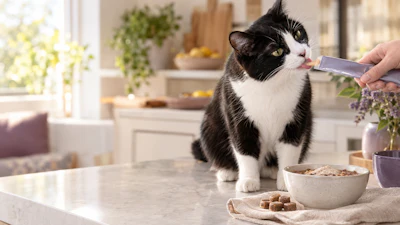
APPA data shows cat-parent purchases of mixers and toppers more than doubled, from 8% in 2018 to 19% in 2024. Hill found cat supplement buyers are 1.5 times as likely as cat owners overall to feed lickable treats, and Landry's research identified soft chews as the most popular cat supplement format.
7. Hydration in lickable formats is the one to watch
Hill singled out hydration-forward daily wellness supplements as the top trend for the year ahead.
"If I had to name one thing to watch, it would be hydration-forward daily wellness supplement in a lickable or pour-over format aimed at indoor and indoor/outdoor cats," she said. "Taking a format cue from the treat category, lickable supplement formats are on the rise. Like 'indoor cat' and hairball control, hydration and immunity are more specific facets of daily wellness. Delivered in a lickable stick pack to be added to food or fed by hand, a hydration/immunity supplement can be easily incorporated into daily feeding routines."
8. Digestive health leads the condition list
According to a 2024 Cargill survey, nearly half of cat parents, 46%, look to food for gut or digestive-health benefits, and gastrointestinal upset is a leading reason cats are taken to the veterinarian, noted Ravi Sheth with Kingdom. Digestive benefits rank among the top reasons cat owners buy food and supplements.
Grow said retail sales data point in the same direction. "Surveys highlight joint support and dental care as top priorities, but if you look at sales from a top online retailer, half of the top 10 best-selling cat supplements are for gastrointestinal issues," she said. From her point of view, urinary and kidney health, dental care and joint health follow.
9. Dental care, longevity and calming are open opportunities
Hill's research found 25% of cat owners are interested in dental supplements but haven't tried them, more than the 22% who currently use them. "This conversion gap signals underserved demand in the cat supplement space," Hill said.
Landry pointed to aging cats, noting more than half of cat-owning households include a cat older than 7, and to anxiety, which more than a third of cat owners report in their cats. "This is another area where cat owners may be looking for solutions and not necessarily finding them," she said.
10. Feline clinical proof and premiumization will raise the bar
Sheth expects cat-specific clinical evidence to become a baseline expectation.
"Cats remain underserved by companion animal clinical research, and studies conducted in dogs are often used to substantiate feline benefits," he said. "The next generation of cat supplement products will be designed around feline biology, supported by clinical evidence in cats and delivered in form factors that make supplementation part of a cat parent's daily routine and relationship with their cat."
Grow called the shortage of feline-specific products a "massive" opportunity for brands willing to formulate for cats rather than adapt dog products.
Read the November 2026 issue of Petfood Industry for an in-depth analysis of cat supplement trends in our new Supplement Watch column.