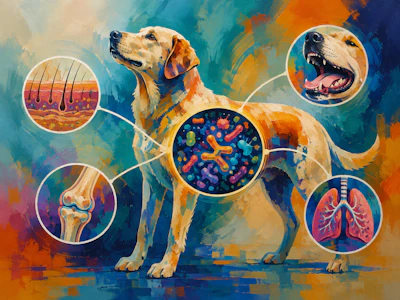
Recent research shows that a dog's microbiome influences far more than gut-brain health, with connections to skin barrier function, joint mobility, oral health, respiratory function, and behavioral issues. Microbiome diversity and composition appear linked to multiple body systems, and factors like exercise, birth method, age, and breed can shape microbial patterns that affect overall canine wellness.
- The canine microbiome connects to seizure activity, anxiety, and aggression, though it should be viewed as a supportive tool alongside training and diet rather than a diagnostic tool
- Skin has its own distinct microbiome influenced by breed and skin site, and disruption to the skin barrier may trigger allergic reactions and dermatitis
- Oral bacteria in saliva and plaque may offer early biomarkers for periodontal disease, which affects up to 70% of dogs
- Dogs with 60+ minutes of daily exercise show better microbial markers, and those with diverse microbiomes respond better to joint-support nutrition
- Microbiome diversity typically declines around age seven, correlating with reduced energy, worse joint health, and higher inflammation levels
The gut-brain axis has dominated microbiome conversations in the pet food and supplement space, but researchers are finding that gut bacteria may be linked to skin, joint, oral and respiratory health in dogs. Dr. Bushra Schuitemaker, head of microbiology at Pooch & Mutt and head of science and research at Biome9, shared her perspective on where the science stands across various body systems.
1. The gut-brain connection may be tied to seizure activity in dogs with epilepsy.
Dr. Schuitemaker said observations from dogs with epilepsy first pointed her toward the gut-brain relationship. "That was a clear indication that something was going on between the gut ecosystem and brain activity, and we've used that as a model to better understand the gut-brain axis in dogs," she said.
2. Certain gut bacteria may be associated with anxiety and aggression.
A 2025 study in companion dogs linked microbiome composition to anxiety and aggression groupings, Dr. Schuitemaker said, though she cautioned against drawing firm conclusions. "That doesn't mean we can use it to diagnose or treat behavior," she said. "I see the microbiome as an additional tool to support dogs, the same way training and diet are tools."
3. Behavioral issues may sometimes trace back to undetected pain.
Dr. Schuitemaker said gut microbiome shifts can sometimes signal a physical issue behind a behavior change. "The fact that we can see those changes in the gut environment first gives us a clear indication when something else is going on that isn't directly tied to the gut-brain axis — it could be joints or digestive function," she said.
4. The skin has its own microbiome, distinct from the gut.
"Dogs have their own skin microbiome, and recent metagenomic work in healthy dogs found that skin site and breed influence microbial variation," Dr. Schuitemaker said.
5. Skin barrier disruption may be linked to allergy and dermatitis patterns.
Dr. Schuitemaker described the skin as more than a surface. "It's an immune barrier, and when that barrier is disrupted, microbial communities can shift both externally and internally, which may be relevant to itching, allergies, atopic dermatitis and skin infections," she said.
6. Birth method may play a role in a breed's skin sensitivity.
Citing research in French bulldogs, Dr. Schuitemaker pointed to a possible parallel with human pediatric findings. "Pediatric studies in humans show that babies born by cesarean are more likely to develop eczema, allergies and asthma as they age, so something similar could be happening with French bulldogs," she said.
7. Oral bacteria may offer early markers for periodontal concerns.
Periodontal issues remain common in dogs, according to Dr. Schuitemaker. "A 2024 study noted that gingivitis and periodontitis are the most common oral diseases in dogs and can affect up to 70% of canine patients," she said, adding that saliva and plaque microbiome analysis may help identify relevant biomarkers.
8. A gut-lung connection is an emerging area of interest.
Dr. Schuitemaker said the respiratory microbiome, while still an early area of study, appears tied to broader immune function. "It's relevant to immune response and how local airways may interact with the gut and the wider environment," she said.
9. Joint mobility markers may correlate with microbiome diversity.
Exercise habits appear to line up with certain microbial patterns, Dr. Schuitemaker said. "Dogs that get more than 60 minutes of exercise a day generally have really good microbial markers," she said, adding that dogs with more diverse microbiomes tend to respond better to joint-support nutrition.
10. Microbiome diversity may decline as dogs age, correlating with several markers of wellness.
Dr. Schuitemaker said the shift tends to begin around a dog's seventh year. "A loss of diversity and richness is associated with less energy, worse joint health and higher inflammation," she said, noting that breed can shape these patterns as well. Spitz-type breeds, for instance, may respond differently to high-protein diets, she noted.
This roundup is drawn from Lindsay Beaton's recent conversation with Dr. Bushra Schuitemaker on Trending: Pet Food’s recent episode, “What body systems, aside from the gut-brain connection, does the microbiome influence?” The episode explores what current research suggests about the canine microbiome's reach across the body.