Nearly three in four pet supplement brands now sell an ingredient that started as a human wellness trend, from collagen and ashwagandha to lion’s mane and NAD+ precursors, according to a 2026 census of 195 brands conducted by La Petite Labs. Those ingredients typically reached pet supplements about seven years after they caught on in human supplements.
“The human aisle is a remarkably good forecast of the pet aisle,” said the La Petite Labs research team. According to the team, 30 of the 40 fastest-rising human supplement ingredients are already sold in pet supplements, and among the 17 ingredients the census could date in both markets, pets never came first.
Collagen leads six trend ingredient families
The census tracked six ingredient families from the human supplement aisle. Of the 195 brands, 143 (73%) sell at least one product containing one of them. Adoption is mainstream rather than niche: All 10 brands with the largest ranges sell at least one trend ingredient, as do 31 of the 34 brands selling 20 or more supplements.
- Collagen and connective-tissue ingredients: 94 brands (48%)
- Adaptogens such as ashwagandha: 73 brands (37%)
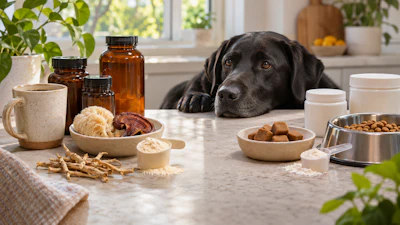
- Functional mushrooms such as lion’s mane, reishi and turkey tail: 69 brands (35%)
- Cognitive ingredients: 63 brands (32%)
- Postbiotics: 36 brands (18%)
- NAD+ precursors such as nicotinamide riboside and nicotinamide mononucleotide, or NMN: eight brands (4%), up from one in 2023
According to the census, postbiotics were the second-fastest-rising ingredient in new U.S. human supplements between 2016 and 2025. NAD+ precursors, the newest family, have tracked the human longevity boom a few years behind.
A hedge, not a pivot
While the trend is widespread, trend products account for only 28% of the supplements on the shelf, or 803 of 2,865 products in the census.
“It looks like a hedge, not a pivot,” noted the research team. “The typical pattern is a mushroom blend or a collagen chew added beside the joint, digestion and skin products. The trend product keeps a brand current and draws newer customers; the core range carries the volume.”
Why pet brands trail by seven years
According to the research team, the lag reflects consumer behavior more than corporate strategy. “People discover ashwagandha or lion’s mane for themselves, live with it for a few years, then go looking for the dog or cat version,” the team said. “Pet brands watch for that demand.”
Human supplement companies are not the ones carrying these trends over. Of the 143 pet brands selling a trend ingredient, only three also sell supplements for people. “Hence there is a bit of a ‘passive’ factor here, which may explain why it takes so long,” added the research team.
Brands also tend to wait until an ingredient is familiar, widely available and affordable at pet price points, the team said. “It’s easier not to have to educate the market but rather enter one that is familiar with the ingredient,” it added.
The census dated when individual ingredients caught on in human supplements, then in pet supplements:
- Collagen peptides: 2017, then 2020 (three years)
- Eggshell membrane: 2014, then 2020 (six years)
- NMN: 2020, then 2026 (six years)
- Nicotinamide riboside: 2018, then 2025 (seven years)
- Lion’s mane: 2012, then 2020 (eight years)
- Chaga: 2012, then 2021 (nine years)
- UC-II collagen: 2012, then 2024 (12 years)
- Tremella: 2012, then 2025 (13 years)
Recent crossings have been faster, explained the research team. Ingredients that caught on with human supplement brands in 2012-13 took a median of about 9.5 years to reach pet supplements, compared with three years for collagen peptides and six for NMN.
“Be cautious about calling it a trend, though,” said the research team. “An ingredient that took off with people in 2020 can’t have shown a 10-year lag yet.”
Fisetin, saffron, shatavari and luteolin all caught on with human supplement brands in 2012-13, and none appears in a pet supplement in the census, a gap of 13 to 14 years. “Time explains some of the lag, but not all of it,” the team said. “Some ingredients aren’t late. They’re stuck.”
Cats wait twice
A smaller lag sits inside the larger one. Only 14% of pet supplements in the census are made for cats alone. When a brand sells the same ingredient for both species, the cat-only version arrives a median of five months later, and it came later in 180 of the 276 cases the census could date. For 32 of the 64 trend ingredients, the census found no study in live cats.
“If you want to know what will be in the pet aisle in 2030, look in your own supplement cabinet today,” said the research team.
The full La Petite Labs report is available here.
Disclosure
La Petite Labs makes Hollywood Elixir, built around nicotinamide riboside with reishi and 15 other active ingredients, and Pet Gala, which contains collagen and 14 other active ingredients. The company said its products were excluded from every census figure. La Petite Labs said it is also planning its own studies, starting with senior dogs and extending to cats.