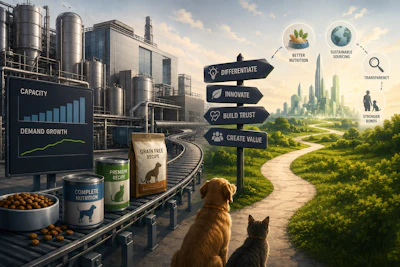
Over the past five years, the pet food industry has gone through what may be one of the most intense investment waves in its history. The pandemic gave the industry a surge that manufacturers around the world read as a signal to scale — billions went into new plants and expansions. But time has passed, and the market has shifted.
Today, looking at the industry from the inside, I see the hallmarks of what investment analysts call a capital cycle — a scenario in which high industry profitability attracts capital, investment outruns actual demand, and excess capacity builds up. What risks does this create for pet food manufacturers, and how can we counter them to hold our ground in the next phase of the market?
How we got here
Investment in pet food didn't start with the pandemic — manufacturers had been putting money into new facilities and expansions well before that. But after COVID-19, those investments took on a different scale. The rapid growth in pet ownership and spending on pets gave the market reason to expect sustained demand growth, which in turn called for more aggressive capacity investment.
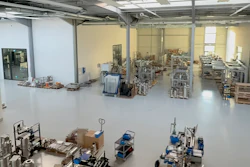
In 2020 alone, Nestlé Purina PetCare announced $450 million for a new plant in North Carolina and $550 million for an expansion in Georgia. According to Global Location Strategies, between 2020 and 2022 the industry completed 40 major production projects — double the number in the three pre-pandemic years. Among them was Kormotech's new facility in Lithuania. And the investment wave didn't fade after 2022. From early 2023 through mid-2024, companies invested over $1.5 billion in new plants and production expansions.
Today, capacities designed for the rapid demand growth of the pandemic years are gradually coming fully online. The question is: What happens if those capacities begin to outpace the rate at which the market is actually growing?
The new reality
I'm not one to overdramatize, but the next few years are likely to be challenging for many manufacturers.
First, excess capacity can put pressure on margins. In that kind of environment, manufacturers compete more aggressively for sales, and retailers gain more leverage in negotiations. This pressure may be felt most acutely in wet food, where, from what I've observed, a significant share of pandemic-era investment was directed. The market continues to grow, but at a slower pace. On top of that, the inflationary momentum in pet food is fading: After the price increases of 2022–2023, prices are no longer rising at the same rate.
Second, when more capacity enters the market, some manufacturers naturally look to fill it through private label. The result is a growing number of private label products on shelves that compete with brands not just on price but on quality. In the U.S., this segment is already growing faster than branded products.
As private label increasingly offers products comparable to brands in formulation, functionality and ingredient quality, it gradually shifts consumer expectations around what quality nutrition should cost. For manufacturers, this can mean ever-increasing pressure to justify their price point.
How to hold your ground
I don't believe in one-size-fits-all solutions, but in my view there are several things that, in today's environment, can separate those who stagnate from those who grow:
Investing in the development of key suppliers. Trying to offset margin pressure by cheapening formulations is a dangerous path. If lower cost comes at the expense of quality, it will eventually erode consumer trust. A stronger strategy is to develop your suppliers — invest in their research, certification and capacity. A manufacturer that does this gains a more stable supply chain and a partner with a stake in its success, rather than just a supplier who might leave for another buyer.
Strengthening the evidence base. Today's pet parents want to buy products that work — products that deliver real health outcomes for their pets. They won't pay simply because the packaging says "premium." That means it's not enough for a manufacturer to claim benefits — those benefits need to be substantiated. In practice, this means investing in R&D, validating ingredient efficacy, and putting evidence-backed value at the center of communications. Beyond that, palatability also needs to improve, because the end consumer — the cat or the dog — will ultimately choose based on taste.
Deep understanding of consumer behavior. In traditional fast-moving consumer goods (FMCG), the manufacturer has almost no visibility into its end customer — behavioral data stays on the retailer's side. This means the manufacturer has a weaker understanding of who is buying its product and how pet parent needs are evolving. But what matters today isn't just having data — it's the ability to connect it in a way that reveals the consumer journey.
I believe manufacturers should consider investing in a data architecture that brings together information from e-commerce, CRM, veterinary services, breeder programs and service channels into a single consumer profile. That kind of infrastructure can become the foundation for personalization, repeat purchases and more effective demand management.
Building omnichannel capability. Today's shopper might discover a product on social media, compare prices on a marketplace, and buy it at a local pet store — or the other way around. If a manufacturer is present in only one of those channels, it simply won't meet the buyer at the right moment. But it's not just about being everywhere — it's about building a system where channels complement each other: different brands for different channels, aligned pricing and a consistent communication logic.
The market is shifting from rewarding scale to rewarding distinctiveness — quality of formulations, depth of partnerships, closeness to the consumer. In my view, these are the factors that will define which companies prove resilient in the next chapter of the industry's development.
Rostyslav Vovk is chairman of the board and co-owner of Kormotech. This international family-owned company with Ukrainian roots ranks among the top 50 global pet food manufacturers. Its brands are available in 46 countries, both under its own trademarks and those of partner companies. Vovk leads a team of 1,300-plus employees worldwide.