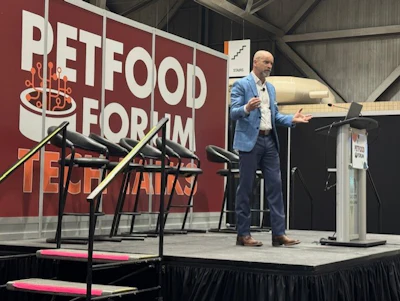
Pet food manufacturers are navigating a shift from volume-based production to value-driven growth, as evolving consumer expectations reshape operations across the sector, said Paul McKeithan, senior vice president of business development at Reiser, during his Tech Talk on April 28 at Petfood Forum 2026 in Kansas City, Missouri.
During the session, "Market trends shaping the future of pet food manufacturing," McKeithan said trends such as premiumization, health and functionality are accelerating innovation while creating new manufacturing challenges.
"We have the humanization accelerating margin opportunity," McKeithan said. "But you're also looking at health and functionality parts of the products, and they're driving innovation."
That shift is forcing processors to rethink traditional high-volume kibble systems in favor of more flexible production models capable of handling smaller batches and a wider range of stock-keeping units.
"If you go back to kibble manufacturing, those operations are standard in place, large equipment, high volume," he said. "Now market trends are looking for more SKUs, and that creates challenges because you're looking for lines that are more flexible."
From grain science to meat science
A key driver of change is the growing emphasis on protein and fresh or minimally processed ingredients. McKeithan noted the industry is increasingly moving from grain-focused formulations toward meat-based products, influencing both research and development and plant operations.
"You'll see the conversation go from grain science to meat science," he said. "What form do you get your protein in? Are you starting to deal with raw, fresh, frozen type protein, and how do your manufacturers deal with that?"
Handling raw and fresh proteins introduces new complexities, including separation of processes, temperature control and equipment sanitation. McKeithan said manufacturers must evaluate whether proteins are processed as powders, frozen blocks or fresh inputs, and how those formats affect production flow.
Other considerations
The rise of alternative formats — including air-dried, freeze-dried and high-pressure processed products — is also influencing facility design and equipment selection, said McKeithan.
Packaging is also evolving alongside formulation trends. McKeithan pointed to increased adoption of formats commonly used in human food, such as trays, pouches and thermoformed packs, replacing or supplementing traditional bags.
"You're trying to capture that human view of a product," he said, adding that packaging flexibility is critical to support frequent product changeovers and varied formats.
Convenience and portion control are emerging considerations as well, particularly in fresh and frozen categories. McKeithan said manufacturers are experimenting with formats such as chubs, patties and meatball-style portions to simplify feeding for consumers.
"How does the consumer handle your product?" he said. "That piece is becoming very critical, and it has impact on the manufacturing space as well."
These shifts are prompting closer collaboration between R&D and operations teams. McKeithan encouraged companies to involve manufacturing early in product development and to draw from existing food industry technologies rather than building entirely new systems.
"One of the biggest shifts is the amount of meat, and raw meat coming into the industry," he said. "The good news is that equipment exists. We don't have to reinvent the wheel, but we do have to explore ways to adopt that into the pet food space."