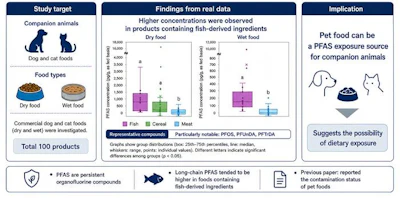
Japanese researchers found widespread PFAS contamination in commercial pet foods, with fish-based products containing higher levels of these persistent synthetic chemicals that accumulate differently in dogs and cats based on species and dietary exposure patterns.
- PFAS chemicals were detected across 100 commercial pet food products tested in Japan, with fish-based foods showing the highest contamination levels.
- Cats showed significantly higher levels of long-chain PFAS compounds including PFNA, PFDA, and PFUnDA, while dogs exhibited profiles more influenced by PFOS and PFHxS.
- Paired serum-food analysis in cats revealed stronger correlations between dietary PFAS and blood levels, suggesting diet is a primary exposure route for felines.
- Multiple exposure pathways beyond diet—including indoor dust, drinking water, grooming, and household products—may contribute to PFAS accumulation in pets.
- An emerging PFAS compound, 9Cl-PF3ONS, was detected in some pet food products, adding to concerns about novel synthetic chemical exposure.
Researchers at the Center for Marine Environmental Studies at Ehime University in Japan have published two linked studies examining PFAS contamination in pet food and its relationship to chemical exposure in dogs and cats.
PFAS, or per- and polyfluoroalkyl substances, are synthetic chemicals used for their water- and oil-repellent properties. The compounds are said to be highly persistent and have been detected in water, food and wildlife, raising concerns for environmental and public health.
Pet food study finds widespread PFAS
In the first study, "Widespread PFAS contamination in pet food: Dietary sources and health risks to companion animals," researchers analyzed 100 commercial dog and cat food products sold in Japan and quantified 34 PFAS compounds, examining how PFAS patterns differed by food type, ingredients and country-related product characteristics.
PFAS were widely detected across the products tested. Fish-based foods tended to contain higher levels of PFOS and long-chain perfluoroalkyl carboxylic acids such as PFUnDA and PFTrDA, compounds known to accumulate in aquatic food webs. An emerging PFAS compound, 9Cl-PF3ONS, was also detected in some products.
Serum analysis pairs pets with their food
The follow-up study, "Species-specific PFAS profiles in companion dogs and cats: paired serum–food evidence for dietary long-chain PFCA exposure in Japanese cats," analyzed serum samples from 23 privately owned dogs and 30 cats collected in Hokkaido, Osaka and Ehime, Japan. In the Ehime group, researchers also collected dry pet food samples the same animals were eating, allowing for paired serum-food analysis. The team targeted 38 PFAS compounds, including branched isomers and emerging compounds, using LC-MS/MS.
The serum study found differences between species. Cats showed higher levels of long-chain perfluoroalkyl carboxylic acids, including PFNA, PFDA, PFUnDA, PFDoDA and PFTrDA, while dogs showed profiles more influenced by PFOS and PFHxS.
In the paired Ehime group, researchers observed stronger serum-food relationships in cats for PFOS, PFUnDA, PFTrDA and total PFAS. In dogs, the weaker serum-food relationships suggested more varied exposure pathways may be involved.
Researchers noted that diet is not the only potential source of PFAS exposure in pets. Indoor dust, drinking water, grooming behavior, outdoor activity, household products and species-specific biological differences may also play a role.