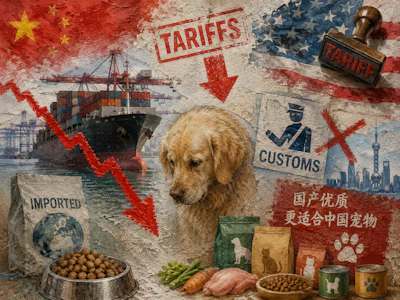
China imported US$474.1 million worth of packaged pet food in 2025, down 5.2% from the previous year, according to a report from USDA’s Agricultural Trade Office in Shanghai. The decline was attributed to higher tariffs, rising domestic competition and restrictions related to avian influenza.
The United States remained China’s largest supplier of retail dog and cat food, exporting US$244.7 million in 2025, although that represented a 17% decline from the record levels seen in 2024.
Beginning Jan. 1, 2025, China raised the tariff on imported retail-packed pet food from 4% to 10%, increasing cost pressures for imported brands. The report noted that the higher costs could encourage some consumers to shift toward domestic alternatives, particularly in more price-sensitive segments.
Despite headwinds affecting finished products, U.S. ingredients such as poultry meal, plasma and functional ingredients remain highly valued by Chinese manufacturers for their consistency, nutritional quality and performance in premium formulations.
Competition intensifies across price tiers
The market has become increasingly segmented by price. Imported brands continue to dominate the premium segment, while domestic companies hold strong positions in mid- and low-priced categories.
According to the report, foreign brands account for roughly 75% of China’s premium pet food segment. Domestic manufacturers, meanwhile, are competing through localized formulations, lower prices and strong digital marketing capabilities.
Middle-market products face pressure from both ends of the spectrum, forcing companies to differentiate through innovation, specialized ingredients and premium offerings.
Digital channels support domestic brands
China’s e-commerce landscape continues to evolve. Established platforms such as Tmall and JD.com provide stable channels for customer loyalty and repeat purchases, while Douyin’s short-video ecosystem has emerged as a powerful driver of impulse buying and trend-based consumption.
Domestic brands have capitalized on these channels through livestreaming, influencer marketing and flash-sale campaigns, often outperforming imported products in mid-tier categories.
Although the total number of pet stores declined slightly during 2025, brick-and-mortar retailers in major cities such as Shanghai, Beijing and Chengdu remained resilient thanks to service-based revenue from grooming and bathing that cannot easily be replicated online.