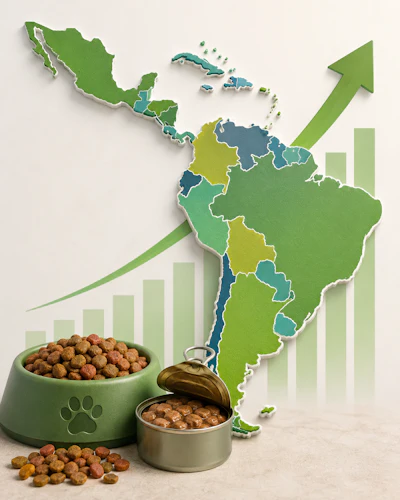
Brazil and Mexico may dominate Latin America's pet food industry, but they no longer explain where the region is heading.
A broader group of markets is developing through very different combinations of local manufacturing, imports, retail expansion and category specialization. Argentina, Chile and Colombia remain established production centers, while Peru and Ecuador are strengthening their domestic capacity. Across Central America, the Caribbean and smaller South American markets, growth is following increasingly distinct industrial paths.
Smaller markets are following different industrial paths
The traditional view of smaller Latin American markets as largely import-dependent is becoming outdated.
Guatemala has an important local manufacturing base and serves neighboring Central American markets. Costa Rica combines domestic production with a relatively sophisticated retail structure and growing demand for premium and specialized products. Uruguay remains a high-consumption market with strong pet food penetration, although imports continue to represent a significant part of supply.
Paraguay, by contrast, has developed a visible domestic manufacturing sector supported by local producers and Brazilian companies. Bolivia is expanding rapidly from a lower consumption base, with growth concentrated in affordable dry food and a limited number of dominant manufacturers. The Dominican Republic presents another model, where local production, private-label brands and modern retail coexist with regional and multinational imports.
According to Triplethree International's Pet Food Intelligence Platform, these differences show that market size alone is no longer enough to evaluate opportunity. Industrial structure, retail concentration, local brands, trade flows and production capacity must be analyzed together.
Cat food is becoming the region's most consistent growth engine
Across much of Latin America, cat food volumes are increasing faster than dog food.
This trend is visible across both major and smaller Latin American markets. As cat ownership expands and purchasing patterns become more sophisticated, cat food is gaining relevance within regional portfolios. Growth is being supported by greater demand for wet food, treats, premium nutrition and products designed for specific health and life-stage needs.
Although the category remains smaller in absolute volume, its faster expansion is creating opportunities in wet food, treats, premium nutrition and specialized formulations.
Premiumization is advancing — but affordability still drives volume
Premium pet food continues to expand in Brazil, Mexico, Chile, Costa Rica and major urban centers across the region. However, Latin American premiumization is far from uniform.
In Guatemala, Bolivia, Paraguay, the Dominican Republic and several Andean markets, most incremental volume still comes from economy and standard dry food. Price, availability and distribution remain decisive, particularly in traditional retail.
Latin America's next growth phase will therefore not follow one model. It will be driven by large industrial hubs, stronger regional manufacturers and smaller markets developing distinct combinations of local production, imports, private labels and category specialization. For companies evaluating the region, the priority should be to identify which market structure best matches their portfolio, price architecture and route-to-market capabilities rather than applying a single regional strategy.
Iván Franco is the founder of Triplethree International and has collaborated on hundreds of research projects for several consumer goods industries.