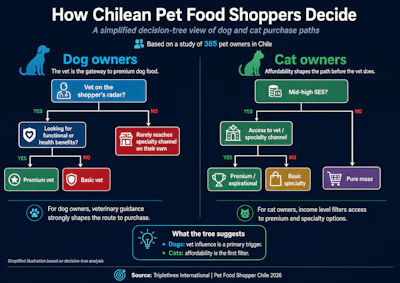
Decision tree analysis reveals that Chilean dog and cat owners follow different paths to purchasing pet food, with veterinary recommendations driving premium dog food sales while cat owners require multiple entry points including price, treats, and direct brand communication.
- Dog owners in Chile are highly influenced by veterinary recommendations, which legitimize premium nutrition and drive higher-value purchases.
- Cat owners follow a more complex decision path based on socioeconomic status, category participation, and treat purchasing behavior.
- Treats serve as an entry point for cat owners into specialized products and greater engagement with functional benefits.
- Chilean cat owners can develop nutritional involvement without veterinary guidance, creating opportunities for direct brand communication through digital and in-store channels.
- Effective pet food strategies in Chile require multiple premiumization approaches rather than a single universal shopper funnel.
Retailers usually know what shoppers buy. The harder question is why one shopper chooses a functional formula, another follows a veterinarian's recommendation and another remains within the lowest available price tier.
According to research by Triplethree International, these decisions do not follow a single path in Chile. Dog and cat owners respond to different combinations of professional advice, nutritional interest, purchasing power and category involvement.
What a decision tree reveals
In retail analytics, a decision tree divides shoppers into groups according to the variables that best explain a behavior. Each branch represents a condition, such as socioeconomic status, interest in functional nutrition or reliance on veterinary advice.
Unlike a simple ranking of purchase drivers, it shows how factors interact. Price may matter, but its effect changes depending on the pet species, the shopper's income and whether nutritional quality is already a priority.
The veterinarian opens the door for dog food
For dog owners, the veterinarian is a major entry point into higher-value nutrition. Shoppers who include veterinary recommendation among their purchase criteria are highly likely to follow professional advice.
Preference for recognized brands, interest in functional products and attention to nutritional ingredients strengthen this route. Premium dog food is therefore not sold only through product claims. It is often legitimized through professional endorsement.
Cat owners follow a different route
Cat owners follow a more complex path to purchase. Socioeconomic status and category participation play a stronger role in determining whether the shopper becomes veterinarian-driven.
Middle- and higher-income cat owners who purchase treats are more likely to enter the specialized channel. Lower-income owners who do not buy treats are more likely to decide through price, routine or personal experience.
Treats may therefore serve as an entry point into greater engagement with specialized products, functional benefits and professional recommendations.
Nutritional involvement can develop without a veterinarian
For both dog and cat owners, quality, functional benefits and veterinary recommendation are strong indicators of nutritional involvement.
However, Chilean cat owners may also become highly involved without depending on veterinary guidance, particularly when quality and functionality are already central to their choices. This creates space for direct brand communication through digital media, packaging and in-store education.
There is no universal shopper funnel
Manufacturers and retailers should not approach Chile with a single premiumization strategy. Dog food should emphasize veterinary endorsement and nutritional credibility. Cat food requires multiple access points, including affordable trial formats, treats, functional claims and direct consumer education.
Competitive advantage will come from identifying which branch of the decision tree the shopper is already following.
Iván Franco is the founder of Triplethree International and has collaborated on hundreds of research projects for several consumer goods industries.