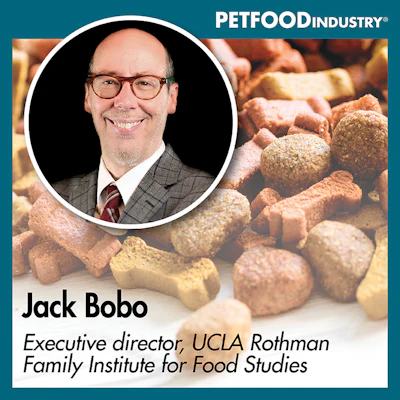
Declining birth rates, a world that needs better food rather than more of it, and consumers who care more about food than ever while knowing less about how it’s made are changing how people eat. According to Jack Bobo, they will also change what goes into the pet bowl, though not always the same way.
On the latest episode of Trending: Pet Food, Bobo, a food futurist and executive director of the UCLA Rothman Family Institute for Food Studies, explains why premiumization isn’t a passing trend, why pet food protein will have to come from a wider mix of sources, and why sustainability works better as a resilience strategy than as a selling point at the shelf. He also covers why sharing the science often fails to win over skeptical consumers, and how pet food brands can build trust before they need it.
Bobo will give the keynote address at Petfood Forum 2027, April 26-28 in Kansas City.
We would like to thank Scoular for sponsoring this podcast. Scoular is the all-in-one partner for pet food ingredients, helping brands create wellness-focused products that support digestion, immunity, mobility, heart health and more.
Learn how Scoular is shaping the future of pet nutrition at scoular.com/pet.
Jackie Roembke, editor-in-chief, Petfood Industry: Hello, and welcome to Trending: Pet Food, the industry podcast where we cover the latest hot topics and trends in pet food. I’m Jackie Roembke, editor-in-chief of Petfood Industry and the new host of Trending: Pet Food. I’m taking over for Lindsay Beaton, who left to start Beaton Path Communications, a consultancy focused on the pet industry. We’re grateful for what Lindsay built here, and we wish her the absolute best.
Today we are joined by Jack Bobo, food futurist and the executive director of the UCLA Rothman Family Institute for Food Studies. He’s here to examine why the forces reshaping human food will play out differently in the pet bowl.
But before we cut to the conversation, here's what you need to know:
In his current position at UCLA, Jack leads research on how narrative shapes public trust, policy and the adoption of new innovations. His career spans more than two decades at the intersection of global food policy and behavioral science, including leadership roles at the U.S. Department of State, The Nature Conservancy, and as CEO of Futurity, a foresight company. He has advised governments, corporations and civil society organizations across more than 50 countries on how trust is built, lost and rebuilt in contested food systems. Jack is the author of Why Smart People Make Bad Food Choices, and he has delivered more than 1,000 talks worldwide on the future of food.
On this note, Jack will give the keynote address at Petfood Forum 2027.
Welcome, Jack. Thanks for being on the podcast.
Jack Bobo, executive director, UCLA Rothman Family Institute for Food Studies: It's a pleasure to be here.
Roembke: Let’s start at the beginning. You’ve spent your career where policy, science and public opinion meet. What first pulled you into thinking about the future of food?
Bobo: I think it really started when I was at the U.S. Department of State, and I spent a few years covering African food policy, then Asian food policy, and Europe. But the last few years, my only job was really giving speeches -- and so I had an unlimited travel budget. I could travel anywhere in the world and just talk about the future of food, the role of science, and how do we better communicate and engage with the public. It was a great opportunity to learn by visiting companies and universities and governments, and seeing what was going on around the world, and then to sort of think deeply about what the implications of all that were.
Later, I worked in industry and started a consulting firm, Futurity, where I worked with food tech startups, big food brands, and continued to work with governments to try to understand why do people do what they do, and believe what they believe -- and when do people change their minds? And so I was working with organizations trying to really understand global demographic trends and the forces that are shaping the future of food.
Roembke: You’ve studied the human food system for decades. When you look at pet food from the outside, where does it fit in that system? And what makes it different?
Bobo: Well, it is different in a few ways, and there's sort of the history of pet food and then maybe where it's going in the future. I think in some ways, traditionally, pet food has kind of run on things that human food didn't want or need, and so it was, in a sense, making the food system more circular.
I think today it's changing how people relate to their pets, and because of that, how they relate to pet food. In many ways, I think its place in the food system has become more and more prominent over time because people care more and more about the quality of food that goes to their pets.
Roembke: Now that shift toward caring about pet food quality is often credited to ‘humanization,’ the idea that pets are now family. Is humanization the right lens, or is something deeper driving how much people invest in their pets?
Bobo: Well, certainly people invest a lot. You know, people will cut back on meals themselves before they will cut back on what they feed their pets. They care very deeply for them. I think in some ways, there is this feeling that many people talk about their fur babies and things like that, but I think a lot of it is just that in society today, as families have become smaller and people have more and more single-family households, we crave that feeling of belonging, and we desire the ability to be caregivers, and that's becoming harder in the human world.
It may not necessarily be humanizing in the sense that we think of them just like people, but that we do care deeply about them, and we want to be able to take care of somebody, and we feel like they are taking care of us. It's a very social role, very much part of the family. Whether we think of it exactly as humanizing or not, one thing that does suggest that is that trend, as I said, from pet food being more of the food that people don't eat to being more and more seen as, you know, food.
Roembke: You mentioned smaller families. We saw a surge in pet ownership during COVID, and birth rates keep falling in many countries. Does that mean pet populations keep growing, or do long-term demographics eventually set a ceiling?
Bobo: I think it's going to do two things at the same time. On one hand, we have people having fewer children, or no children at all, and that certainly drives interest in having more pets. But we also have changing demographics around the world. And so, as we look out 75 years -- which I know is a very long time -- what we find is that by the end of the century, global populations are probably declining in most parts of the world.
Just to give you one example, the population of China in 2100 is 50% of where it is today. China today, though, is one of the fastest-growing places for pet ownership. In fact, I think urban pet populations passed the number of children in 2024, or the number of children under age four in 2024.
While it's growing really fast in China, because of declining birth rates you're going to hit a ceiling. A lot of people are older, and so they may not have children, and so you have these different trends. If you look at some high-income countries, they're probably not going to have more pets, but they are going to spend more on those pets because they're part of the family.
Some places could level off and decline while other parts of the world are going to grow quickly, but then these demographic trends are going to come into effect in all of these different places, whether it's Asia or Latin America and eventually Africa as well.
Roembke: Premiumization has been one of the defining stories in pet food for years. With inflation and tighter household budgets, is it a lasting shift or could it reverse when consumers feel squeezed?
Bobo: I don't think that it's going to shift in terms of long-term trends. Premiumization is not -- it's not a trend or a fad. I think that in every country in the world, as incomes rise, they want more and more premium products.
As a general trend, every place in the world is going to want better products over time, but the demographic trends that I pointed to are also going to be a huge driver of this. As population levels begin to decline, in a sense, the world doesn't need more food, so companies can't make more money by producing more stuff. And so in a world of adequate supply or even abundance, people are not looking for more because we can only eat so much. We're looking for better.
I would say the future will reward quality; it will not reward quantity. That's going to take place in the human food world as well as the pet food world. I think one could be incredibly confident that premiumization is going to continue, not just as a trend, but because global demographic forces will drive us in that direction.
Roembke: Quality over quantity. That’s a theme our listeners will recognize -- especially when it comes to protein. Protein is having a moment in human nutrition, and it’s always been central to pet food. As global protein demand grows, can conventional animal agriculture keep up, or will pet food have to draw on new sources?
Bobo: I think we're going to need a variety of sources for that pet food protein. If you think about agriculture today, 40% of all the land on Earth is currently devoted to agriculture, 70% of fresh water is going to agriculture, and 10 or 15% of greenhouse gases come from deforestation -- 80% of which is caused by agriculture. That's almost a third of emissions -- so the current footprint of agriculture is quite big.
Now, that doesn't mean we're not doing wildly better in terms of efficiency. If we were farming today with 1960s technology, we would need one billion additional hectares of land. So that's just a measure of how amazingly good agriculture is. But it is hard to imagine that we're going to expand agriculture by 25 or 50% to meet that future protein need through livestock alone.
I think that's going to drive a variety of changes in protein, both for human food and as a second-order impact through pet food as well. I would expect that we'll continue to see much of what we do today, but some of the new protein demand will begin to be met through some of these alternative sources.
And, you know, that could be through more plant protein; it could be through some of these cultivated meat and other things. But I wouldn't see this as a threat to traditional agriculture. I would see this as helping us to meet our future demand while reducing that impact on the planet because obviously we don't want to cut down half our forests to make way for livestock production so that we can meet our human and pet needs. We want to do it in a better way, not just more of it.
Roembke: Better, not just more. Let’s talk about sustainability. A lot of pet food brands are investing in sustainability claims. But at the shelf, does sustainability actually drive what pet owners buy?
Bobo: I get that question a lot on the human food side too. My provocative response is, "Most people won't change what they eat to save their lives. Why do we think they'll change what they eat to save the planet?"
Now, that doesn't mean sustainability isn't incredibly important, but I don't think we should expect consumer demand to drive it in particular. And in a sense, I think it's actually tougher for the pet food space because if somebody's sitting there in the grocery store aisle and they have the choice between two products, and one has a sustainability claim, but it's not as nutritious as the other, I think most people are going to choose the health of their pet over the health of the planet.
If the products are equal, now that suddenly makes it, in a sense, an easy choice because people do want a better planet for themselves, for their families, for their pets. But I think we need to understand where some of those drivers are. They're going to be government regulation, they're going to be supply chain partners, they're going to be Scope 3 emissions expectations. We're going to have to deliver those things. What I would say is that we're probably thinking about sustainability wrong in a sense, that for most businesses, they think of sustainability as a cost, and when times are tough, the first thing you cut are your costs. I think we should be thinking about it in terms of resilience. Resilience is like insurance: When times are tough -- when there's a flood, when there's a drought -- you're glad you have insurance. I think part of it is just thinking about the system differently. Another point would be that when we think about efficiency, which has helped us to increase revenue for decades, if not forever, the thing is that we live in a destabilized world today, where we have geopolitics and climate risk and supply chain risk and all those things -- and that same efficiency in a destabilized world can lead to fragility, and, in a sense, resilience leads to stability.
I think we're going to see a bit of a shift in how people think about the food system from where it was in the past, which has worked well, to where it needs to be in the future because things have changed so dramatically. I think if we begin to think of sustainability in terms of more resilient systems -- more resilient supply chains, and all those things -- that we'll begin to see the value of it for the company, rather than as a premium to get for the consumer. It's a value we bring to the business.
Roembke: Great point, Jack. Earlier you mentioned alternatives like plant-based and cultivated proteins, and those ingredients often get skepticism, as does processing generally. Your work focuses on how trust is built and lost. Why is trust so hard to earn in food, and how can companies get ahead of it?
Bobo: Yes. I often say people love innovation almost as much as they despise change, and there's no place they despise change more than in the food they eat or the food they feed to their pets because food is what brings us together with family, with friends, with our pets. And if people mess with our food, you're messing with our family, and people don't like that.
Things have changed dramatically over the last 50 years, and so sometimes we love innovation in our lives and then we resist change in our lives -- and that's sort of a subtle difference. Sometimes people are asking tough questions about what's in their food, but they're not really asking tough questions about what's in their smartphone. There are a lot of chemicals that go into producing a device.
I think we ask tough questions when we don't have trust, and we don't ask questions when we have it, and that's part of what makes it really difficult to build trust in a contested environment because the nature of the questions means they're probably not going to trust our answers. And so, you know, you can't fill a trust gap with data, and we need to build that trust before we have those questions. I think the pet food sector probably has tremendous trust in the public because these products are so important. But they also need to be thinking about, well, what will the food system and the pet food system need to look like in 25 years in order for us to deliver sustainable, nutritious food? And how do we ensure that we have that trust from the public when we need it?
Trust isn't something you build in the moment. Trust is something you build over decades, and innovation moves at the speed of trust. It doesn't matter if companies have innovative new products if nobody wants them. I would say think about what it means to offer this product. Sometimes that means not offering it as an innovation at all and just talking about it in terms of an extension of what we do every day.
An example might be a company like Tyson Foods. If it was offering a plant-based product, that might strike people as very odd. Why is Tyson doing it? But if they said, "You know, here's our new plant-based burger from a company with 100 years of experience of bringing safe, nutritious protein to your family," that makes perfect sense. So how we think about it completely changes how we feel about it.
Roembke: You said you can’t fill a trust gap with data. That cuts against the usual advice, which is to be transparent and share the science. So when a brand does all that and consumers are still skeptical, what’s going wrong?
Bobo: I spent a lot of my career thinking about that as well. And that's part of what led me down the rabbit hole of behavioral science. When I was in government, I kept encountering the fact that science at the beginning of conversations often polarized the audience. Those who agreed with me agreed with me more, but those who disagreed often became more entrenched in their views. That sent me back to start reading about cognitive psychology and behavioral science and marketing and advertising. Some of this is that feeling of the sense of change that makes us nervous. People have never cared more, nor known less, about how their food is produced, and because they care so passionately, they're asking things of food companies. But because they're so separated from the food system and food production, what they ask for might not deliver what they want.
I'll give you an example of how we've been trying to help with this communication at UCLA. When many companies are trying to explain innovation, they will talk about, "Well, here's a problem, and here's our solution." And the public knows when you're like, "Oh, problem and solution, you're probably trying to convince me of something." And it makes them skeptical.
Think about risk communication: You try to tell people about the thing you care about, and it could be preservatives in the food, it could be gene editing, it could be anything. And the more you talk about it, the more worried the public gets because they just don't know anything about it. Additives in the food, binders, emulsifiers -- all those things that they don't know. The first rule of holes is when you're in one, stop digging. But risk communication is about putting them in the hole and then trying to dig them out of the hole. And if you're wildly successful, you end up where you started, and we're never wildly successful. So one of the things we're developing is what we call a contextual framework for risk communication. And the first is a historical context. If people understood the history of something, they would think about it differently. We worry about preservatives in our food because we've forgotten that 100 years ago, our food would kill us, and that brands, in a sense, arose as a promise not to kill the consumer. Things have changed dramatically.
And then, the second is sort of the global or challenge context. What's the big picture thing the public cares about, not the thing I care about, so that my thing is a tiny piece of their thing.
The third is the future context: what's the world we're trying to create that the public wants?
The order matters because if I talk to you about the problems you care about and the future you want, hopefully you ask, "Yes, but how do we get there?" Well, now we're in a conversation about innovation that the public is asking for instead of trying to sell them a solution that they don't really know that they need.
And so that's where narrative frameworks come in to help guide a conversation.
Roembke: That framework of historical, global and future context is really useful. Looking ahead, what’s the one mindset shift pet food leaders need to make over the next decade?
Bobo: Instead of trying to explain to people the risks, de-risk the future in a sense. When we talk about the problems we face and how we solve them, that's strategic planning. Whereas in strategic foresight, we're asking the question, where do we want to go? And the things you do tomorrow to get to your best future are fundamentally different than the things we do tomorrow to prepare for the worst. The message I would leave them with is that they need to stop asking people to sacrifice for the future, and they need to invite them to embrace the future because I think it can be an amazing future, and people want to be inspired.
Roembke: Where can people find more information about you and your work, Jack?
Bobo: Well, I can be found at UCLA or they can catch me on LinkedIn, and I invite anybody to reach out to me. Love to continue this conversation offline.
Roembke: If you would like to hear more from Jack and his take on the future of pet food, join us at Petfood Forum 2027, held on April 26-28 in Kansas City. For more information about Petfood Forum and to register for the event, please visit petfoodforumevents.com.
This episode of Trending: Pet Food was sponsored by Scoular, delivering the ingredient access, quality and partnership pet food companies rely on to stay ahead of industry trends.
You can find more Trending: Pet Food podcasts at petfoodindustry.com, on SoundCloud or on your favorite podcast platform.
Once again, I'm Jackie Roembke, editor-in-chief of Petfood Industry magazine.
Thanks for tuning in!